My daughter-in-law changed the alarm code on my Florida beach house and told me, ‘You can visit after we approve it.’ She forgot I had paid the mortgage, the taxes, the insurance, and the lawyer who wrote the ownership papers. I smiled, slept that night at a motel off Highway 98, and made one phone call at 7 a.m. By lunch, her bags were on the porch—and the sheriff was explaining why the house had never been hers to control.

The beach house was never meant to become a battlefield.
It was supposed to be the safest place left in my life.
Not extravagant.
Not luxurious in the way magazines describe luxury.
It was simply a small Florida beach house with weathered white siding, faded blue shutters, and a screened porch that always smelled faintly of salt air, sunscreen, and old wood warmed by the sun.
Sand found its way into every corner no matter how often I swept.
The porch screen rattled during storms.
The kitchen faucet dripped unless you turned it exactly the right way.
Harold used to joke that the house had more personality than most people.
And maybe it did.
Because after my husband died, that house became the last place in the world where grief softened enough for me to breathe.
Every room still carried pieces of him.
The outdoor shower where he rinsed fishing rods after sunrise trips.
The coffee mugs stacked unevenly because he never cared about matching sets.
The faded baseball cap hanging near the back door.
The old western novels he pretended not to reread every summer.
Sometimes I would sit on the porch before dawn with coffee in my hands and almost hear him humming softly in the kitchen.
That house was not property to me.
It was memory made physical.
It was decades of sacrifice.
Harold and I did not inherit wealth.
We built stability slowly and painfully.
Used cars.
Double shifts.
Canceled vacations.
Cheap Christmases.
Careful grocery lists.
Years of saying “maybe next year” while paying the mortgage one month at a time.
We bought that beach house through exhaustion.
Every floorboard had cost us something.
My name is Patricia Wells.
I am sixty-nine years old.
Widowed.
And for most of my life, I believed that if you loved your family enough, they would naturally understand where the line was.
That belief nearly cost me my home.
The trouble did not begin dramatically.
Family betrayals rarely do.
They begin quietly.
Politely.
Almost invisibly.
A mug moved without asking.
A drawer reorganized.
A guest becoming too comfortable inside spaces that do not belong to them.
After Harold passed away, I kept the beach house mostly unchanged.
Some people thought that was unhealthy.
My sister Diane once told me gently, “Patty, you can’t turn the place into a museum forever.”
But it never felt like a museum to me.
It felt alive.
The shell bowl still sat on the coffee table exactly where Harold liked it.
His photograph stood near the front window holding the giant redfish he once caught after insisting all morning that “today feels lucky.”
The house comforted me because nothing inside it demanded I stop loving him simply because he was gone.
Then Marcus called.
My son.
My only child.
“Mom,” he said carefully one afternoon, “Lauren and I are in kind of a difficult situation.”
Immediately, I heard tension in his voice.
Marcus had inherited Harold’s charm and my tendency to avoid conflict. At forty-two, he still rubbed the back of his neck whenever he felt cornered emotionally.
His wife Lauren was different.
Polished.
Smooth.
Beautiful in that expensive effortless way some women cultivate intentionally.
Every sentence she spoke somehow sounded finalized before anyone else had agreed to it.
Marcus explained that their condo in Destin had suffered water damage after a burst pipe upstairs.
Repairs would take “a few weeks.”
“Could we stay at the beach house temporarily?” he asked. “Just until everything gets sorted out.”
A few weeks.
That phrase would later replay in my mind endlessly.
At the time, though, I felt relieved.
The house had become too quiet lately.
Maybe family would make it feel alive again.
“Of course,” I answered immediately.
Marcus sounded genuinely grateful.
“You saved us, Mom.”
That was my mistake.
Mothers continue believing old versions of their children long after reality changes.
At first, everything seemed fine.
Lauren sent me sunset photos from the porch.
Marcus fixed the outdoor shower latch.
I brought groceries during weekend visits and watched them settle into the house with what appeared to be appreciation.
Then small things began disappearing.
The shell bowl moved from the coffee table to a lower shelf.
Harold’s western novels vanished into storage boxes.
The framed photo of him near the window suddenly appeared in the guest bedroom.
When I asked about it, Lauren smiled brightly.
“It looked less cluttered this way.”
Cluttered.
That word bothered me more than I admitted.
Still, I told myself not to become one of those difficult older women who treat every adjustment like an attack.
People rearrange things.
Young couples decorate differently.
Then Lauren started referring to the property as “our beach house.”
Not accidentally.
Repeatedly.
“Our porch gets the best sunset.”
“We’re finally settling into our beach house.”
“You should visit us at our beach place sometime.”
The first time I corrected her gently.
“My beach house,” I said with a small smile.
Lauren laughed as though I had made a charming little joke.
Marcus overheard us.
“Mom,” he sighed, “don’t make it weird. Lauren just loves the place.”
That sentence should have alarmed me immediately.
Instead, I swallowed my discomfort because widowed mothers become experts at minimizing themselves to preserve peace.
By September, Lauren had replaced the bedroom curtains without asking.
The original blue cotton curtains had faded beautifully over years of salt air and sunlight. Harold chose them himself because he said they looked “coastal without looking rich.”
Lauren installed stiff white designer panels instead.
“They looked dated,” she explained.
I stood there silently holding the folded blue curtains against my chest.
“They were mine,” I answered quietly.
Lauren smiled again.
“Of course. I saved them for you.”
For me.
As if I were merely a visitor collecting old belongings from a house no longer fully mine.
Marcus became increasingly useless during those months.
Whenever tension surfaced, he developed this exhausted expression that silently begged me not to force him into choosing sides.
But refusing to choose is still a choice.
That became painfully clear in October when my neighbor Ruth called me unexpectedly.
Ruth had lived three houses down from us for nearly twenty years.
She was the kind of retired nurse who noticed everything while pretending not to gossip.
“Patty,” she said carefully, “I’m only calling because I’d want someone to tell me.”
Immediately my stomach tightened.
“Tell me what?”
“There was a party at your beach house last night.”
I froze.
“A party?”
“Lots of people. Cars everywhere. Music late. And Lauren mentioned something about ‘luxury rentals’ next season.”
Something inside me went cold.
Not because of the party itself.
Because suddenly I understood what had been happening all along.
This was no longer temporary shelter.
Lauren was settling in.
Claiming territory slowly.
Publicly.
Strategically.
I remembered the day Harold and I first walked through that house decades earlier.
The porch screen had holes.
The linoleum curled near the refrigerator.
The air conditioner sounded broken.
But Harold stood by the back window overlooking the dunes and whispered:
“Patty… this is where we’ll grow old together.”
We never got that chance.
He died suddenly at sixty-eight beside our Tallahassee driveway while watering the lawn.
One moment alive.
One moment gone.
Afterward, the beach house became sacred because it still contained echoes of our unfinished future.
Lauren saw it as aesthetic potential.
That realization changed something inside me permanently.
I called Marcus immediately.
“There was a party?” I asked.
He sighed heavily.
“Mom, it wasn’t a party. Just some friends.”
“Lauren mentioned rentals.”
Silence.
Then Lauren’s voice entered through speakerphone.
“Patricia, honestly, we didn’t think we needed permission every time we had guests.”
Guests.
That word almost made me laugh.
“You’re staying there because I allowed it,” I answered calmly. “That house is not a business opportunity.”
“No one said it was,” Marcus replied too quickly.
But now I knew better.
By Thanksgiving, the shift became undeniable.
Marcus and Lauren still had not returned to their condo despite repairs being supposedly “almost finished” for weeks.
Every explanation changed.
Insurance delays.
Mold concerns.
Furniture delivery problems.
Excuses multiplied because they no longer intended to leave.
Then Lauren announced she would be “hosting Thanksgiving” at my beach house.
Hosting.
Not asking.
Not suggesting.
Declaring.
I arrived carrying pies and Harold’s old carving knife.
Inside, the entire house looked wrong.
Neutral-colored decorations replaced personal items.
The shell bowl had vanished completely.
Lauren’s mother complimented her “beautiful updates.”
Then I noticed the fake lemons.
Bright decorative fake lemons arranged carefully in a glossy ceramic tray where Harold’s shell collection once sat.
I heard myself ask quietly:
“Where are the shells?”
Lauren answered casually without even turning around.
“Oh, I packed them away. They didn’t match.”
Didn’t match.
That sentence followed me into the laundry room later when I discovered Harold’s shell bowl wrapped inside towels beside detergent bottles.
Two shells were cracked.
I sat on the washing machine crying silently while dinner laughter echoed from the dining room.
That was the moment I finally understood something terrible:
Lauren wasn’t simply redecorating.
She was erasing evidence that another woman’s marriage had existed there before her.
After Thanksgiving, I demanded a move-out date.
Marcus said, “After New Year’s.”
Lauren said, “We’ll revisit it.”
Revisit it.
As though my ownership required committee approval.
That was when I contacted attorney Rebecca Marsh.
Rebecca had handled Harold’s estate years earlier.
Practical.
Sharp.
Impossible to manipulate emotionally.
When I explained everything, she listened carefully before opening the old leather folder Harold once labeled:
BEACH HOUSE — DO NOT LOSE
Inside sat the deed, tax records, insurance documents, and one extremely important signed agreement Harold insisted Marcus complete years earlier after college.
At the time, we laughed about Harold being overly cautious.
Now that paper saved me.
The document clearly stated:
Any family member permitted temporary use of the property remained a guest only. No occupancy, decoration, maintenance, storage of belongings, hosting activities, or verbal claims could establish ownership, tenancy, or residency rights.
Marcus had signed it himself years earlier.
Rebecca looked at me over her glasses.
“Your husband anticipated this possibility.”
I nearly cried hearing that.
By December, I dreaded calls from my own son.
Lauren no longer asked before making changes.
She ordered expensive porch furniture.
Stored Harold’s rocking chairs in the garage.
Discussed “future renovations” openly.
And Marcus kept defending her with phrases like:
“You’re emotional about the house.”
Emotional.
The favorite word people use when they want boundaries to sound irrational.
Then came the social media post.
My sister Diane sent me the screenshot with one horrified text:
PLEASE tell me she asked permission.
The photo showed my screened porch glowing beautifully at sunset.
Wine glasses.
Designer candles.
Fancy napkins.
And beneath it, Lauren wrote:
“First Christmas in our beach home. New traditions begin where old energy ends.”
Old energy.
My husband reduced to “old energy.”
I stared at those words until my hands shook.
That Thursday, I drove down to the coast unexpectedly carrying groceries and an overnight bag.
When I reached the front door, I entered the alarm code.
Red light.
I tried again.
Red light.
Then Lauren opened the door wearing my white linen shirt over her swimsuit.
My shirt.
Not borrowed.
Taken.
“Oh,” she said casually. “We changed the code.”
Behind her, my living room looked unfamiliar.
Her candles.
Her photos.
Her decorations.
Harold’s picture gone.
I stood there holding grocery bags like a stranger delivering supplies.
“Why would you change the code to my house?” I asked.
Lauren smiled calmly.
“We just need boundaries, Patricia. You can visit after we approve it.”
Something inside me ended permanently in that moment.
Not my love for Marcus.
My willingness to tolerate disrespect disguised as politeness.
Then Marcus appeared behind her.
He saw me.
The groceries.
The alarm panel.
And he looked away.
That hurt more than anything Lauren said.
Because he knew exactly what was happening.
I could have screamed.
Instead, I calmly placed the grocery bags down on the porch.
“Alright,” I said softly. “Enjoy the evening.”
Then I left.
Not because I surrendered.
Because Harold taught me something years earlier:
“Never argue with people who think volume creates ownership. Let paperwork speak when emotions get stupid.”
I drove to a cheap roadside motel instead.
Thin towels.
Flickering sign.
Air conditioner rattling endlessly.
There, alone on the edge of the motel bed, I finally let my hands shake.
Not from helplessness.
From realizing how close I came to allowing them to rewrite reality around me.
I opened Harold’s folder.
Read Marcus’s signed agreement again.
Then called Rebecca.
The next morning everything changed.
I reset the alarm legally through the security company.
Contacted insurance.
Requested sheriff supervision.
Prepared legal termination notices.
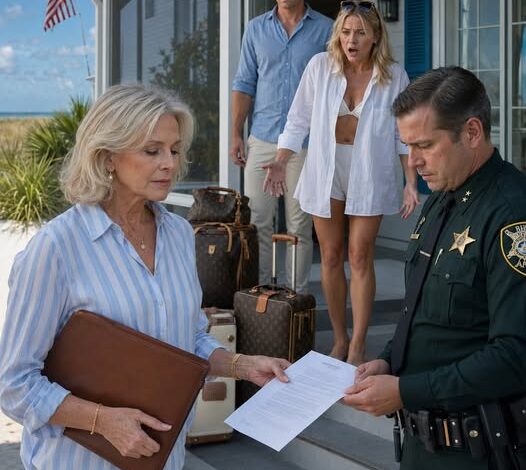
By 10:30 a.m., I returned to my own property accompanied by Deputy Calhoun.
This time, my new alarm code flashed green.
Lauren opened the door barefoot and furious.
Marcus stood behind her holding Harold’s coffee mug.
My husband’s mug.
“This is Deputy Calhoun,” I announced calmly. “He’s here while I revoke your permission to remain in my home.”
Lauren laughed nervously.
“You can’t be serious.”
“I am.”
What followed felt surreal.
Legal documents.
Excuses.
Tension.
Then the truth finally surfaced.
Marcus admitted Lauren convinced him that extended occupancy and “improvements” could help establish legal claims later.
She had receipts.
Photos.
Documentation.
This was never innocent.
Lauren wasn’t redecorating.
She was constructing ownership slowly enough that everyone would feel uncomfortable challenging her publicly.
But Harold anticipated exactly that possibility years earlier.
The signed agreement destroyed her strategy instantly.
When Lauren realized she had lost, the confidence drained from her face completely.
Not dramatically.
Quietly.
That’s how entitlement usually collapses.
Silently.
They packed their belongings under sheriff supervision.
Lauren moved angrily.
Marcus looked shattered.
Before leaving, he finally whispered:
“I’m sorry.”
I answered honestly.
“I believe you’re sorry this ended badly. But fair would have been defending me before legal paperwork became necessary.”
That silence afterward said more than arguments ever could.
When they finally drove away, the house exhaled.
I spent the entire afternoon undoing Lauren carefully.
Replacing Harold’s curtains.
Restoring photographs.
Returning the shell bowl to the coffee table.
Not angrily.
Lovingly.
By sunset, the house felt wounded but alive again.
Later, Marcus and Lauren separated.
Counseling followed.
Apologies followed.
Slow rebuilding followed.
Not because family magically heals overnight.
Because boundaries finally forced truth into the open.
Months later, Marcus returned alone carrying flowers and asking permission before entering.
That mattered deeply to me.
Because healing begins when entitlement ends.
Eventually we rebuilt something honest between us.
Fragile.
Careful.
Real.
And one evening while sitting on Harold’s porch watching rain move across the ocean, I finally understood the most important lesson hidden inside everything that happened:
Peaceful women are often mistaken for weak women.
People like Lauren rely on that misunderstanding.
They think kindness means surrender.
Grief means confusion.
Politeness means permission.
But women my age have survived too much to collapse quietly.
We have buried husbands.
Raised families.
Worked impossible years.
Balanced bills during hard seasons.
Signed painful paperwork with shaking hands and kept moving anyway.
We may speak softly.
We may even spend one difficult night in a cheap motel crying quietly beside a flickering lamp.
But that does not mean we have surrendered.
Sometimes it simply means we are finished arguing.
And by morning…
the paperwork is ready.