My DIL Told My Grandson to Stop Calling Me Grandma – Then During His School Play, He Slipped a Note Into My Hand That Said, ‘Please Don’t Let Mommy See This’

Grief changes shape over time.
At first, it arrives violently.
Phones ring.
People cry in hallways.
Flowers appear on porches.
Casseroles stack untouched inside refrigerators while relatives speak softly as though volume itself could injure the grieving further.
Then eventually the crowds disappear.
And what remains afterward is something quieter and, in many ways, harder:
the long slow ache of continuing life without someone who once occupied it completely.
Margaret learned that the winter her son died.
Daniel was only thirty-two.
Old enough to have become solid in the world.
Young enough that everyone still spoke about his future more naturally than his past.
He left behind a wife named Rachel,
a seven-year-old son named Noah,
and a mother who still expected to hear him walking through the back door every evening.
That detail haunted Margaret most.
Not dramatic memories.
Not hospital rooms.
The back door.
Daniel never used the front entrance when he visited. He’d shoulder his way into the kitchen carrying groceries or fast food bags while calling for leftovers before his shoes were even off.
Then Noah would come flying in behind him like a second heartbeat.
After Daniel died, the back door stayed closed.
And suddenly silence became unbearable.
People describe silence romantically sometimes, as though it represents peace or healing. But certain silences feel alive in terrible ways.
They sit beside you at dinner.
Follow you through grocery stores.
Wait at the foot of your bed at night reminding you exactly who is missing.
For Margaret, Noah became the only place where Daniel still visibly existed.
He had Daniel’s eyes.
Daniel’s crooked smile.
Even Daniel’s habit of frowning hard when trying not to cry.
Children often carry grief physically through resemblance. Every familiar gesture becomes both comfort and wound simultaneously.
In those first months after the funeral, Rachel still allowed Margaret close.
She folded laundry.
Picked Noah up from school.
Cooked casseroles nobody really ate.
And Noah still ran toward her then.
“Grandma!”
That word mattered more than anyone realized at the time.
Because names inside families are not merely labels.
They are emotional permission.
Belonging.
History.
Margaret answered every time exactly the same way:
“There’s my brave little boy.”
Daniel used to say that to Noah constantly.
After shots.
After nightmares.
After fevers.
After hard days.
Brave little boy.
One afternoon Noah asked quietly from the back seat of Margaret’s car:
“Was Daddy really brave?”
Margaret understood instinctively what he was actually asking.
Children do not only grieve absence.
They fear forgetting.
At seven years old, Noah already sensed something terrifying:
if stories stop,
if names disappear,
if adults stop speaking about someone,
does that person slowly vanish completely?
So Margaret answered carefully.
“Being brave means you keep loving even when you’re scared.”
Noah nodded solemnly like he was storing the sentence somewhere safe inside himself.
That image becomes heartbreaking later because eventually the adults around him begin trying to remove exactly those memories from his life.
Not maliciously at first.
Fearfully.
That distinction matters.
Rachel was drowning too.
Widowhood with a child creates a very specific exhaustion:
practical,
financial,
emotional,
constant.
Every routine suddenly requires one fewer adult and twice the emotional energy.
Noah cried at night asking about Daniel.
Rachel couldn’t answer without crying herself.
Then neither of them slept.
Grief often spreads this way through families:
everyone hurting each other accidentally simply because pain leaves people emotionally depleted.
Then spring arrived.
And with it came Brent.
At first, his presence looked harmless enough:
overnight bags,
extra shoes by the door,
easy confidence filling spaces where sorrow used to sit.
But slowly something shifted emotionally inside the house.
The first warning came when Noah ran instinctively toward Margaret shouting “Grandma!” only to stop abruptly because Rachel interrupted him.
“We talked about this.”
The room changed immediately.
Noah stared at the floor.
Brent stood nearby watching casually.
And suddenly a relationship that had always felt natural became treated like a problem needing correction.
“You need to stop calling her that,” Rachel said.
That moment reveals something psychologically important:
control over language often becomes control over memory itself.
If Margaret stops being “Grandma,” then Daniel’s side of Noah’s identity weakens subtly too.
The request sounded small on the surface.
But emotionally, it was enormous.
Margaret answered the only way she could:
“I am his grandmother.”
Rachel crossed her arms defensively and explained that Brent was trying to build “something stable.”
That word appears repeatedly in families experiencing grief transitions:
stable.
Adults often pursue emotional stability so desperately after loss that they begin treating grief itself as dangerous instead of necessary.
Brent encouraged exactly that idea.
According to him, Noah did better when adults stopped “making everything so heavy.”
But Daniel was not heaviness.
He was Noah’s father.
That distinction became the emotional center of the conflict.
Brent interpreted ongoing grief as an obstacle to rebuilding.
Margaret understood grief as proof love still existed.
Both approaches emerged from fundamentally different beliefs about healing.
One says:
move forward by reducing pain triggers.
The other says:
move forward by carrying memory honestly.
Noah became trapped between those philosophies.
And because he was only seven, adults began making emotional decisions around him without realizing what he heard and internalized.
Visits shortened.
Doors stayed half-closed.
Conversations tightened.
Margaret still brought soup and casseroles because caregiving remained her instinctive language of love. Rachel increasingly rejected them because every visit reopened emotional wounds she was trying desperately to quiet.
Then came the social media photograph.
Brent standing behind Noah wearing matching baseball caps.
Caption:
“My boys. New beginnings.”
Margaret stared at the image feeling something colder than anger.
Replacement.
That was the fear finally taking shape.
Not that Noah would stop loving Daniel.
That eventually he would stop being allowed to.
Children adapt quickly to emotional environments. If certain topics repeatedly cause adult discomfort, children learn silence surprisingly fast.
Mrs. Alvarez, Noah’s music teacher, recognized that before anyone else did.
Teachers often notice emotional fractures families miss because children reveal themselves differently in neutral spaces.
At the grocery store, Mrs. Alvarez mentioned the upcoming school play casually, assuming Margaret already knew.
She didn’t.
That revelation alone exposed how thoroughly she had been pushed outside the family structure.
Then came the truly devastating detail.
During music class, another child mentioned Father’s Day songs. Noah asked quietly:
“Do people disappear for good if nobody says their names anymore?”
Children ask philosophical questions with terrifying directness because they have not yet learned how adults soften existential fear.
Mrs. Alvarez answered beautifully:
“Names are always allowed in a music room.”
That sentence mattered because it gave Noah something nobody else currently was:
permission.
Permission to remember.
Permission to speak.
Permission to grieve openly.
So Margaret attended the play.
And when Noah walked onto stage, he scanned the crowd anxiously until he found her sitting in the back row still wearing her coat.
Then he smiled.
Small.
Relieved.
Certain.
Children look for emotional witnesses instinctively.
Seeing Margaret there steadied him enough that his solo grew stronger halfway through. The emotional significance of that moment cannot be overstated.
Noah did not only want applause.
He wanted someone present who still understood the missing pieces of his life.
After the performance he ran directly into Margaret’s arms shouting “Grandma!” before anyone could stop him.
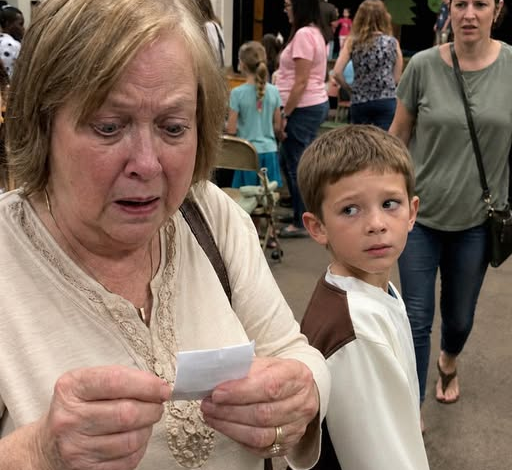
Then came the note.
Folded carefully into her palm while Rachel approached down the hallway.
Grandma, I want to come home.
On the back:
He says I can’t talk about Daddy anymore.
Margaret sat inside her car afterward shaking hard enough she could barely breathe.
The word home devastated her because she understood instantly Noah was not describing a physical location.
He meant emotional home.
The place where Daniel still existed safely.
That distinction matters enormously in grieving families.
Children need continuity of identity after loss. When surviving adults erase or suppress the deceased parent emotionally — even unintentionally — children often experience profound internal confusion:
Am I allowed to miss him?
Am I hurting Mom if I remember Dad?
Will talking about him make people upset?
Noah had already begun associating love for his father with guilt.
Margaret confronted Rachel directly that night.
At first Rachel responded defensively:
“You come in with your stories and casseroles, then I’m left awake all night with a child crying for a man I can’t bring back.”
That sentence reveals Rachel’s real exhaustion.
She wasn’t trying to erase Daniel out of cruelty.
She was trying to survive endless grief cycles she felt powerless to soothe.
Brent offered her a dangerous simplification:
if discussing Daniel causes pain,
stop discussing Daniel.
Pain avoidance often masquerades as healing advice.
But unresolved grief rarely disappears through silence.
It usually deepens underground.
Margaret finally asked the question directly:
“Who told him he can’t talk about his father anymore?”
Rachel hesitated.
Then admitted:
“Brent said structure would help.”
Structure.
Another word hiding emotional suppression behind practicality.
When Mrs. Alvarez later described overhearing Brent tell Noah that “Daddy stories were a bad habit,” everything clarified completely.
Brent was not merely uncomfortable with grief.
He was competing with memory.
That is psychologically significant because replacement dynamics sometimes emerge unconsciously in blended grieving families. New partners can feel threatened by the emotional presence of the deceased parent:
photographs,
stories,
comparisons,
ongoing attachment.
Instead of joining the child’s grief respectfully, they attempt to manage or minimize it.
But dead parents are not ex-partners.
Children do not “move on” from them emotionally.
They integrate them.
Or at least healthy grieving allows them to.
Margaret realized confrontation alone would only harden Rachel further.
So she changed strategies completely.
Instead of arguments, she mailed memories.
One page at a time.
Stories about Daniel burning pancakes every Saturday because Noah liked the crunchy edges.
Stories about singing wrong lyrics in the car.
Stories about ordinary love.
And at the bottom of every page:
Noah deserves both his future and his father.
That line became the emotional thesis of the entire conflict.
Because grieving children do not heal by abandoning the dead.
They heal by carrying them forward safely while still building new attachments.
Rachel eventually texted the question that cracked everything open:
“Did Daniel really call him ‘brave little boy’ every day?”
Margaret answered:
“Every day.”
That exchange mattered because Rachel suddenly remembered something important:
Daniel was not merely grief.
He was love too.
And once she reconnected emotionally to that truth, Brent’s influence weakened rapidly.
Three weeks later, Rachel arrived at Margaret’s house with Noah standing beside her clutching his backpack nervously.
Brent remained stiff inside the car.
Noah immediately asked:
“Can I call you Grandma again?”
Margaret answered the only possible way:
“Always.”
Then Noah ran into her arms while nobody stopped him this time.
That moment symbolized more than reconciliation.
It restored continuity.
Rachel finally admitted the mistake aloud:
“I thought moving on meant leaving things behind.”
Many grieving people believe exactly that initially.
But grief experts understand something essential:
healthy healing does not require severing bonds with the deceased.
It requires transforming them.
Daniel could remain Noah’s father while Brent still became an important adult figure.
Those roles never needed competition except through insecurity and fear.
When Brent defended himself —
“I was trying to help” —
Rachel answered with devastating clarity:
“You were trying to make Daniel disappear.”
That sentence cut to the center of everything.
And perhaps the most emotionally revealing moment of all came from Noah himself.
“Daddy stories don’t make me upset all the time.”
Children often understand emotional truth more clearly than adults projecting fears onto them.
Remembering Daniel hurt sometimes, yes.
But silence hurt more.
Because stories did not only remind Noah what he lost.
They reminded him what he still belonged to.
Inside the house that evening, Margaret read aloud the pancake story while Noah smiled and Rachel cried quietly beside him.
And when Noah finally asked:
“Can we keep talking about Daddy?”
Rachel answered yes.
That yes mattered more than anyone realized.
Because memory itself had become contested territory inside that family.
And in the end, love survived not by replacing Daniel,
not by erasing grief,
but by allowing him to remain present honestly in the stories, phrases, and ordinary moments that still shaped the people who loved him most.
Sometimes healing begins the moment a child no longer has to choose between remembering someone and being loved by the people still alive.