My Son Brought Home a One-Eyed Ginger Cat Because He Said They Matched – What We Discovered Under That Cat’s Collar Two Days Later Brought Us to Our Knees

The Tuesday light spilling through the kitchen window looked ordinary enough at first.
Soft.
Golden.
Domestic.
The kind of late-afternoon light that settles quietly across countertops and dishes and makes exhausted people believe they can survive one more day.
I stood at the sink in faded blue scrubs washing cereal bowls from breakfast because double shifts leave strange gaps in life. You stop noticing time properly. Morning and evening blur together into bills, laundry, medications, grocery lists, and survival.
Behind me, Noah sat at the kitchen table drawing superheroes.
That part hadn’t changed.
Even after surgeries.
Even after hospital rooms.
Even after learning words like “retinoblastoma” before he learned multiplication.
He still drew superheroes.
“Mom?” he asked suddenly.
I dried my hands on a dish towel and turned halfway toward him.
“Yeah, baby?”
“Do you think a pirate could be a doctor?”
The question was so serious I almost smiled.
“I think a pirate can be anything he wants.”
He hesitated before asking the real question.
“Even if he only has one eye?”
My chest tightened instantly.
The black patch sat neatly over the place where his left eye used to be. Two years had passed since the diagnosis, but grief doesn’t follow calendars neatly. Some wounds stop bleeding long before they stop aching.
Especially the invisible ones.
Noah looked down at his paper while waiting for my answer.
I crossed the kitchen immediately and crouched beside his chair.
“Especially then,” I whispered.
He nodded slowly.
But he still didn’t smile.
A minute later he asked the question every parent fears hearing from a child too young to understand cruelty fully.
“Mom?”
“Yes?”
“Am I ugly?”
I moved so fast my knee slammed against the chair leg hard enough to bruise.
“Noah, look at me.”
He did.
Those enormous brown eyes — one frightened, one hidden — searched my face carefully like he already suspected adults sometimes lie to protect children.
“You are the most beautiful thing I have ever seen,” I said.
“Even with the patch?”
“Especially with the patch.”
His lower lip trembled slightly before he looked back down at his drawing.
I turned away quickly so he wouldn’t see my eyes filling.
Because there are certain kinds of pain parents carry privately:
the pain of hearing your child question whether they deserve to be loved visibly.
That grief never fully leaves the body.
The screen door banged open twenty minutes later hard enough to rattle the wall clock.
“Mom! Come look!”
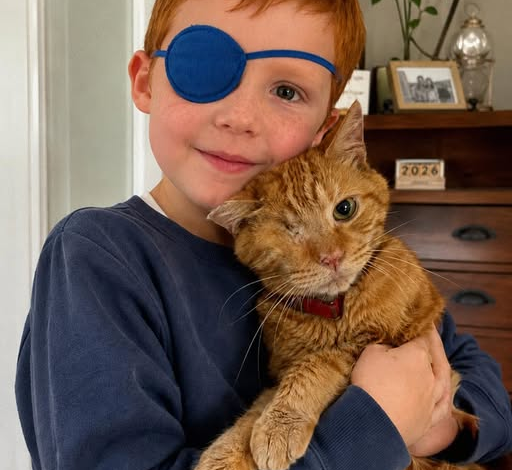
Noah stood in the doorway holding an orange cat carefully against his chest.
At first glance, the animal looked rough enough that my nurse instincts activated immediately:
matted fur,
thin frame,
one back leg hanging awkwardly,
scar tissue where the left eye should have been.
Then Noah looked down at the cat with absolute wonder and whispered:
“Mom… he’s just like me.”
Something inside me cracked quietly right there.
The cat lifted his single good eye toward me without fear.
No hissing.
No panic.
Just tired trust.
“Where did you find him?” I asked softly.
“By the mailbox.”
The cat wore an old leather collar rubbed pale with age. Someone had cared for him once. That much was obvious immediately.
“Mom,” Noah whispered again, “he needs us.”
I looked toward the stack of unpaid medical bills beside the toaster.
Children notice money far earlier than adults realize.
Noah already understood enough about hospitals and finances to ask dangerous questions like:
Can we afford this?
That knowledge alone felt unfair.
“We can help him until we find his owner,” I said carefully.
Noah smiled for the first time all day.
A real smile.
The kind that transforms his whole face and makes me briefly forget every hospital hallway we survived.
“Can we name him Captain?” he asked. “Like a superhero pirate.”
The cat blinked once slowly.
“Okay,” I whispered. “Captain.”
That night, I stood in Noah’s doorway long after bedtime watching them sleep together.
The boy with one eye.
The cat with one eye.
Curled together like two wounded things finally recognizing themselves inside another living creature.
The sight hurt in ways I couldn’t explain.
Not sadness exactly.
Recognition.
The next morning, I posted in every neighborhood group I could find:
Found orange one-eyed cat near Maple and Sixth. Injured leg. Leather collar. Please contact me if he belongs to you.
Most comments were kind.
Poor thing.
Hope he’s okay.
Try the vet clinic on Pine Street.
Then came the ugly one.
Don’t let your kid get attached just because they “match.”
I stared at the word match until my face burned.
People can be cruel so casually online. They forget real children exist behind photographs and posts.
For one furious second I almost typed:
My son survived cancer. What’s your excuse?
But Noah entered the room dragging a shoelace behind him while Captain clumsily attempted to attack it with one paw.
Noah laughed so hard he snorted.
I closed the laptop.
Some battles are not worth sacrificing peace over.
At the vet clinic the next day, Dr. Stone examined Captain carefully while Noah stood beside the table protectively.
“He’s been cared for recently,” she said after checking his teeth and old surgical scar. “Medication too.”
Noah’s face fell immediately.
“So he has a family?”
“Almost certainly.”
The room grew quiet.
I could practically feel Noah trying not to love the cat too much.
Then Dr. Stone pointed toward the collar.
“Can you remove this for me?”
I unbuckled the leather strap slowly.
A tiny folded note sat taped underneath.
My hands started shaking before I even opened it.
Inside, written carefully in blue ink:
I left Benji by your house on purpose. He didn’t find you by accident. This was my son’s last wish. Please call me. — Marian.
A phone number followed beneath.
For several seconds I couldn’t speak.
Noah looked up anxiously.
“What does it say?”
I folded the note carefully.
“It says someone loved Captain very much,” I answered softly. “And his real name is Benji.”
“Are they taking him back?”
The question nearly broke me.
“I don’t know yet.”
At home that night, the comments online had gotten worse.
Funny how the cat magically showed up at the house with the little boy in the eye patch.
People really will build a story out of anything.
I closed the laptop before rage swallowed me completely.
Noah sat cross-legged on the floor helping Captain swallow medicine hidden badly inside tuna.
“Mom,” he said quietly, “what if we’re his family now?”
I had no answer.
That night after Noah fell asleep beside Captain, I finally called the number.
A woman answered immediately.
“Hello?”
“This is Cecelia,” I said carefully. “I found your cat.”
Silence flooded the line.
Then:
“Oh thank God.”
Her relief sounded so genuine that some of my anger faltered despite myself.
But only some.
“You left an injured animal outside my house,” I said sharply. “You followed my child.”
“I know.”
“And strangers online are accusing me of using my son for attention because of this.”
“I know,” she whispered again.
That quiet guilt stopped me briefly.
Then came the sentence that changed everything.
“My son knew your son from the pediatric oncology ward.”
I stopped breathing.
“What?”
“Leo called him the pirate boy.”
Suddenly memories came rushing back in painful fragments:
Noah running hospital hallways wearing a cheap plastic eye patch over his bandage.
A little boy laughing from another doorway.
Nurses smiling despite themselves.
“My son made yours laugh?” I whispered.
Marian started crying softly.
“It was the first real laugh after we learned treatment wouldn’t work anymore.”
The air disappeared from my lungs.
She explained everything slowly after that.
Leo adopted the cat because of the missing eye.
Said Benji was brave like the pirate boy.
Made his mother promise to find Noah if anything happened to him.
“Mama,” he told her before he died, “the pirate boy will keep him safe.”
I sat on the porch gripping the phone so tightly my hand hurt.
Part of me wanted to stay furious.
Another part already understood grief too well.
“I searched for a year,” Marian admitted. “Then I saw Noah at the playground three weeks ago.”
My stomach turned cold.
“You followed us home?”
“Yes.”
The honesty in her voice somehow made it worse.
“I hated myself for it,” she whispered.
Grief makes people irrational sometimes. Desperate.
Lonely.
Dangerously attached to promises made beside hospital beds.
None of that excused what she did.
But suddenly I could see the shape of her pain clearly enough to understand it.
Then she asked the thing I could not bear hearing.
“Leo’s birthday is Saturday. We gather in the hospital garden every year. I hoped Benji… Captain… could come.”
I stood up so quickly the porch chair scraped backward.
“No.”
Silence.
“I spent two years trying to get my son away from that hospital psychologically,” I snapped. “I am not dragging him back there because you made a promise.”
“I understand.”
But she sounded devastated anyway.
Then quietly:
“Captain can still stay with Noah if you want. I’ll pay every vet bill.”
I froze.
“What?”
“He belongs with your son now if you allow it.”
For the first time since finding the cat, the decision became mine instead of grief’s.
The next morning, Noah sat beside me at the kitchen table eating cereal while Captain slept nearby in sunlight.
“The boy who loved Captain was sick like you,” I said gently.
Noah stopped chewing immediately.
“Did he get better?”
I shook my head.
He looked toward the cat silently.
Then:
“When I was in the hospital, I missed being normal.”
The sentence hurt because children should never understand that feeling at seven years old.
“But Captain doesn’t make me feel sad,” Noah whispered. “He makes me feel like different isn’t bad.”
I covered his hand with mine.
That afternoon, he made the decision easier than any adult could have.
“If Leo’s mom cries,” Noah said thoughtfully, “we can bring tissues.”
So on Saturday we drove back to the hospital.
The building still smelled exactly the same.
Antiseptic.
Coffee.
Fear.
Noah squeezed my hand tighter walking through the garden gates.
“I’m scared too, Mom.”
“We can leave.”
He shook his head.
“No. Captain needs both of us.”
Marian stood beside a table covered in Leo’s drawings.
When she saw Captain, she covered her mouth and started crying immediately.
Then Noah walked toward her before I could say anything.
“Are you Leo’s mom?”
She nodded.
“And you’re the pirate boy.”
He grinned shyly.
“He really called me that?”
Marian handed him a drawing carefully.
It showed a little boy wearing an eye patch holding an orange cat like a superhero sidekick.
Noah touched the paper gently.
“He made my patch look cool.”
“He thought it was.”
For one heartbreaking moment, grief stopped dividing everyone and simply connected them instead.
Then Noah handed Captain carefully into Marian’s arms.
“You can hold him,” he said seriously. “But he comes home with me after.”
Marian laughed through tears.
And somehow, finally, so did I.
Months later, Captain still sleeps curled beside Noah every night.
The medical bills still exist.
The scars still exist.
The patch still exists.
But something changed after the cat arrived.
Noah stopped asking whether he was ugly.
Now he tells people pirates are brave.
Sometimes love arrives politely through front doors and introductions.
And sometimes it limps to your mailbox carrying someone else’s grief,
someone else’s promise,
and a second chance for healing no one saw coming.
Maybe Leo understood something adults forget too easily:
broken things recognize each other.
And sometimes that recognition saves both of them.