My 14-Year-Old Got Detention for Defending Her Marine Dad – When Four Men in Uniform Walked Into the School, the Entire Building Went Silent

WWhen my fourteen-year-old daughter came home from school with detention for defending her late father, I assumed I was walking into one more exhausting meeting with administrators who wanted to “handle the situation” quietly and move on.
I had no idea that less than a day later, an entire auditorium full of students, teachers, parents, and Marines would be forced to face the truth about the man my daughter refused to let them reduce to a cruel joke.
The call from the school came late Thursday afternoon.
By the time I arrived, Grace was already sitting in the office chair beside the vice principal’s desk, shoulders tense, hands twisted together so tightly her fingertips had turned white. She kept staring at the floor like she was trying not to break apart in front of strangers.
I sat beside her and tried to keep my voice calm.
“Can someone tell me what happened?”
Her teacher let out a slow breath, clearly exhausted by the situation already.
“There was an incident during class discussion,” she explained carefully. “Another student made an inappropriate comment, and Grace reacted by yelling and knocking over her chair.”
Grace’s head snapped upward immediately.
“That’s not what she said.”
The teacher’s expression tightened.
“Grace—”
“No,” I interrupted softly, turning toward my daughter. “I want to hear exactly what happened.”
For a second she looked unsure, almost frightened.
Then the words finally came out.
“She said maybe Dad never came home because he didn’t want to.”
The room went completely silent.
Nobody corrected her.
Nobody denied it.
Nobody even looked shocked.
And in that silence, I understood immediately that my daughter was telling the truth.
I felt something cold and heavy settle deep in my chest.
I looked directly at the staff.
“And after someone mocked her dead father in front of the class, your solution was detention?”
The vice principal shifted uncomfortably.
“Both students are facing disciplinary action.”
“Not the same kind,” Grace muttered under her breath.
When I turned toward her again, I saw her face crumple completely.
Not anger anymore.
Just hurt.
That night I found her sitting on the floor of her bedroom wearing her father’s old Marine sweatshirt, his dog tags wrapped around her fingers so tightly they left red marks against her skin.
She looked impossibly small sitting there.
“I’m sorry I got in trouble,” she whispered without looking up. “I just couldn’t let her talk about him like that.”
I sat down beside her slowly.
“You never need to apologize for loving your father.”
She wiped at her face quickly.
“I lost my temper.”
I gave a tired little smile.
“Yeah,” I admitted. “You definitely did.”
She stared down at the dog tags for several seconds before asking quietly:
“What if I embarrassed him?”
That question hit me so hard I almost laughed from disbelief.
“Grace,” I said softly, “your father once got written up because he argued with a superior officer for disrespecting one of the younger Marines. Standing up to authority was basically his favorite hobby.”
That finally earned the faintest smile from her.
At the time, I thought that conversation was the hardest part of the story.
I was wrong.
The next morning, everything changed.
At exactly 8:17 a.m., my phone buzzed.
Mom are you awake
I answered immediately.
Yes. What’s wrong?
Instead of texting back, Grace called.
The second I heard her voice, I knew something strange was happening.
“Mom,” she whispered, sounding stunned. “You need to come to school.”
My stomach dropped instantly.
“Grace, are you okay?”
There was noise behind her.
Voices.
Movement.
An energy that sounded far too large for a normal school morning.
Then she said something that made my entire body go cold.
“There are Marines here. Four of them. In dress uniform.”
I grabbed my keys immediately.
“Stay where you are. I’m coming.”
By the time I reached the school, the parking lot was overflowing.
Inside, the auditorium was completely packed.
Students filled every seat.
Teachers lined the walls.
Parents crowded near the back entrance whispering in confusion.
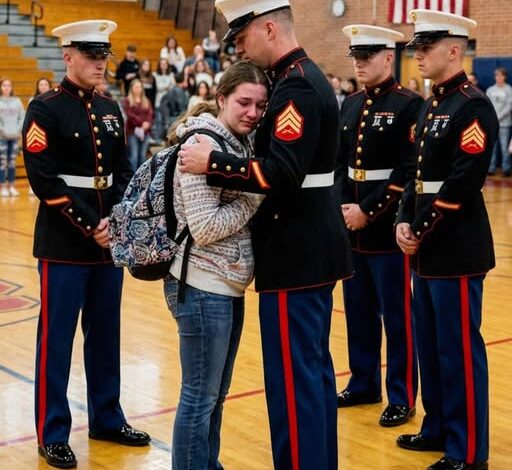
And standing onstage beside the principal were four Marines in full dress blues.
Grace sat alone in the front row.
The principal spotted me immediately, and the expression on her face told me she already understood how badly the school had failed my daughter the day before.
Then she stepped toward the microphone.
“Yesterday,” she began carefully, “one of our students experienced something that should never happen in this school. Today, we have the opportunity to acknowledge that failure—and to honor someone whose recognition was long overdue.”
One of the Marines stepped forward.
Older.
Composed.
Carrying a small velvet box with visible care.
He looked directly at Grace before speaking.
“Your father was Staff Sergeant Daniel Mercer,” he said. “I served beside him.”
Grace covered her mouth instantly.
The Marine opened the box.
Inside was a Bronze Star.
A visible ripple moved through the auditorium.
Then another Marine stepped forward carrying a folded American flag.
“This commendation was approved years ago,” he explained, “but due to administrative failures, it was never formally presented to the family. We were already working to correct that oversight. After hearing what happened at this school yesterday, we requested permission to do it now.”
That detail somehow made the moment even more emotional.
This wasn’t a dramatic publicity stunt.
This had already existed.
Waiting.
The third Marine spoke next, his voice quieter.
“This replacement ceremonial flag should also have been delivered properly years ago. That mistake is being corrected today as well.”
My knees actually weakened.
Then the first Marine looked back toward Grace again.
“Your father wasn’t respected only because he was brave,” he said. “He was respected because people trusted him. He kept others steady when things became dangerous. He made people laugh when morale disappeared. And he never stopped talking about his daughter.”
Grace broke instantly.
Not dramatic sobbing.
Just tears pouring silently down her face faster than she could stop them.
The Marine stepped down from the stage, knelt directly in front of her, and said gently:
“He would be unbelievably proud of you.”
You could have heard a pin drop inside that auditorium.
Then the principal cleared her throat carefully.
“There’s one more thing.”
A girl stepped forward from the side aisle.
Grace’s classmate.
Her face was bright red, her hands trembling violently.
She stopped directly in front of Grace.
“What I said was cruel,” she whispered. “I didn’t think about how much it would hurt you. I’m really sorry.”
Grace stared at her for several seconds.
Then finally nodded once.
Everyone assumed that would be the end of it.
It wasn’t.
That night, the medal sat beside the folded flag on our kitchen table while Grace kept walking past both of them every few minutes like she needed reassurance they were still real.
Then suddenly she stopped.
“Mom…”
I looked up.
“If this medal was approved years ago… why didn’t we ever get it?”
I opened my mouth automatically.
“Probably paperwork delays.”
But even while saying it, something felt wrong.
The next afternoon, one of the Marines—Captain Ruiz—called me directly.
“There are documents connected to your husband’s file,” he said carefully. “I think they need to be delivered in person.”
An hour later, he sat across from us at our kitchen table holding a sealed envelope.
Grace hovered nervously nearby until he looked at her and said softly:
“You should hear this too.”
Inside were military records, witness statements, internal correspondence—and a handwritten letter from Daniel that had never reached us.
Ruiz folded his hands together carefully.
“The delay involving the medal was legitimate,” he explained. “But reopening the file raised larger questions.”
I felt dread settle immediately inside my chest.
“What kind of questions?”
“The kind your family deserved answers about years ago.”
As I read through the documents, the story we had been told slowly began unraveling.
The mission where Daniel died had already raised concerns beforehand.
There were warnings.
Questions about intelligence reliability.
Timing concerns.
Requests for reassessment from people on the ground.
Daniel knew the risks.
Others did too.
But the mission moved forward anyway.
And when everything went wrong, Daniel did exactly what every Marine there later confirmed he would do:
he protected other people first.
For years, I had carried grief around like a permanent weight.
Now something else joined it.
Anger.
Grace looked at me quietly.
“Did they lie about Dad?”
I shook my head slowly.
“No,” I answered. “Not about who he was.”
“Then what?”
Captain Ruiz answered for me.
“They left out the parts that made other people responsible.”
That truth changed everything.
Over the following months, I fought through redacted files, incomplete records, carefully worded explanations, and bureaucratic silence trying to understand what really happened overseas.
Piece by piece, a clearer picture emerged.
Daniel had raised concerns.
Other Marines had too.
Those warnings were ignored.
The official story focused entirely on heroism—and that part was true—but it erased the institutional failures that made heroism necessary in the first place.
Later that year, the school invited me to speak during a community service event.
Originally, I planned to keep the speech simple.
Then I saw Grace sitting in the front row wearing her father’s dog tags around her neck.
And I changed my mind.
I stepped to the podium and said:
“My husband was a hero. And I’m grateful my daughter finally got to hear people say that out loud.”
The room stayed silent.
Then I continued.
“But I’ve learned something difficult since then. Heroism and failure can exist in the same story. Good people can do everything right and still be failed by decisions made above them.”
You could feel the room shift.
“For years, our family received an honorable version of Daniel’s story—but not a complete one. And he deserved better than half the truth.”
My voice shook, but I kept going.
“He was brave. He was kind. He was stubborn. He loved his daughter more than anything in this world. If we choose to remember him, then we remember all of him—not just the convenient parts.”
When I stepped away from the podium, nobody moved.
Then Captain Ruiz stood slowly and saluted.
One by one, the other Marines followed.
And after that, something changed permanently.
The school quietly removed Grace’s detention from her record.
Parents started reaching out differently.
Teachers listened more carefully.
People asked harder questions.
But the biggest change happened at home.
Grace stopped obsessing over how her father died.
Instead, she began asking how he lived.
What made him laugh.
What food he always ordered.
Whether he was scared during thunderstorms.
Whether he ever cried.
I told her everything.
That he couldn’t cook but insisted on trying anyway.
That he sang completely off-key during long drives.
That he cried holding her for the first time and pretended afterward that “something got in his eye.”
One night I found her standing quietly beside the hallway photo of Daniel holding her as a toddler.
She had pinned the Bronze Star carefully beside the frame.
She stared at it for a very long time before finally whispering:
“I think I understand him now.”
I stood beside her in the silence.
And softly, honestly, I answered:
“So do I.”
We’re still healing.
Some losses never fully close.
But we are no longer carrying only fragments of his story.
And my daughter no longer stands alone when she speaks her father’s name.
No matter how delayed it was…
No matter how incomplete the truth once seemed…
he was finally seen fully by the person who needed that truth most.