My Son’s Valedictorian Speech Stopped Halfway Through – Then He Looked at His Stepfather and Said, ‘Now Everyone Will Find Out What You Did’

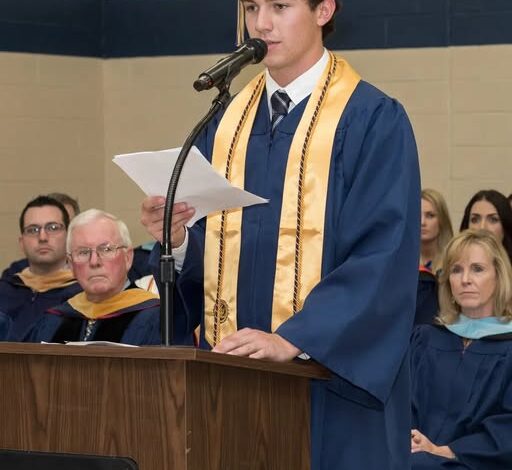
She wrapped both arms around him and held on like she thought he might disappear if she let go.
For a moment, nobody in that gym moved.
The principal stood frozen beside the stage.
Teachers sat with tears in their eyes.
Parents who had come expecting a graduation ceremony suddenly found themselves witnessing something far more intimate—a family reckoning that had been years in the making.
I don’t remember standing up.
I only remember finding myself walking.
One second I was in the bleachers.
The next, I was crossing the gym floor.
My daughter followed behind me.
Patrick called my name.
I didn’t stop.
I couldn’t.
Because suddenly all the little moments that had never quite made sense were arranging themselves into a picture I could no longer ignore.
The birthdays when Caleb seemed disappointed for reasons he couldn’t explain.
The holidays when he would quietly ask if anyone had heard from his grandmother.
The times he mentioned writing letters and never receiving responses.
The sadness that appeared whenever his father’s family came up in conversation.
I had believed distance had naturally grown between them.
I had believed grief had pulled everyone in different directions.
I had believed time was responsible.
Standing in that gym, I realized time had nothing to do with it.
Someone had been standing in the middle of those relationships for years.
Someone had been quietly deciding which messages arrived and which disappeared.
Which connections survived and which died.
Which people stayed family and which people were erased.
And that someone was my husband.
When I reached Caleb, he was still holding his grandmother.
Both of them were crying.
The kind of crying that comes from relief more than sadness.
The kind that follows years of carrying something too heavy alone.
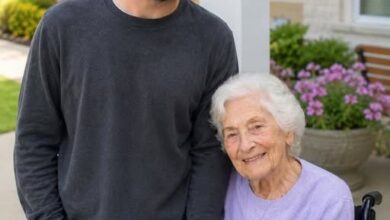
His grandmother looked older than I remembered.
Smaller.
More fragile.
But when she saw me, she stepped forward immediately.
Her hands shook as she reached for mine.
“I wrote him every month,” she said.
No greeting.
No accusation.
Just those words.
“I wrote every month.”
I couldn’t speak.
She swallowed hard.
“I thought he hated me.”
The pain in her voice was unbearable.
Not dramatic.
Not angry.
Just wounded.
The sound of someone who had spent years believing she had lost her grandson twice.
Once when her son died.
And again when the child he left behind stopped answering.
I started crying again.
Harder this time.
Because suddenly I wasn’t grieving only for what Caleb had lost.
I was grieving for her too.
For every birthday card that never arrived.
For every letter she thought was ignored.
For every holiday she spent wondering what she had done wrong.
For every year she believed her grandson had chosen silence.
Behind us, people were beginning to leave their seats.
The ceremony had completely unraveled.
Nobody cared anymore.
Graduation had become secondary.
The truth had become the event.
Patrick was standing near the bleachers.
Alone.
I remember noticing that.
Not because anyone was intentionally avoiding him.
Because people naturally drift away from someone once they realize what that person has done.
His explanations had stopped working.
The performance had ended.
For the first time since I had known him, there was nobody left to manage.
Nobody left to convince.
Nobody left willing to accept his version of events.
My daughter tugged on my sleeve.
She was crying too.
“What happens now?” she asked.
Children ask impossible questions in the simplest ways.
I looked at Caleb.
I looked at his grandmother.
I looked at Patrick.
And for the first time in a very long time, the answer felt obvious.
“The truth happens now.”
We left the gym together.
Not with Patrick.
Without him.
My daughter walked beside me.
Caleb walked beside his grandmother.
The June air outside felt cooler than it should have.
Almost unreal.
Like stepping into a different life.
Parents were gathered in small groups around the parking lot.
Some pretended not to stare.
Others didn’t bother pretending.
I couldn’t blame them.
The entire town would know by morning.
Probably by midnight.
Patrick followed us outside.
He kept trying to talk.
Trying to explain.
Trying to reshape what had happened into something less terrible.
“I was trying to protect this family.”
“I didn’t mean it the way it sounds.”
“You don’t understand the whole story.”
Every sentence sounded smaller than the one before it.
Because the facts didn’t require interpretation.
He had hidden letters.
He had hidden cards.
He had hidden an entire relationship.
There was no version of that story that became noble with enough explanation.
Finally Caleb turned around.
His face was still wet with tears.
But his voice was calm.
Calmer than mine would have been.
“You stole years from us.”
Patrick opened his mouth.
Nothing came out.
Because there was nothing to say.
No defense exists for stolen years.
Not really.
Some losses can be repaid.
Money.
Property.
Mistakes.
Not time.
Time is the one thing that never returns.
And Patrick had taken it from all of us.
His grandmother stepped closer to Caleb.
Then she said something I will never forget.
“None of this is your fault.”
The words broke something open inside him.
I could see it happen.
All the guilt he had been carrying.
All the confusion.
All the wondering.
All the questions.
Years of believing he hadn’t been enough.
Years of believing he had somehow failed people who loved him.
Gone.
Not instantly.
Healing never works that way.
But the process began right there in the parking lot.
His shoulders relaxed.
Just slightly.
Enough for me to notice.
Enough for me to understand how heavy that burden had been.
Over the next few weeks, the truth kept spreading.
Not rumors.
Facts.
Boxes of unopened letters.
Birthday cards.
Photographs.
Christmas gifts returned to sender.
Voicemails deleted before Caleb ever heard them.
Evidence stacked so high it became impossible to deny.
His grandmother brought everything.
Every copy she had kept.
Every letter she had written.
Every photograph.
Every attempt.
There were hundreds.
Literally hundreds.
Some were addressed to a thirteen-year-old boy.
Others to a fourteen-year-old.
Fifteen.
Sixteen.
Seventeen.
Eighteen.
A complete record of love trying desperately to find its way through a locked door.
And failing.
Because someone inside the house had decided it wasn’t welcome.
The hardest night came three weeks after graduation.
We sat around my kitchen table reading the letters.
One after another.
His grandmother reading some aloud.
Caleb reading others himself.
There was one she had written on his fifteenth birthday.
She described a fishing trip she and his father had taken when he was little.
She wrote that she missed him every day.
She wrote that she hoped he was happy.
She wrote that she would keep writing even if he never answered.
Because loving family wasn’t something you stopped doing.
Halfway through the letter, Caleb stood up and walked outside.
I found him sitting on the porch.
Holding the paper in both hands.
Crying silently.
Not the loud crying people notice.
The quiet kind.
The kind that comes from mourning something that should have existed all along.
I sat beside him.
For a long time, neither of us spoke.
Finally he asked, “Do you think Dad would be angry?”
I knew exactly who he meant.
His father.
Not Patrick.
Never Patrick.
I looked out into the darkness.
Then I said the only truthful thing I could.
“No.”
He nodded slowly.
I think he already knew that.
Months later, people still ask me about graduation night.
They ask whether I was embarrassed.
Whether I was shocked.
Whether I wish Caleb had handled it privately.
The answer surprises them.
No.
Because silence was how the damage happened in the first place.
Silence protected lies.
Silence protected manipulation.
Silence protected the person causing the harm.
The truth needed witnesses.
And that night, it finally got them.
When I think back now, I don’t remember the scandal.
I don’t remember the whispers.
I don’t remember the way everyone stared.
I remember a grandmother standing by a gymnasium door.
I remember a young man brave enough to tell the truth.
I remember years of stolen connection finally being returned.
Most of all, I remember what happened after.
Sunday dinners.
Photo albums spread across tables.
Stories about his father that Caleb had never heard.
A family finding each other again.
Not because the pain disappeared.
Because love survived long enough to make its way back.
And in the end, that was the part Patrick never understood.
You can hide letters.
You can intercept calls.
You can manipulate stories.
You can delay the truth.
But you cannot permanently destroy a bond built on genuine love.
Eventually, somehow, it finds its way home.