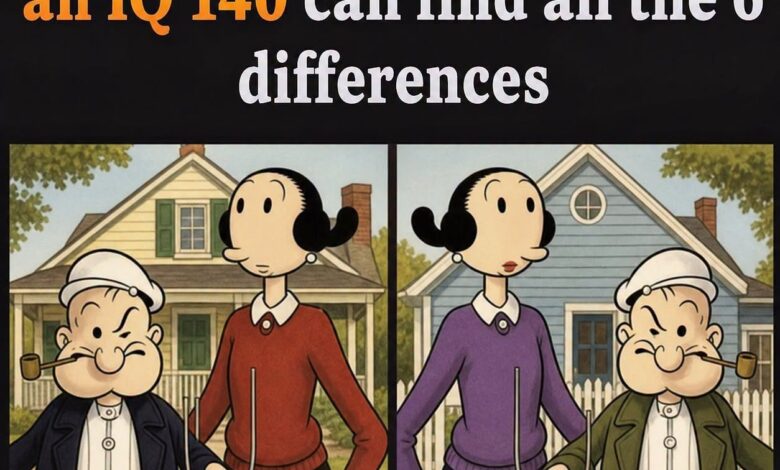
Think your eyes are sharp? This picture puzzle might prove otherwise.
At first glance, the two images below look almost exactly the same. The colors match. The characters appear to be in the same places. Even the smallest details seem identical.
But they aren’t.
Hidden somewhere between the two pictures are four subtle differences, and some of them are much harder to notice than you might expect.
The challenge is simple:
Study both images carefully and try to find every difference before checking the answer.
Sounds easy?
Don’t be so sure.
These puzzles are designed to fool your brain because your eyes tend to focus on the overall scene instead of tiny changes. Once you recognize what you’re looking at, your brain begins filling in details automatically. That means something can disappear, change shape, switch position, or even change color without you immediately noticing it.
So take your time.
Look at picture A.
Then picture B.
Now go back to A again.
Instead of scanning the entire image at once, divide it into sections.
Start at the top.
Compare the background.
Look at any objects hanging, floating, or sitting near the edges of the picture.
Then move toward the center.
Check clothing, facial expressions, hands, shoes, decorations, furniture, food, toys, or anything else appearing in the scene.
Finally, inspect the bottom of both pictures.
Tiny differences often hide in places people overlook because their attention naturally goes toward the main subject.
Ready?
FIND THE DIFFERENCE CHALLENGE
There are four differences hidden between the two pictures.
Your goal is to find all four without looking at the answer.
Give yourself a time limit if you want to make the challenge harder.
Try:
30 seconds if you want a relaxed challenge.
20 seconds if you think you have sharp eyes.
Or just 10 seconds if you really want to test yourself.
Start now.
Look closely.
Did something change color?
Is an object missing?
Did one detail become larger or smaller?
Is something facing a different direction?
Sometimes the most obvious-looking part of the picture contains the trick.
Other times, the difference is sitting quietly in the background where almost nobody thinks to look.
How many have you found?
One?
Two?
Three?
If you already spotted all four, you may have an unusually strong eye for visual detail.
But before you celebrate, check both pictures one more time.
A common mistake with these puzzles is finding three differences quickly and then assuming the fourth must be somewhere complicated.
Often, it isn’t.
The final difference may be sitting directly in front of you.
Your brain has simply decided that both images are identical in that area.
That is what makes “spot the difference” puzzles so entertaining. They aren’t merely tests of eyesight. They also test attention, patience, memory, and how quickly your brain notices when something familiar has been slightly altered.
WHY THESE PUZZLES CAN BE SO TRICKY
When you look at an image, your brain doesn’t carefully analyze every individual pixel.
Instead, it rapidly builds a general understanding of the scene.
Person.
Tree.
Table.
House.
Food.
Animal.
Once your brain understands what something is, it often stops checking every tiny detail.
That saves enormous mental effort in everyday life.
But it also makes puzzles like this surprisingly difficult.
For example, imagine both pictures contain someone wearing a shirt with four buttons.
If the second image contains only three buttons, your brain may still register both objects simply as “the same shirt.”
Or perhaps one image contains a small cloud that disappears in the second.
Because the cloud isn’t important to understanding the scene, your attention may completely skip over it.
That is exactly what puzzle creators rely on.
They hide changes in places your brain considers unimportant.
HOW TO FIND THE LAST DIFFERENCE
Still stuck?
Try this method.
Pick one small section of the first picture and compare only that section with the second.
Don’t jump around.
Move slowly from left to right.
Check shapes.
Count objects.
Look at colors.
Compare lines and patterns.
Watch for anything that has disappeared.
Then repeat the process from top to bottom.
You might be surprised how quickly a hidden difference becomes obvious once you stop looking at the whole image.
Another useful trick is to focus on the empty spaces.
People naturally inspect the main characters or objects, but puzzle designers frequently hide changes in the background.
A missing branch.
A different window.
One extra stripe.
A changed shadow.
A small object that has vanished.
Those tiny details can be incredibly easy to overlook.
So give yourself one final chance.
There are four differences.
Can you find every one?
Don’t scroll down yet.
Seriously.
Look again.
Picture A.
Picture B.
Back to A.
Now B.
Did you catch something you missed before?
If you’ve found all four, remember how long it took you.
You can compare your time with friends or family and see who notices the changes fastest.
ANSWER
Time’s up.
Now check the solution and see whether the four differences you found were correct.
If you spotted every one without help, congratulations—you passed a surprisingly difficult visual challenge.
If you found only two or three, don’t worry. The final difference is usually the one that drives everyone crazy.
And if you couldn’t find any?
Take another look after seeing the solution.
Once the differences are pointed out, they often become so obvious that you’ll wonder how you missed them in the first place.
That strange effect is part of what makes these puzzles addictive.
Your brain can ignore a tiny detail repeatedly—and then, the moment somebody reveals it, you suddenly cannot stop seeing it.
So how did you do?
Did you find:
1 difference?
2 differences?
3 differences?
Or did you manage to spot all 4?
Share your result and challenge someone else to try.
You might be surprised who has the sharpest eyes.