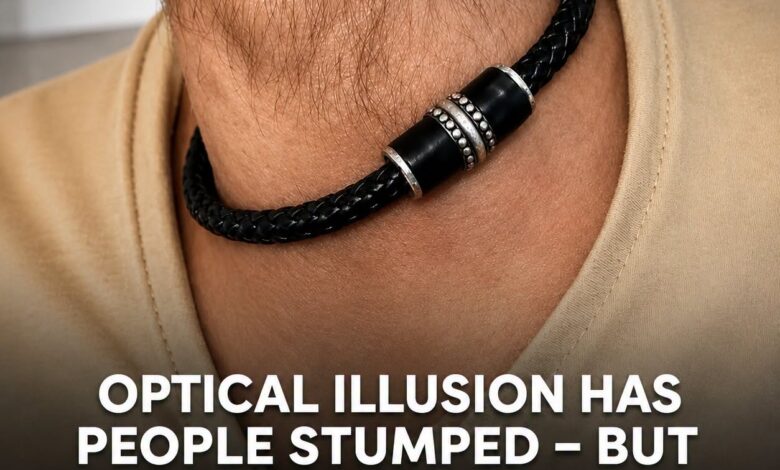
At first glance, something is horribly wrong with this photograph.
The man’s neck appears impossibly long.
Not slightly unusual.
Not merely stretched by an awkward camera angle.
Absurdly, anatomically impossible long.
It seems to extend downward through the image before disappearing beneath what looks like the collar of his shirt.
Then you notice something else.
There appears to be a dark band wrapped around the “neck.”
A choker?
A necklace?
And suddenly your brain begins trying to construct a human body around something that clearly shouldn’t exist.
That’s why this seemingly ordinary photograph has left so many people staring at it far longer than they expected.
Some viewers immediately understand what’s happening.
Others can study it for minutes and still see the same disturbing image.
But here’s the secret:
That isn’t his neck.
It’s his arm.
Once you understand that, the entire photograph changes.
And somehow, it also doesn’t.
The illusion begins with the way the image is cropped.
The man is standing with one hand resting inside the pocket of his trousers. His forearm extends downward at an angle, but because much of the surrounding body is missing from the tightly framed image, your brain doesn’t immediately receive enough information to identify the limb correctly.
Instead, it searches for a more familiar explanation.
There’s skin.
There’s something resembling an Adam’s apple.
There’s a dark band around the narrow section.
There’s even a beige area beneath it that looks suspiciously like a shirt collar.
So the brain makes a spectacular mistake.
It decides:
Neck.
Once that interpretation takes hold, everything else begins cooperating with it.
The shape around the wrist becomes part of the throat.
The wrist bone suddenly resembles a protruding Adam’s apple.
The braided bracelet becomes a choker.
And the waistband of the man’s trousers transforms into what looks like the neckline of his clothing.
Nothing in the photograph has actually changed.
Only your interpretation has.
That’s what makes the image so effective.
It isn’t created with elaborate special effects.
There doesn’t need to be Photoshop manipulation stretching someone’s anatomy.
It’s simply an ordinary arrangement of body parts, clothing, perspective, and cropping that happens to provide the brain with exactly the wrong clues.
And your visual system eagerly completes the deception.
Human vision doesn’t work like a camera recording every detail objectively.
The eyes gather information, but the brain has to interpret it.
And it does that incredibly quickly.
Usually, that’s useful.
If you had to consciously analyze every line, shadow, texture, and shape before recognizing an object, ordinary life would become exhausting.
Instead, the brain relies heavily on patterns and expectations.
It asks, in effect:
What does this most likely represent?
Then it fills in missing information.
Most of the time, the shortcut works beautifully.
Occasionally, however, the evidence is ambiguous.
And that’s when optical illusions become possible.
In this photograph, the tight crop removes much of the context that would normally prevent the mistake.
You can’t immediately see the complete relationship between the man’s shoulder, arm, hand, trousers, and torso.
Without that context, the forearm becomes visually available for another interpretation.
The bracelet makes the illusion even stronger.
Placed around the wrist, it’s completely ordinary.
But once you’ve decided you’re looking at a neck, the same object suddenly resembles jewelry worn around the throat.
Then there’s the waistband.
Again, nothing unusual.
It’s simply part of his trousers.
But because of its position beneath the apparent “neck,” the brain interprets it as clothing surrounding the base of the throat.
Now the illusion has everything it needs.
Skin.
“Adam’s apple.”
“Choker.”
“Collar.”
Your brain effectively builds an imaginary person from perfectly real pieces of another image.
Then someone shows you the uncropped photograph.
And the mystery collapses instantly.
There’s the shoulder.
There’s the arm.
There’s the elbow.
There’s the hand resting in the pocket.
There’s the bracelet around the wrist.
There’s the waistband.
Suddenly, what seemed physically impossible becomes embarrassingly obvious.
Of course it’s an arm.
How could anyone have seen a neck?
Then you return to the cropped image.
And something frustrating happens.
The neck comes back.
You know it isn’t real.
You understand exactly how the illusion works.
You could point to every individual feature creating the deception.
Yet your brain may still insist on seeing that grotesquely elongated throat.
That’s perhaps the most fascinating part of the entire puzzle.
Knowledge doesn’t always defeat perception.
You can intellectually understand an optical illusion while your visual system continues producing the incorrect interpretation.
The same phenomenon occurs with many famous visual illusions.
You know two lines are the same length, yet one still looks longer.
You know an image isn’t moving, yet it appears to shift.
You understand that two areas contain the same shade, yet your brain insists they’re different.
Seeing isn’t simply receiving reality.
It’s interpreting reality.
And interpretation can be stubborn.
That’s why this photograph became so shareable.
People weren’t merely asking:
“What’s wrong with this man’s neck?”
They were challenging friends to escape the illusion.
Some viewers spotted the arm almost immediately.
Others needed the full photograph before everything clicked.
And then came the inevitable reaction:
“How did I not see that?”
But that’s the wrong question.
The more interesting question is:
Why did your brain see something that wasn’t there so confidently?
Because your mind hates incomplete information.
When pieces are missing, it doesn’t simply give up.
It predicts.
It fills gaps.
It uses previous experience to construct the most plausible explanation available.
Usually, that ability helps us navigate the world effortlessly.
But give the brain carefully arranged ambiguous information, and the same strength becomes a weakness.
That’s what happened here.
There was never a monstrous neck.
There was never a strange choker wrapped around someone’s throat.
There was never an impossible human body.
There was simply a man standing casually with his hand in his pocket.
The horror existed entirely in the interpretation.
And perhaps that’s why the image remains strangely unsettling even after the answer is revealed.
It demonstrates how confidently we can perceive something that isn’t actually there.
For a few seconds, your brain doesn’t say:
“This might be an unusually long neck.”
It says:
“That’s a neck.”
Certainty arrives before investigation.
Only additional context breaks the spell.
So if you’re still seeing the bizarre neck, try mentally separating the pieces.
The “neck” is his forearm.
The “Adam’s apple” is part of his wrist.
The “choker” is his bracelet.
The “shirt collar” is the waistband of his trousers.
And the missing clue is his hand, positioned inside his pocket.
Once those pieces lock into place, you’ll probably wonder how the illusion fooled you.
But don’t be surprised if you look away, return a few seconds later, and see the impossible neck all over again.
That’s not the photograph changing.
That’s your brain doing what it does every waking second:
Taking incomplete information, making its best guess, and presenting that guess to you as reality.
Most of the time, you never notice.
This photograph just happened to catch your brain in the act.