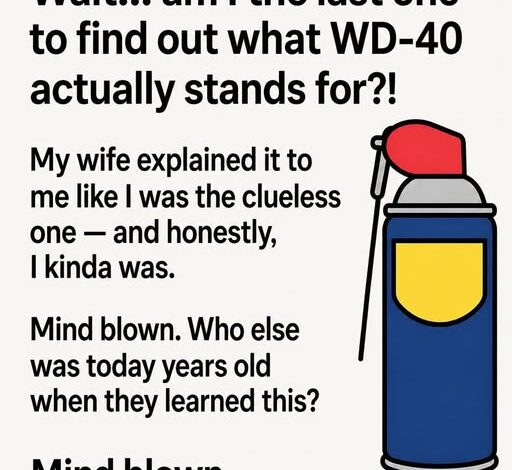
That familiar blue-and-yellow can sitting in garages, toolboxes, workshops, and kitchen drawers has a much bigger story than most people realize.
Today, WD-40 is the thing people reach for when a hinge squeaks, a bolt refuses to move, a zipper sticks, or rust begins creeping across an old tool. It feels ordinary now, almost too familiar to be interesting.
But its origin was anything but ordinary.
WD-40 was not created for everyday household repairs.
It was born from a serious industrial problem during the 1950s, when engineers were trying to protect metal parts from moisture and corrosion. In 1953, Norm Larsen and the Rocket Chemical Company were working to develop a formula that could displace water and prevent rust on sensitive equipment.
The goal was not convenience.
It was protection.
The name itself tells the story. WD stands for “Water Displacement.” The number 40 comes from the fact that it reportedly took 40 attempts before the team finally perfected the formula.
The first version failed.
So did many after it.
But they kept adjusting, testing, and trying again until Formula 40 finally worked.
That persistence is part of what makes the product so memorable. WD-40 is not just a clever name or a random brand label. It is a reminder that success often comes after repeated failure, trial, patience, and stubborn problem-solving.
Once the formula proved effective, people began discovering that its usefulness extended far beyond its original purpose. The same qualities that helped protect metal from moisture made it helpful for loosening rusted parts, quieting squeaks, removing grime, and freeing stuck mechanisms.
A product designed for high-stakes industrial use gradually became a household essential.
That is why WD-40 feels almost magical to so many people. It seems to solve little problems that look permanent: the bolt that will not budge, the lock that sticks, the garden tool coated in rust, the hinge that announces every opening door with a groan.
But the real magic is engineering.
It was designed to fight moisture, reduce corrosion, and help metal move again.
So the next time you pick up a can of WD-40, remember that you are holding more than a household spray. You are holding a small piece of problem-solving history—one built from 39 failures and one successful formula that never stopped working.
And when someone asks what WD-40 stands for, the answer is simple:
Water Displacement, 40th formula.
Sometimes the most ordinary things have the most stubborn beginnings.