In the age of social media, fame no longer follows the path it once did.
A decade ago, becoming a public figure typically required a gateway—television, film, music, publishing, or another traditional industry capable of placing someone in front of a large audience. Today, a smartphone and an internet connection can accomplish the same thing.
Platforms that began as places for sharing photos, videos, and personal updates have evolved into powerful engines of influence. Ordinary individuals can build audiences numbering in the millions, shaping trends, conversations, and even cultural values from their living rooms.
These new public figures are known as influencers.
Some focus on beauty.
Others focus on fitness, travel, fashion, parenting, or lifestyle.
Many promote products, brands, and routines that affect how people spend their money and time.
But a smaller group uses its visibility for something more controversial—and often more meaningful.
They challenge society’s assumptions.
They question long-standing standards.
And they force conversations that many people would rather avoid.
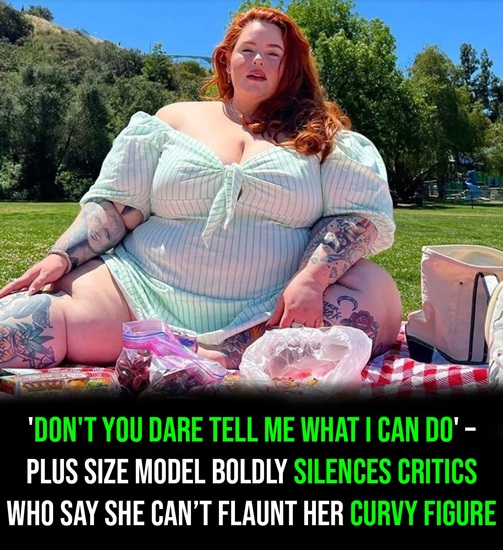
Few figures embody that role more clearly than Tess Holliday.
For years, Holliday has occupied a unique and often polarizing place in public life. As a plus-size model and advocate for body acceptance, she has built an international platform by embracing a reality that mainstream fashion spent decades trying to ignore.
Her visibility alone became a statement.
In an industry that traditionally celebrated a narrow definition of beauty, Holliday appeared unapologetically different.
She did not try to shrink herself to fit existing expectations.
Instead, she challenged the expectations themselves.
That decision transformed her into both a fashion figure and a cultural lightning rod.
Supporters saw representation.
Critics saw controversy.
And the conversation surrounding her rarely remained quiet for long.
Now in her mid-thirties, Holliday has spent much of her adult life navigating public attention that extends far beyond modeling. Every appearance, interview, campaign, and social media post tends to generate discussion—not only about her work, but about larger questions involving beauty, health, identity, and self-worth.
Few public figures understand the experience of being judged by appearance as intimately as she does.
What continues to surprise her, she has said, is the degree to which strangers feel entitled to make assumptions about her life based solely on her size.
People who know nothing about her habits, health, experiences, or character often speak as though they do.
For Holliday, that tendency reveals a deeper social problem.
Too often, people are reduced to what others see rather than who they actually are.
One of the most discussed aspects of her advocacy involves language.
In particular, her perspective on the word “fat.”
For many people, the term immediately carries negative associations. It is often used as an insult, a judgment, or a weapon intended to shame.
Holliday challenges that interpretation.
She argues that the word itself is not inherently harmful.
Instead, its meaning depends on how it is used.
In her view, “fat” can function as a simple descriptive term, much like tall, short, or thin. The problem arises when the word becomes attached to ridicule, contempt, or assumptions about a person’s worth.
That distinction sits at the center of her message.
She identifies openly as both fat and plus-size because she sees those descriptions as factual rather than offensive.
However, she draws a clear line between description and humiliation.
The issue, she argues, is not the label.
It is the intention behind it.
When words are used to diminish, shame, or dehumanize, they become harmful regardless of their literal meaning.
This perspective has fueled much of her advocacy work.
Again and again, Holliday returns to the same idea: body shaming rarely produces positive outcomes.
Instead of inspiring growth or healthier behavior, it often creates emotional wounds, damages self-esteem, and reinforces cycles of shame.
Her criticism extends beyond individual comments and into broader cultural patterns.
She frequently points out that people in larger bodies are often treated less as individuals and more as symbols in public debates.
Their existence becomes something others feel entitled to discuss, analyze, and criticize.
As a result, their humanity is often overlooked.
Their talents become secondary.
Their experiences become secondary.
Even their achievements can become overshadowed by discussions about appearance.
For Holliday, that dynamic reflects a society that remains deeply uncomfortable with body diversity.
She believes people deserve to be seen as complete human beings rather than physical stereotypes.
Language plays a powerful role in shaping those perceptions.
Words influence how people see others.
They also influence how people see themselves.
Repeated exposure to negative messages about bodies can gradually become internalized, affecting confidence, self-image, and mental well-being.
This is particularly true in digital spaces, where criticism spreads rapidly and reaches audiences far beyond its original source.
A single comment can be amplified thousands of times.
A harmful idea can become normalized through repetition.
That reality is one reason Holliday consistently encourages more thoughtful communication online.
She argues that words matter.
Not because people are fragile.
Because language shapes culture.
Throughout her career, Holliday has faced significant criticism from those who disagree with her visibility in fashion.
Her magazine covers, advertising campaigns, and public appearances have often sparked fierce debate.
Some critics argue that showcasing larger bodies in mainstream media sends the wrong message.
Others claim it promotes unhealthy lifestyles.
Holliday has repeatedly rejected those accusations.
In her view, representation is not endorsement.
Featuring different body types does not require people to adopt those body types themselves.
It simply acknowledges reality.
Human beings come in many shapes and sizes.
Fashion, media, and entertainment can reflect that diversity without making moral judgments about it.
She also challenges the common assumption that body size alone reveals everything about a person’s health.
According to Holliday, reducing health to appearance oversimplifies a complex issue and often leads to unfair conclusions.
More importantly, she argues that shame has never been an effective health strategy.
People rarely improve their lives because strangers humiliate them.
More often, such treatment creates isolation, anxiety, and emotional distress.
At the heart of Holliday’s advocacy lies a simple principle.
Every person deserves dignity.
Not because they fit a particular beauty standard.
Not because they look a certain way.
But because they are human.
That belief drives her efforts to encourage greater empathy and self-reflection in public conversations.
She frequently asks people to consider how they speak about others, especially online, where criticism can feel detached from its real-world consequences.
Body diversity, she argues, should not be treated as a controversy.
It should be recognized as a normal part of human existence.
Whether people agree with her or not, her impact on public discourse is undeniable.
Over the years, discussions about inclusivity, representation, and body image have moved increasingly into mainstream culture. While countless factors contributed to that shift, Holliday has become one of its most visible voices.
Her presence forces questions that society once avoided.
Who gets to be considered beautiful?
Who deserves visibility?
Who decides which bodies belong in public spaces, fashion campaigns, and media coverage?
Those questions remain contested.
The answers remain debated.
But the conversation continues.
And perhaps that is Holliday’s greatest influence.
Not convincing everyone to agree with her.
Simply ensuring that the discussion cannot be ignored.
Ultimately, her message extends beyond fashion, weight, or appearance.
It is about respect.
It is about language.
It is about the way people choose to see one another.
Through her work, Holliday continues to challenge the assumption that worth can be measured by appearance alone. She advocates for a culture in which people are recognized for their humanity first and their physical characteristics second.
Whether viewed as a trailblazer, a provocateur, or something in between, she remains a central figure in one of the most important cultural conversations of the digital age.
A conversation about who gets to belong, who gets to be seen, and whether society is willing to look beyond the surface.