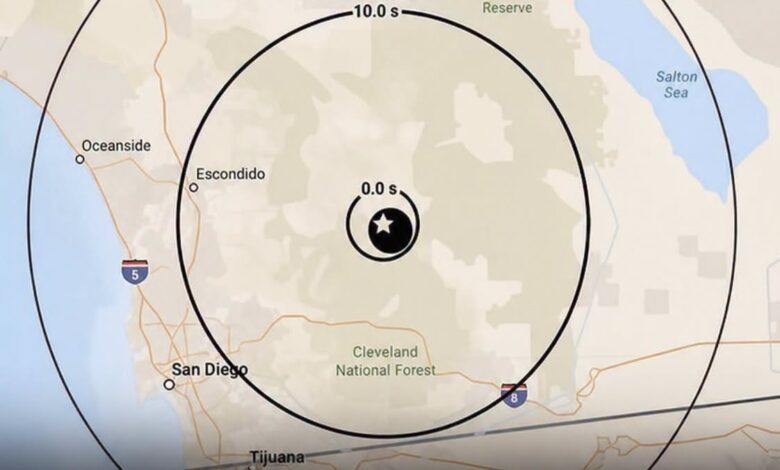
The warning arrived before the fear did.
Phones across San Diego County suddenly buzzed with an earthquake alert, giving some residents only a handful of seconds to understand what was happening.
Then the ground moved.
For people near Julian and across the surrounding region, those seconds were enough to turn an ordinary day into something instantly unforgettable.
Walls trembled.
Windows rattled.
Hanging lights swung.
Items shifted on shelves.
Dogs barked.
People froze in doorways or reached instinctively for children and loved ones.
And then, almost as quickly as it had begun, the strongest shaking stopped.
The earthquake measured magnitude 5.2, centered near Julian in San Diego County.
It was strong enough to be felt across a wide area and powerful enough to remind Southern Californians of something they already know but rarely want to think about:
The ground beneath them is never completely still.
Yet the immediate aftermath brought something precious.
Relief.
There were no scenes of widespread destruction.
No reports of collapsed neighborhoods.
No overwhelming surge of casualties.
For many families, the experience amounted to frightened phone calls, fallen objects, nervous pets and several minutes spent inspecting walls and ceilings.
That might sound minor.
Until you’re the person standing beneath a shaking roof.
Earthquakes are frightening partly because they provide so little sense of control.
A hurricane can be tracked.
A winter storm can be forecast days in advance.
Even wildfires often provide visible warning signs.
An earthquake can begin beneath your feet while you’re making coffee, driving to work, sitting in a classroom or putting a child to bed.
There is no negotiation.
The earth simply moves.
That is why the alerts received before the shaking mattered so much.
California’s earthquake early-warning technology is not designed to predict earthquakes hours or days before they occur.
It works after an earthquake has already begun.
Sensors detect the initial seismic activity and rapidly estimate where stronger shaking may be headed. If the system can transmit an alert faster than the damaging waves travel through the ground, people farther from the epicenter may receive a brief warning.
Sometimes that warning is substantial.
Sometimes it’s only seconds.
But seconds matter.
Five seconds can be enough to step away from a large window.
Enough to stop climbing a ladder.
Enough to move away from a tall bookcase.
Enough to protect your head.
Enough for a surgeon, train operator, factory worker or school employee to react according to established safety procedures.
Enough to drop, cover and hold on.
The system cannot stop an earthquake.
It can give people something earthquakes traditionally deny them:
A moment to react.
For some San Diego County residents, that was exactly what happened.
Their phones sounded.
Then the shaking arrived.
The sequence was unsettling, but it also demonstrated what years of investment in earthquake detection are intended to accomplish.
The alert wasn’t a prediction.
It was a head start.
And although this earthquake did not become a major disaster, that doesn’t make the warning meaningless.
In fact, relatively moderate earthquakes provide an important real-world test.
People learn what the alert sounds like.
Families discover whether their phones are configured properly.
Schools and workplaces can compare actual behavior with emergency plans.
Engineers and scientists receive more data.
And ordinary residents get an uncomfortable opportunity to ask themselves:
If this had been stronger, would I have been ready?
For many people, the answer is probably no.
That’s understandable.
Emergency preparedness has a strange psychological problem.
When nothing happens for a long time, preparation begins to feel unnecessary.
The emergency water gets pushed behind other supplies.
Flashlight batteries die.
Heavy furniture remains unsecured.
Old food stays in emergency kits years beyond its useful date.
Family members vaguely agree they’ll “figure something out” if cell service fails.
Then the floor moves.
Suddenly, preparation stops feeling excessive.
After the Julian-area earthquake, some residents walked through their homes looking differently at objects they’d passed thousands of times.
That tall bookshelf beside the bed?
Potentially dangerous.
The heavy television sitting unsecured?
Worth reconsidering.
The glass objects stored high above the kitchen counter?
Maybe they belong somewhere else.
Earthquake preparation is often less dramatic than people imagine.
It isn’t necessarily about constructing a bunker.
It’s about reducing predictable risks.
Secure heavy furniture.
Know how to shut off utilities when appropriate.
Keep water and essential supplies available.
Maintain flashlights and batteries.
Have necessary medications accessible.
Keep sturdy shoes somewhere you can reach them after broken glass hits the floor.
Make a family communication plan.
And learn the recommended response during shaking:
Drop.
Cover.
Hold on.
Running outside during strong shaking can expose people to falling glass, bricks and other debris. The safest response depends on the circumstances, but emergency guidance generally emphasizes protecting yourself where you are rather than attempting a panicked escape.
Then there are aftershocks.
A significant earthquake changes stresses in the surrounding crust, and smaller earthquakes can follow.
Most aftershocks are weaker than the original event.
But after a frightening quake, even a minor tremor can send adrenaline rushing through the body again.
A door rattles.
A glass vibrates.
Everyone stops talking.
“Was that another one?”
That anxiety can linger long after the physical shaking ends.
For parents, the experience can be particularly unsettling.
Adults may understand probabilities, fault systems and emergency alerts.
A frightened child understands something simpler:
The house moved.
The place that was supposed to be solid suddenly wasn’t.
Reassurance matters.
So does honesty.
The goal isn’t to teach children that another earthquake could never happen.
No one can promise that.
The goal is to show them that the family knows what to do if it does.
That’s the deeper value of preparedness.
It doesn’t eliminate uncertainty.
It replaces helplessness with a plan.
Southern California has lived with earthquake risk for generations.
That familiarity can create both resilience and complacency.
People joke about earthquakes.
They compare magnitudes.
Longtime residents sometimes distinguish between a “real earthquake” and one barely worth leaving the couch for.
Humor is understandable.
But familiarity shouldn’t become indifference.
The Julian earthquake offered a relatively forgiving reminder.
Strong enough to frighten.
Strong enough to trigger alerts.
Strong enough to make people pay attention.
But, fortunately, not catastrophic.
There will be other earthquakes.
No responsible scientist can say precisely when the next damaging one will strike a particular community.
That’s the uncomfortable reality of seismic risk.
Preparedness happens before certainty.
And perhaps that is why those few seconds of warning deserve attention.
Five seconds sounds almost meaningless in ordinary life.
Five seconds waiting for an elevator feels like nothing.
Five seconds at a traffic light disappears unnoticed.
But five seconds before the ground starts shaking?
That’s time.
Time to move.
Time to protect yourself.
Time to call out to someone nearby.
Time to get beneath something sturdy.
Time that earlier generations simply didn’t have.
When the shaking stopped, San Diego County returned to ordinary life remarkably quickly.
People went back inside.
Children returned to bed.
Phones stopped buzzing.
Traffic continued.
Coffee was made.
Work resumed.
But for many residents, something had changed.
They had been reminded that ordinary life rests on systems we barely notice until they’re tested.
Buildings.
Emergency plans.
Communication networks.
Scientific instruments.
And increasingly, a warning delivered through the device in your pocket.
This time, the story ended mostly with relief.
That’s worth being grateful for.
But relief shouldn’t be mistaken for immunity.
The quake near Julian was not a guarantee that the next earthquake will be similarly forgiving.
It was an opportunity.
Check the emergency kit.
Secure the bookshelf.
Talk to the children.
Charge the battery pack.
Learn what the alert means.
Know where you’ll take cover.
Because someday another phone may buzz.
And between that sound and the first violent movement beneath your feet, you may have only five seconds.
Five seconds isn’t much.
But when the earth begins to move, it can be everything.