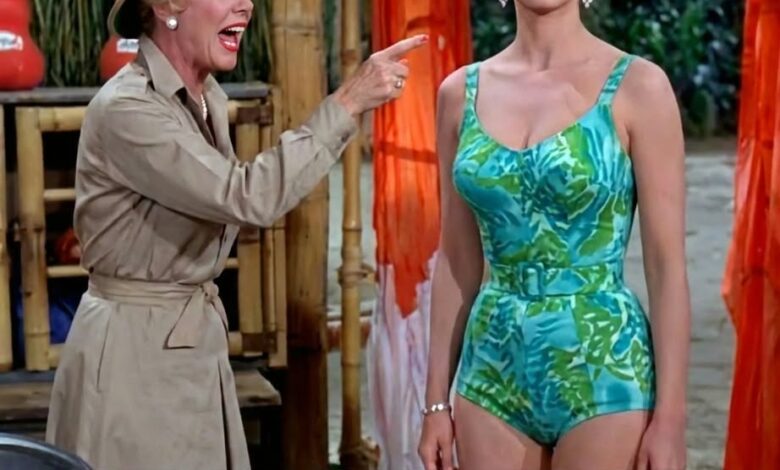
For only a second, the illusion falls apart.
The camera lingers slightly too long.
Something appears at the edge of the frame that was never supposed to be there.
Maybe it’s part of the crew.
Maybe it’s equipment.
Maybe it’s scaffolding, a studio wall, or some other unmistakable piece of the machinery responsible for creating the supposedly deserted tropical island.
Then the shot changes.
The story continues.
Gilligan is still Gilligan.
The Professor is still trying to invent something impossible out of bamboo and coconuts.
And the castaways remain stranded on an island that, for one fleeting moment, has revealed itself for what it really was:
a television set.
For modern viewers accustomed to enormous visual-effects budgets and digital cleanup, the mistake can be hilarious.
Pause the episode.
Rewind.
Look at the corner.
There it is.
Once you’ve noticed it, you can’t stop seeing it.
But the tiny production error reveals something much more interesting than a careless crew member or badly framed shot.
It reveals how television magic used to be made.
When Gilligan’s Island premiered in 1964, viewers weren’t expecting documentary realism.
They understood that they were watching a comedy.
Still, every week the show asked audiences to accept a wonderfully ridiculous premise.
Seven people had been stranded after what was supposed to be a three-hour boat tour.
They couldn’t escape.
Rescue attempts repeatedly failed.
Visitors somehow reached the island and then conveniently departed without taking the castaways with them.
The Professor could construct extraordinary devices from primitive materials but apparently couldn’t solve the central problem of getting everyone home.
None of it made much logical sense.
That was the point.
The island wasn’t geography.
It was a playground.
And millions of viewers happily agreed to pretend.
The show’s opening theme did much of the work.
Within moments, audiences knew exactly what world they were entering.
The tiny ship.
The tropical surroundings.
The storm.
The stranded passengers.
Gilligan and the Skipper.
The millionaire and his wife.
The movie star.
The Professor and Mary Ann.
It was practically a nursery rhyme disguised as television exposition.
Once the song ended, realism was no longer especially important.
What mattered was the game.
What ridiculous problem would appear this week?
How would Gilligan accidentally make it worse?
What improbable invention would the Professor produce?
Would the castaways finally escape?
Of course they wouldn’t.
If they did, there would be no show.
The audience knew that too.
That shared understanding created the peculiar charm of the series.
Everybody was in on the joke.
Which is why spotting something that shouldn’t be visible can feel so strangely delightful.
The mistake doesn’t merely expose the set.
It exposes the agreement between television and viewer.
For half an hour, we’ll pretend this is an isolated island.
We’ll pretend these palm trees continue beyond the camera.
We’ll pretend the lagoon belongs somewhere in the Pacific rather than within reach of a production crew.
We’ll pretend nobody can see the lights, cables, cameras, technicians, makeup artists, wardrobe workers, prop builders, and assistants standing just beyond the frame.
Then one camera angle drifts a little too far.
And suddenly the invisible world becomes visible.
There is something almost intimate about it.
The viewer isn’t simply watching Gilligan anymore.
For a second, the viewer is standing behind the camera.
That can be especially jarring today because modern audiences have been trained to inspect images differently.
High-definition restoration has changed the experience of watching older television.
Details that would have disappeared on a small 1960s television set can become obvious on a huge modern screen.
Sets look more like sets.
Makeup becomes easier to detect.
Painted backgrounds can reveal their texture.
Prop materials become recognizable.
Seams appear.
Reflections betray equipment.
And tiny continuity errors that once flashed by unnoticed can now be frozen indefinitely.
A modern viewer can pause a frame and examine it with a precision the original production team never anticipated.
In a strange way, technology has made old television less capable of hiding its secrets.
But it has also made those secrets part of the entertainment.
Fans love finding mistakes.
A supposedly untouched object changes position between shots.
A character’s clothing suddenly shifts.
A glass goes from full to empty and back again.
A shadow moves in a way that doesn’t match the scene.
A crew member briefly wanders into view.
Equipment appears where wilderness should be.
These discoveries create a second show underneath the first one.
The fictional story says:
Look at the castaways.
The accidental story says:
Look at the people making the castaways possible.
And those people were working under conditions very different from today’s television industry.
Episodes had to be produced quickly.
Sets had to be reused.
Props had to be improvised.
Budgets had limits.
There wasn’t an army of digital artists waiting afterward to erase every unwanted object from every frame.
If something slipped through, it could remain there forever.
No software quietly removed a boom, extended a background, replaced a sky, or painted over a crew member’s arm.
The illusion depended largely on getting the physical shot right.
Most of the time, they did.
Sometimes they didn’t.
And decades later, those mistakes survive alongside the performances.
There is something wonderfully human about that.
Television can appear effortless when we watch the finished product.
But it isn’t.
Behind every few seconds of apparently simple comedy are people solving problems viewers never know existed.
Someone had to build the hut.
Someone had to dress the beach.
Someone had to make sure the coconut landed where it was supposed to.
Someone had to move equipment before the next setup.
Someone had to check costumes, dialogue, lighting, props, sound, makeup, timing, and camera placement.
Someone had to make a studio environment feel enough like a tropical island that viewers would stop thinking about California and start worrying about whether Gilligan had ruined another rescue.
All of that work happened under deadlines.
And Gilligan’s Island demanded an especially playful kind of artificiality.
The show routinely required things that didn’t exist.
Primitive gadgets had to look functional.
Storms had to feel dangerous enough to propel stories without becoming genuinely frightening.
The island had to contain whatever location that week’s script suddenly required.
One episode might need caves.
Another might need jungle.
Another might require a strange visitor, hidden treasure, mysterious footprints, or some absurd threat that would conveniently disappear before the credits.
The island expanded and contracted according to the needs of comedy.
Nobody was supposed to draw a map.
If viewers started asking too many geographical questions, the whole thing collapsed.
The same was true of the characters’ possessions.
After years on an island, they somehow seemed capable of producing an astonishing variety of clothing and materials.
The Howells maintained an improbable degree of luxury.
Ginger retained movie-star glamour.
The castaways possessed exactly enough resources for whatever the writers needed that week.
And the Professor’s inventions were perhaps the greatest joke of all.
Give that man some bamboo, vines, coconuts, and miscellaneous debris and he could practically reconstruct civilization.
Yet somehow, escape remained elusive.
Fans have joked about that contradiction for generations.
But demanding strict realism from Gilligan’s Island is like complaining that a fairy tale contains magic.
The impossibility is part of the structure.
The show wasn’t asking, “What would seven people realistically do if marooned indefinitely?”
It was asking, “What funny thing can happen to these seven characters before everything resets next week?”
That distinction explains why a visible production mistake doesn’t truly damage the series.
There isn’t enough realism to destroy.
The audience was already participating in fantasy.
If anything, seeing the edge of the illusion can make the experience warmer.
It reminds us of childhood theater.
You knew the castle was painted plywood.
You could see where the curtain ended.
You understood that the moon hanging overhead was cardboard.
And somehow, when the lights went down, it became a castle anyway.
That’s the peculiar power of willing suspension of disbelief.
Magic doesn’t always require deception.
Sometimes you can see exactly how the trick works and still enjoy it.
That may be one reason Gilligan’s Island remains recognizable generations after its original run.
Nobody watches it because its depiction of survival is convincing.
People return because the characters became comforting.
Gilligan’s innocence.
The Skipper’s exasperated affection.
The Professor’s impossible competence.
Ginger’s glamour.
Mary Ann’s warmth.
The Howells’ absurd privilege.
Together, they created a peculiar surrogate family.
They argued.
They panicked.
They made ridiculous mistakes.
But when trouble arrived, they usually protected one another.
The island trapped them physically while giving the series emotional stability.
Nothing changed very much.
For audiences, that predictability became comforting.
No matter how chaotic the episode became, the castaways would still be together at the end.
Tomorrow there would be another coconut.
Another invention.
Another opportunity for rescue.
Another disaster caused by Gilligan.
Another reset.
In an increasingly complicated world, that simplicity has aged surprisingly well.
Perhaps the visible mistakes have too.
Modern entertainment often strives for seamlessness.
Digital environments can stretch infinitely.
Entire crowds can be generated.
Actors can appear in locations they never visited.
Objects can be removed after filming.
A production error that once would have remained forever can now disappear with a few clicks and enough money.
The result can be breathtaking.
But perfection has its own strange sterility.
Older television carries fingerprints.
You can sometimes see where the illusion was assembled.
The painted sky.
The artificial rock.
The recycled prop.
The set wall.
The shadow that shouldn’t exist.
The person who didn’t move quite far enough out of frame.
Those imperfections connect the viewer to the people who made the thing.
Suddenly, Gilligan’s Island isn’t merely a television program from another era.
It is evidence of people working.
Craftspeople building.
Actors sweating beneath studio lights.
Camera operators trying to find the right frame.
Writers racing toward deadlines.
Editors assembling footage.
Crews repeatedly transforming limited physical spaces into an island millions of viewers accepted as real enough.
That tiny accidental glimpse beyond the scenery therefore becomes almost precious.
It doesn’t say the production failed.
It says human beings made this.
Human beings made mistakes.
And somehow the magic survived them.
That’s an important distinction.
Perfection and magic are not the same thing.
Sometimes perfection can even make us forget the labor behind what we’re watching.
An imperfect old television show leaves the seams exposed just enough to remind us that imagination was doing part of the work.
The creators supplied the huts, lagoon, costumes, characters, and jokes.
The audience supplied the ocean beyond the edge of the set.
Together, they made the island.
So yes, freeze the frame.
Point at the production mistake.
Laugh at the thing that clearly wasn’t supposed to appear.
Wonder how nobody caught it.
Show it to someone else and wait for them to say, “How did I never notice that?”
That’s part of the fun.
But then let the episode continue.
Within seconds, the mistake disappears.
The island closes around the characters again.
The painted world becomes convincing enough.
Gilligan runs into another problem.
The Skipper shouts his name.
The Professor starts explaining a plan.
And the viewer willingly steps back inside.
Because the real magic of Gilligan’s Island was never that it fooled us into believing the island existed.
It was that we knew perfectly well it didn’t—and visited anyway.
The visible crew member, stray equipment, suspicious backdrop, or exposed edge of the set can’t ruin that.
If anything, it makes the achievement more charming.
Behind the tropical fantasy were ordinary people working under hot lights, moving scenery, fixing props, memorizing dialogue, positioning cameras, and trying to finish another episode on time.
Occasionally, one of them slipped into the fantasy.
For one second, the curtain opened.
And instead of destroying the illusion, that mistake gave future generations something unexpected:
a glimpse of the hands that built it.
Maybe that’s why these old television errors can feel strangely moving.
They remind us that beloved things don’t have to be flawless to endure.
Sometimes the crooked seam becomes part of what we love.
The island was artificial.
The affection wasn’t.
And decades later, viewers are still willing to take that three-hour tour.