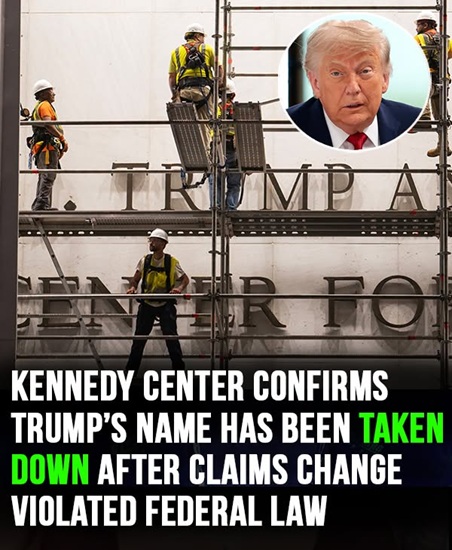
The Kennedy Center removes Donald Trump’s name following claims it may have been added in violation of federal law.


The Kennedy Center in Washington, D.C., has long been recognized as one of the nation’s premier cultural institutions, serving as a home for music, theater, dance, and artistic expression. Named in honor of President John F. Kennedy, the center was established through congressional legislation and has stood for decades as both a performing arts venue and a national memorial.
Recently, however, the institution found itself at the center of a heated controversy involving questions of naming rights, legal authority, and the intersection of politics and cultural heritage.
The dispute began following leadership changes that prompted discussions about modifying aspects of the Kennedy Center’s branding. Reports indicated that proposals emerged to incorporate references to former President Donald Trump into certain naming elements associated with the institution. While supporters viewed the idea as a form of recognition, critics argued that any alteration to the center’s official identity raised significant legal and historical concerns.
At the heart of the debate was a simple question: who has the authority to change the name of a federally established institution?
The Kennedy Center was created by an act of Congress and officially designated as the John F. Kennedy Center for the Performing Arts. Because of this congressional origin, many legal experts argued that the institution’s name carries statutory significance that cannot be altered through administrative decisions alone.
Opponents of the proposed changes maintained that the center exists not merely as a performing arts venue but also as a living memorial to President Kennedy. In their view, adding other names or altering the institution’s official identity without congressional approval would conflict with both the law and the purpose for which the center was established.
Supporters of the rebranding effort offered a different perspective.
Some argued that governing boards should possess flexibility in recognizing individuals who have contributed to cultural institutions or public life. Others viewed the proposal as a symbolic gesture rather than a formal renaming. Regardless of motivation, the discussion quickly expanded beyond administrative policy and entered the realm of public controversy.
As legal challenges emerged, the matter eventually reached federal court.
The court was tasked with examining whether changes to the institution’s naming and exterior presentation complied with the legal framework governing the Kennedy Center. After reviewing the issue, the judge emphasized that Congress had established the center and defined its official name through federal legislation.
According to the ruling, only Congress possesses the authority to formally alter that designation.
The decision concluded that unauthorized naming additions could not stand if they conflicted with the institution’s legally established identity. As a result, the court ordered the removal of disputed signage that had been added as part of the rebranding effort.
The ruling attracted significant public attention.
Following the court’s decision, workers reportedly arrived to carry out the required changes, removing lettering associated with the disputed branding. Portions of the building were temporarily covered while the work was completed, creating highly visible images that quickly circulated through news reports and social media platforms.
For some observers, the removal represented a reaffirmation of legal principles and institutional continuity.
Supporters of the ruling argued that national memorials and cultural landmarks should remain faithful to the purposes established by law. They viewed the decision as an important reminder that symbolic institutions belong to the public and should not be altered without proper legal authority.
Others viewed the outcome differently.
Critics argued that cultural organizations should have greater flexibility in recognizing contemporary figures and adapting to changing circumstances. Some suggested that the legal ruling unnecessarily restricted administrative decision-making, while others viewed the controversy as an example of broader political conflicts extending into cultural spaces.
The debate quickly expanded beyond the specific question of signage.
Public discussions touched on themes of historical preservation, political influence, institutional governance, and the role of cultural organizations in a polarized society. Social media platforms became forums for competing interpretations, with supporters and critics offering sharply different perspectives on what the controversy represented.
For some, the issue was fundamentally about law and procedure.
For others, it was about symbolism and national identity.
The controversy also sparked renewed interest in the Kennedy Center’s governance structure and future direction. Discussions emerged regarding administrative authority, board responsibilities, and proposed plans for modernization and renovation. While these issues were separate from the naming dispute itself, they became intertwined within the broader conversation about leadership and institutional stewardship.
Supporters of renovation efforts argued that continued investment would strengthen the center’s role as a world-class cultural destination. Critics raised questions about priorities, costs, and decision-making processes. Together, these debates highlighted the challenges of managing a major national institution in an environment where cultural and political issues increasingly overlap.
Despite the controversy, the Kennedy Center’s core mission remains unchanged.
The institution continues to host concerts, theatrical productions, dance performances, educational programs, and cultural events that attract audiences from across the United States and around the world. Every year, millions of visitors engage with its programming, reinforcing its position as one of the nation’s most important artistic venues.
In many ways, the dispute serves as a reminder that cultural landmarks often carry meanings beyond their physical structures.
They represent history, values, memory, and identity. Because of that, decisions involving their names, symbols, and governance can generate strong reactions from people who view those institutions through different lenses.
The Kennedy Center controversy illustrates how questions that might initially appear administrative can evolve into larger debates about authority, tradition, and public stewardship. It demonstrates how legal frameworks, historical legacy, and contemporary politics can intersect in ways that draw national attention.
Ultimately, the court’s ruling reinforced a specific legal principle: institutions created and named by Congress remain subject to congressional authority when it comes to official naming decisions.
Whether one views the decision as a necessary protection of historical integrity or an overly restrictive interpretation of administrative authority, the case highlights the enduring significance of cultural institutions and the powerful symbolism they carry.
As the conversation continues, the Kennedy Center remains what it has always been—a place dedicated to the performing arts and a memorial honoring President John F. Kennedy. Yet the controversy surrounding its name has also transformed it into a focal point for broader discussions about law, politics, heritage, and the evolving relationship between culture and public life in America.