It was supposed to be an ordinary photograph.
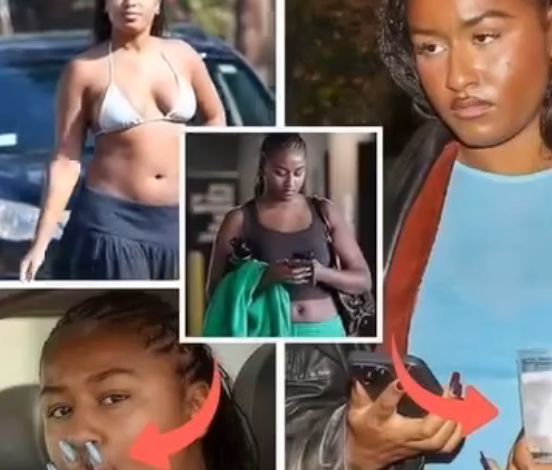
Michelle Obama appeared dressed simply in jeans, a T-shirt, and her hair styled in long braids as she spent time away from the formal settings that had defined so much of her public life. There were no podiums, campaign signs, or political speeches in the background. No carefully staged event. Just a relaxed moment that reflected a woman living life on her own terms.
Yet within hours, the image had spread across social media.
Millions of people shared it.
Some praised her relaxed style and confidence.
Others immediately began asking a familiar question.
Was this a sign she was preparing to return to politics?
The speculation grew quickly.
Every detail of the photograph was analyzed. Some interpreted her casual appearance as evidence of a new public chapter. Others insisted the image symbolized something much more personal—a woman finally enjoying a life no longer defined by the constant pressures of public office.
The conversation soon extended far beyond fashion.
It became another chapter in a debate that has followed Michelle Obama for years.
Would she ever run for president?
Despite repeatedly answering that question with remarkable consistency, speculation continues to resurface whenever she makes a public appearance. For many Americans, Michelle Obama remains one of the country’s most admired public figures. Her years as First Lady earned widespread respect through initiatives focused on education, military families, healthy living, and encouraging young people to pursue their ambitions.
Because of that popularity, many supporters continue hoping she might one day seek elected office.
But Michelle Obama has consistently said otherwise.
During public conversations, interviews, and speaking engagements over the years, she has repeatedly explained that she has no intention of running for president. One of her clearest statements came during an appearance in Brooklyn, where she addressed the speculation directly.
Her response left little room for interpretation.
She explained that her decision was not based on a lack of interest in serving others or contributing to important conversations. Instead, it reflected a deeply personal choice about the kind of life she wanted moving forward after spending years under extraordinary public scrutiny.
For much of her adult life, nearly every aspect of her family’s daily routine became the subject of public discussion.
Every speech.
Every outfit.
Every hairstyle.
Every vacation.
Every parenting decision.
Every expression captured by a camera.
Very few people experience that level of constant attention, and even fewer live under it for as many years as the Obama family did.
When Michelle Obama speaks about protecting her peace, many people understand that those words come from lived experience rather than abstract reflection.
She has often spoken candidly about the sacrifices public service required—not only from herself but from her husband and daughters as well.
Life inside the White House offered extraordinary opportunities.
It also demanded extraordinary compromises.
Privacy became rare.
Ordinary family moments became international news.
Simple mistakes attracted global headlines.
Every decision carried consequences far beyond the personal.
For many observers, her decision to step away from electoral politics reflects something entirely understandable.
After years of fulfilling one of the world’s most demanding public roles, she has chosen to define this chapter of her life differently.
Still, that decision has not stopped public speculation.
Some supporters continue believing she represents exactly the kind of leadership they hope to see.
Others view her repeated refusals as temporary rather than final.
Ironically, the more clearly she says no, the more determined some people become to imagine a future yes.
That dynamic reveals something interesting about modern public life.
Well-known figures often become symbols onto which millions of people project their own hopes, frustrations, and expectations.
Rather than seeing them simply as individuals making personal decisions, the public sometimes begins viewing them as answers to broader national questions.
In Michelle Obama’s case, many supporters see someone they admire and wish to see in a larger leadership role.
She, however, continues emphasizing that admiration does not create obligation.
During her Brooklyn remarks, she also reflected on the unique pressures women continue facing in positions of power.
Her comments were widely interpreted as highlighting the different standards often applied to female leaders compared with their male counterparts. Women in public life frequently find themselves evaluated not only on policies or achievements but also on appearance, personality, tone of voice, family choices, and countless other factors that rarely receive the same level of scrutiny when applied to men.
Her observations resonated with many people who believe these expectations continue shaping political life today.
Whether discussing leadership, opportunity, or representation, Michelle Obama has consistently encouraged broader conversations about fairness rather than focusing solely on herself.
That perspective also helps explain why the viral photograph became so meaningful for many supporters.
It wasn’t simply an image of casual clothing.
It represented something else.
Freedom.
The freedom to wear what she chooses without preparing for a political event.
The freedom to spend time outside the constant demands of elected office.
The freedom to exist as a private citizen after years of extraordinary public responsibility.
For countless admirers, the photograph symbolized someone embracing a chapter of life defined by personal choice rather than public expectation.
Others, of course, continued hoping it hinted at something more.
Yet Michelle Obama’s own words remain remarkably consistent.
She has repeatedly said that her future lies outside electoral politics.
Instead, she continues focusing on writing, public speaking, educational initiatives, charitable work, and projects that allow her to contribute without returning to the relentless pressures of political office.
Whether or not every supporter accepts that decision, it remains hers to make.
Perhaps that is the most important message behind both the photograph and the conversation it inspired.
Public admiration does not erase personal autonomy.
Leadership can take many forms beyond elected office.
And sometimes the most powerful statement a public figure can make is not announcing another campaign—but confidently choosing a different path altogether.
The image of Michelle Obama in jeans and braids ultimately became much more than another viral photograph. It reminded millions that behind every public symbol is a real person with the right to define her own future. For some, the picture represented the possibility of political leadership. For others, it represented something equally meaningful—a woman who, after years of serving in one of the world’s most visible roles, has decided that the next chapter of her life will be written on her own terms, and no amount of public speculation can take that choice away.