The Viral Optical Illusion That Is Driving the Internet Insane — Can You Spot the Hidden Truth?

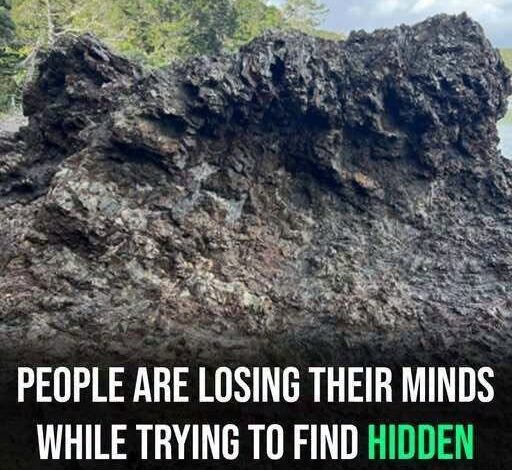
Your eyes are about to betray you.
At first, the photo looks ordinary—just a rough stretch of coastal rock, gray waves rolling in behind it, and the kind of damp, uneven cliffside you might pass without a second glance. Nothing seems unusual. Nothing seems hidden. Nothing seems alive.
Then you read the caption.
“Find my daughter.”
Suddenly, the image changes. What looked like a calm seaside snapshot becomes a visual trap. People have stared at it for minutes, zoomed in until the rocks blurred into pixels, and sworn there was no child anywhere in the frame. Some insisted it had to be fake. Others accused the mother of playing a cruel joke. But the unsettling truth is much simpler.
The girl is there.
She has been there the entire time.
And once you finally spot her, the whole picture will transform in your mind. You will wonder how you missed something so obvious, even though moments earlier it felt impossible to see.
That is what makes this image so addictive.
The scene itself is deceptively plain. Jagged stones dominate the frame, their surfaces marked by dark crevices, barnacles, and patches of shadow. The muted color of the coast blends everything together into a wash of gray, brown, and sea-worn texture. It is not a bright, dramatic image. It does not immediately announce itself as a puzzle.
That is exactly why it works.
The internet quickly became obsessed after the mother shared the photo with her simple challenge. Comment sections filled with confusion, frustration, and laughter. Some people claimed they found the child instantly. Others admitted they stared for half an hour and still saw nothing but rocks. A few were convinced the daughter had been edited out, hidden by some digital trick, or placed so unfairly that no normal person could possibly find her.
But this was not Photoshop.
It was camouflage.
The reason the photo fools so many people has less to do with eyesight and more to do with how the brain organizes what it sees. We like to think vision is straightforward, as if our eyes take a picture and our minds simply receive it. In reality, the brain is constantly interpreting, filtering, and guessing.
When you look at a rocky coastline, your brain expects to see rocks.
So that is what it gives you.
It sorts the image into familiar categories: stone, shadow, water, texture, background. Anything that blends into those categories is absorbed into the scene. The child’s face does not immediately register because it appears inside a natural hollow in the rock, surrounded by shapes and tones that resemble the rest of the cliff. Her skin, clothing, and expression are softened by the shadows, allowing her to disappear into the environment almost perfectly.
Your brain is not looking for a face there.
So it skips right over it.
That is the genius of the puzzle.
The mother who took the photo never expected it to become an online phenomenon. The moment began simply during a quiet coastal outing. Her daughter, curious and playful, discovered a round opening in the rock face and peeked through it with a small smile. It was one of those fleeting childhood moments parents often capture without thinking too much about it.
A child hiding.
A mother snapping a picture.
A memory preserved.
Only later did the image become something else entirely. When she posted it online and invited people to “find my daughter,” the photo stopped being a family snapshot and turned into a shared test of perception.
And the internet could not resist.
If you are still searching, stop scanning the obvious places. Do not look for a full body, a bright shirt, or a child standing openly among the rocks. That is the mistake most people make.
Instead, look higher in the image.
Focus roughly three-quarters of the way up the photo, slightly toward the right-hand side. Search for a small, rounded opening in the cliff. Inside that hollow, tucked neatly into the stone, is the child’s face.
Small.
Smiling.
Almost perfectly blended into the rock.
The discovery feels strange because your mind resists it at first. One moment, there is nothing. The next, there she is. The same image that seemed empty suddenly feels obvious, and it becomes nearly impossible to see it the old way again.
That instant shift is the thrill behind puzzles like this.
They remind us that perception is not as reliable as we believe. We can look directly at something and still fail to see it. Not because we are careless, but because our minds are efficient. They simplify the world to help us move through it quickly. Most of the time, that works. But sometimes, speed comes at the cost of truth.
This is why optical illusions and hidden-image puzzles continue to fascinate people. They create a small but powerful moment of surprise. The brain struggles, searches, fails, and then suddenly clicks into recognition. That “aha” moment feels rewarding because it proves that the answer was there all along, waiting for us to adjust our perspective.
The same pattern appears in many viral visual mysteries, from famous color-perception debates to landscapes hiding animals, faces, or objects. They interrupt the endless scroll and ask us to pause. They invite curiosity instead of passive viewing. They turn strangers online into a temporary community of people all squinting at the same image, laughing at their confusion, and celebrating when the hidden detail finally appears.
But there is also a quieter lesson here.
The girl in the rock is more than a clever hidden image. She is a reminder that the world often contains more than we notice at first glance. We make quick judgments every day based on incomplete information. We assume we understand people, situations, photographs, and even memories because we have looked once and formed an opinion.
Yet sometimes the truth is not absent.
It is simply camouflaged.
It is tucked into the shadows.
It is waiting inside a small opening we did not think to examine.
That is what makes this image so memorable. It is not just about finding a child in a cliffside. It is about realizing how easily our own minds can hide reality from us.
So the next time a picture seems ordinary, linger a little longer. Let your eyes wander. Question what you think you are seeing. Invite someone else to look with you and compare what they notice.
Because sometimes, the most surprising discoveries are not hidden far away.
They are right in front of us, smiling from the stone, waiting for us to finally see.