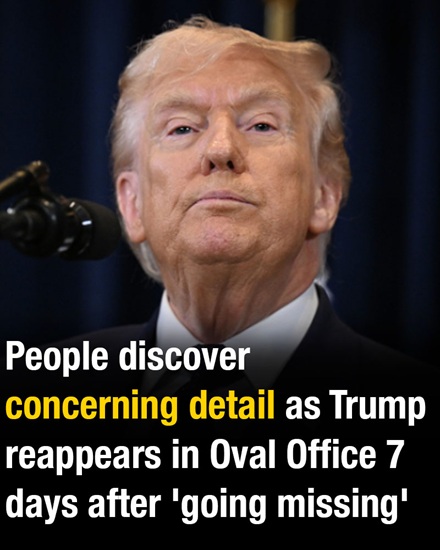
Observers Notice A Small Detail As Trump Reappears In The Oval Office After A Week Away, Sparking Online Discussion.

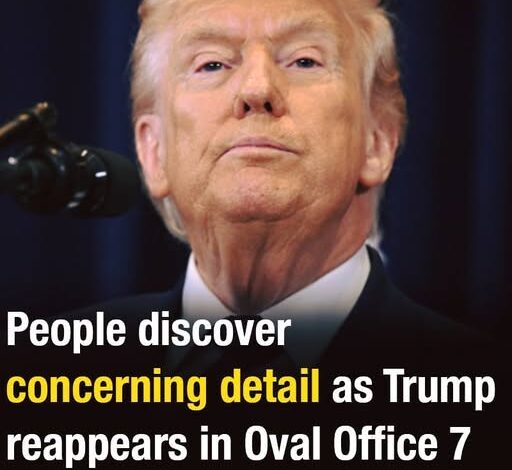
Public interest intensified in early June 2026 after Donald Trump returned to the Oval Office following several days without a public appearance, prompting widespread discussion across news outlets, social media platforms, and political commentary programs.
According to multiple reports, Trump’s last widely documented public event before the gap occurred during a Cabinet meeting at the end of May. After approximately a week outside the public spotlight, he reappeared to speak with reporters from the Oval Office, where both his remarks and his physical appearance quickly became subjects of discussion.
Almost immediately, attention shifted beyond policy issues and toward his body language during the appearance.
Online users began analyzing video clips and photographs from the briefing, with some suggesting that Trump appeared to be positioning his right hand in a way that partially concealed it from camera view. Short video segments and screenshots circulated rapidly across social media, fueling speculation and generating a wide range of interpretations.
Not everyone agreed with those observations.
Many commentators argued that conclusions based on limited camera angles could be misleading. They noted that public figures frequently adjust their posture, hand placement, or stance while speaking, making it difficult to draw meaningful conclusions from isolated images or brief video clips.
Nevertheless, the discussion continued to grow.
Several journalists and independent commentators weighed in, offering their own impressions of the appearance. Some described Trump as looking tired or less energetic than usual, while others cautioned that such judgments are inherently subjective and cannot be used to assess a person’s health or physical condition.
One widely shared commentary characterized the appearance as a “proof of life” moment following several days of public absence—a phrase that reflected political speculation and online debate rather than any verified medical concern.
As discussion expanded, some social media users suggested that the period without public appearances represented a recurring pattern. However, no verified evidence was presented to support those claims. Others questioned whether a week-long gap in public visibility was unusual at all, noting that presidents and political leaders often spend significant time in private meetings, administrative briefings, travel preparation, or other responsibilities that occur away from cameras.
The conversation soon shifted toward another topic that had previously attracted online attention: visible marks and bruising that some observers claimed to have noticed on Trump’s hands during earlier appearances.
Photographs and videos from previous months were recirculated as users compared them with more recent footage. These observations generated additional speculation online, although the claims remained interpretations made by social media users rather than conclusions supported by official medical information.
Some commentators also focused attention on other physical features, including his neck and lower legs, pointing to perceived changes in appearance. Like the discussion surrounding his hands, these observations were based largely on visual analysis rather than documented medical evidence.
Public interest increased further when references surfaced to a recent visit to Walter Reed National Military Medical Center.
According to information released publicly by the White House, the visit was part of a scheduled routine physical examination. Officials described it as a standard medical evaluation consistent with periodic presidential health assessments.
Following the examination, a medical summary attributed to Trump’s physician was released.
The report described his overall health as stable and indicated normal findings across several major areas of evaluation. According to the summary, cardiac, pulmonary, and neurological assessments produced results that were considered strong and consistent with expected performance levels for someone in his age group.
The physician’s report also referenced cognitive testing.
According to the document, Trump received a perfect score on a standardized cognitive assessment commonly used to evaluate memory, attention, and other aspects of mental function.
Based on the findings, the report concluded that he remained medically fit to perform the duties associated with the presidency.
The summary also noted that routine preventive health recommendations had been provided. These included general guidance regarding physical activity, nutrition, and long-term wellness monitoring—recommendations commonly included in standard medical evaluations and not necessarily associated with any specific health concern.
Additionally, the report recorded his weight and noted a moderate increase compared with prior annual examinations.
White House officials emphasized that such fluctuations are common and are typically considered within the broader context of age, lifestyle factors, and ongoing health management.
Despite the release of official medical information, online debate persisted.
Some individuals expressed skepticism and continued questioning the available information, while others viewed the physician’s report as sufficient evidence that no significant health concerns had been identified.
Medical experts generally caution against drawing conclusions based on photographs, brief videos, or public appearances alone.
Healthcare professionals note that bruising, discoloration, or visible marks can result from numerous routine causes, including minor injuries, medical procedures, medications, or simple age-related changes. Likewise, posture, facial expression, movement, and perceived energy levels can be influenced by factors ranging from travel schedules and fatigue to lighting conditions and camera angles.
The situation highlights a broader reality of modern political life.
High-profile public figures often face intense scrutiny regarding their health, appearance, and daily schedules. Even routine medical evaluations and short gaps in public visibility can generate widespread speculation when viewed through the lens of political debate and social media analysis.
In many cases, public curiosity increases whenever visibility decreases, regardless of whether there is evidence of an underlying issue.
As a result, discussions can quickly shift from documented facts to assumptions, interpretations, and unverified claims.
The distinction between official reporting and online speculation remains important.
Verified medical information comes from clinical evaluations, physician reports, and documented assessments. By contrast, conclusions based solely on images, short video clips, or social media commentary often lack the context necessary to support reliable medical judgments.
As of the most recent publicly available information, no official statement has indicated the presence of any serious medical condition beyond routine monitoring and preventive healthcare measures.
White House officials have continued to maintain that Trump remains capable of carrying out his responsibilities, citing physician evaluations and ongoing health assessments as support for that position.
Ultimately, the discussion surrounding his temporary absence and subsequent Oval Office appearance reflects a combination of public curiosity, political scrutiny, official medical reporting, and social media interpretation.
While interest in the health of national leaders is both common and understandable, experts continue to emphasize that medical conclusions should be based on verified clinical information rather than visual speculation.
Until additional documented evidence emerges, many of the claims circulating online remain unconfirmed and should be approached with caution. The episode serves as another example of how quickly modern political discourse can transform routine events into subjects of widespread debate, particularly when health, visibility, and public leadership intersect.