For the passengers settling into their seats that morning, it seemed like an ordinary day of travel.
The Frontier Airlines Airbus A320neo sat at the gate in Charlotte, North Carolina, preparing for its scheduled flight to New York’s LaGuardia Airport. Travelers organized carry-on bags, checked messages one last time, and looked forward to arriving at their destinations just a couple of hours later.
Some were traveling for business.
Others were heading home.
Families chatted quietly while children gazed out the windows, watching baggage handlers and ground crews complete the final preparations before departure.
Everything appeared routine.
Then, in an instant, something went wrong.
A sudden loud noise echoed from outside the aircraft, immediately drawing the attention of crew members and airport personnel. Boarding and departure preparations stopped almost immediately as ground workers realized an unexpected incident had occurred near one of the aircraft’s engines.
What investigators soon discovered highlighted both the immense power of modern jet engines and the importance of strict airport safety procedures.
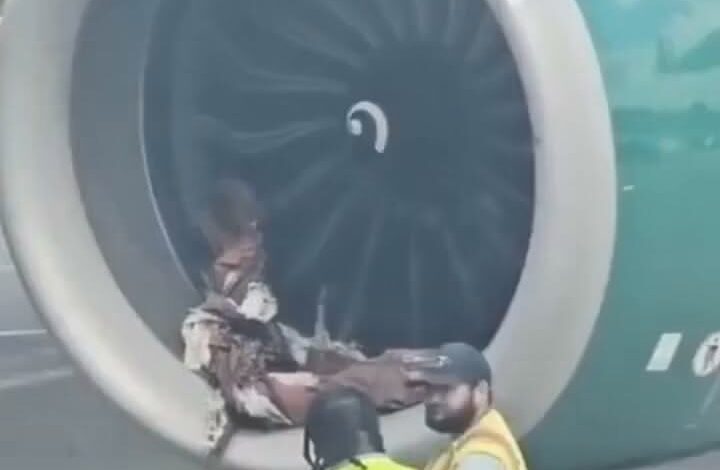
According to airport officials, a ground air-conditioning hose had been pulled into the aircraft’s left engine while the plane remained at the gate.
The powerful suction generated by the engine quickly shredded the flexible hose, scattering debris and leaving the equipment badly damaged.
Fortunately, one crucial fact immediately became clear.
No passengers, crew members, or ground personnel were injured.
Although the incident appeared dramatic, everyone nearby remained safe.
Even so, aviation professionals treat any engine-related event with extraordinary caution.
Modern commercial jet engines are among the most powerful machines in everyday transportation. Even while an aircraft remains on the ground, they generate tremendous airflow capable of drawing in loose objects from considerable distances if equipment is improperly positioned or enters restricted safety zones.
That is why airports operate under highly detailed procedures governing every piece of equipment placed around an aircraft before departure.
Once the damaged hose was identified, the aircraft was immediately removed from service for a comprehensive inspection.
Maintenance personnel surrounded the airplane, carefully examining the engine for possible damage. Even relatively small foreign objects entering a turbine can create serious mechanical concerns, making detailed inspections essential before any aircraft returns to service.
Meanwhile, passengers waited inside the terminal as airline representatives worked to determine the next steps.
At first, many hoped the delay would be brief.
As time passed, however, it became increasingly clear that the aircraft would not be departing anytime soon.
Rather than attempting a temporary repair or rushing the process, Frontier Airlines chose a different approach.
The damaged aircraft would remain grounded.
A replacement airplane would be brought in to operate the flight instead.
For travelers, the decision meant hours of waiting.
Plans changed.
Connections required adjustment.
Business meetings were postponed.
Vacations started later than expected.
Understandably, frustration began growing throughout the terminal.
Long delays rarely feel convenient, especially when passengers have carefully planned schedules waiting at their destinations.
Yet as more information became available, many travelers acknowledged an important reality.
Every additional hour spent waiting on the ground was infinitely preferable to departing aboard an aircraft that required further inspection.
Eventually, nearly nine hours after the original departure time, passengers finally boarded the replacement aircraft and continued their journey to New York.
They arrived tired.
Many arrived behind schedule.
But they arrived safely.
Behind what appeared to many travelers as “just another delay” was an extraordinary amount of coordination taking place out of public view.
Maintenance engineers carefully evaluated the damaged engine.
Operations teams located another available aircraft.
Flight crews adjusted schedules.
Ground personnel repositioned equipment.
Dispatchers coordinated revised departure plans with air traffic control.
Every decision followed established aviation safety procedures designed to eliminate unnecessary risk.
These behind-the-scenes efforts often receive little public attention precisely because they succeed.
Commercial aviation has earned its remarkable safety record not by ignoring unexpected events, but by responding to them with caution, discipline, and rigorous procedures.
Every unusual occurrence—no matter how minor it may initially appear—is investigated thoroughly before an aircraft is cleared to fly again.
Safety experts frequently point out that delays are often evidence of the system working exactly as intended.
Aircraft are not returned to service simply because passengers are waiting.
They return only after qualified professionals confirm they meet the industry’s demanding safety standards.
The damaged Airbus remained grounded while technicians completed detailed inspections and any necessary repairs before it could safely resume operations.
That decision reflected one of aviation’s most important principles.
When uncertainty exists, operations stop.
No timetable.
No financial consideration.
No scheduling pressure outweighs passenger safety.
The incident also served as a reminder of how many safeguards quietly protect travelers every day.
Strict equipment placement rules.
Clearly marked safety zones around operating engines.
Continuous communication between pilots, ground crews, and maintenance teams.
Multiple inspection procedures before every flight.
These overlapping layers exist precisely because aviation recognizes that preventing accidents requires constant attention to even seemingly small details.
Most passengers never witness those systems at work.
They simply board an aircraft, fasten their seatbelts, and expect a safe journey.
Incidents like this offer a rare glimpse into the enormous effort required to make that expectation possible.
In the end, what could have become a far more serious situation instead became an example of aviation safety functioning exactly as designed.
The flight departed much later than anyone had hoped.
Travel plans were disrupted.
Passengers faced hours of inconvenience.
Yet everyone reached their destination unharmed.
Sometimes the safest flight isn’t the one that leaves on time.
It’s the one delayed until every question has been answered, every inspection completed, and every potential risk eliminated.
Because in commercial aviation, stopping everything for safety is never considered a failure.
It’s the very reason millions of people continue trusting airplanes to carry them safely every single day.