No one inside the zoo expected the quiet afternoon to become unforgettable.
Families wandered from one exhibit to another, children pressed excited faces against viewing glass, and visitors paused to photograph the gorillas resting peacefully inside their spacious enclosure. It was the kind of ordinary day that blended into countless others, filled with laughter, conversations, and the familiar sounds of one of the zoo’s most popular attractions.
Then everything changed.
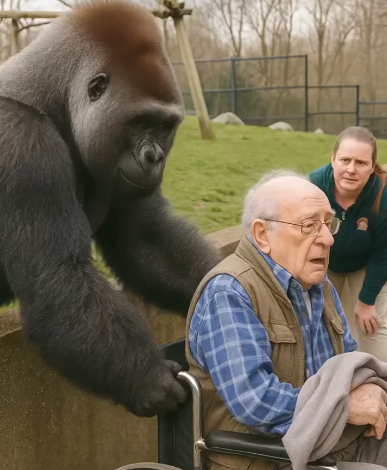
An elderly man in a wheelchair had been brought closer to the viewing barrier by a family member so he could get a better look at the gorillas.
At first, nothing seemed unusual.
Several gorillas glanced briefly toward the visitors before returning to their routines.
Then one large female suddenly lifted her head.
She froze.
Her eyes locked onto the man.
For several long seconds, she didn’t move.
Visitors noticed the change immediately.
The gorilla slowly rose to her feet and began walking toward the front of the enclosure with calm, deliberate steps. Conversations around the exhibit gradually faded as people instinctively watched her approach.
She wasn’t behaving aggressively.
But her size alone commanded attention.
Standing only a few feet from the barrier, she stared at the elderly man without looking away.
The man remained remarkably still.
His hands rested quietly on the arms of his wheelchair.
His expression was peaceful.
Then, in a movement so gentle that many witnesses struggled to believe what they were seeing, the gorilla reached forward through the protective bars and carefully wrapped one enormous hand around the side of his wheelchair.
Gasps spread through the crowd.
Parents instinctively pulled children closer.
Several visitors stepped backward.
Phones appeared almost instantly as people began recording what they feared might become a frightening encounter.
Zoo staff moved quickly toward the exhibit.
Security personnel prepared to intervene if necessary.
Everyone expected the situation to escalate.
It never did.
The elderly man slowly lifted one trembling hand.
Not to pull away.
Not to defend himself.
Simply to greet her.
His fingers rested softly against the bars separating them.
The gorilla leaned closer.
Her powerful face moved only inches from his own as she studied him with remarkable concentration.
It seemed as though she were searching for something.
Or someone.
Tears quietly filled the man’s eyes.
He whispered words too soft for the crowd to hear.
Nearby family members already knew why.
Long before age had confined him to a wheelchair…
Long before arthritis stiffened his hands…
Long before gray hair replaced the young face so many coworkers once knew…
He had spent nearly forty years working at that very zoo.
He hadn’t simply cared for the animals.
He had dedicated his entire life to them.
Every enclosure.
Every feeding schedule.
Every personality.
He knew them all.
His colleagues often joked that he could recognize an animal’s mood simply by watching its eyes.
Storm approaching?
He noticed.
Something bothering one of the gorillas?
He usually knew before anyone else.
To him, they were never exhibits.
They were individuals.
Each with distinct personalities, preferences, fears, and memories.
The gorilla now standing before him held an especially important place in his heart.
Many years earlier, she had entered the world under heartbreaking circumstances.
Complications during birth left her weak, while her exhausted mother struggled to care for the fragile newborn. Despite every effort by animal care staff, the infant remained vulnerable during those first critical days.
The young keeper volunteered without hesitation.
Working alongside veterinarians, he spent countless hours helping provide the intensive care she desperately needed. He bottle-fed her, monitored her health through sleepless nights, wrapped her in warm towels to keep her comfortable, and carried her gently against his chest whenever she became distressed.
She was so small then that both hands could comfortably support her entire body.
He spoke softly while feeding her.
He hummed familiar melodies while she slept.
Little by little, she grew stronger.
Eventually, she was successfully introduced back into the gorilla family, where she continued developing into the powerful adult now standing before him.
Years passed.
The keeper retired.
Life moved forward.
The visits became less frequent.
Age gradually changed both of them.
Yet somehow, in that extraordinary moment, something seemed to bridge the decades separating their last close encounter.
The gorilla’s grip remained incredibly gentle.
Almost protective.
Then she slowly lowered her forehead against the metal barrier between them.
A deep, quiet rumble emerged from her chest.
Zoo staff immediately recognized the sound.
Among gorillas, low vocalizations can occur in a variety of social contexts, including calm interactions, reassurance, or familiar communication. While scientists remain cautious about assigning precise human emotions to animal behavior, decades of research have demonstrated that great apes possess remarkable memory, complex social relationships, and the ability to recognize familiar individuals even after many years.
Standing there, many witnesses couldn’t help wondering whether she somehow remembered the man who had once carried her through the earliest days of her life.
No one could say with certainty.
But the moment felt extraordinary.
Eventually, staff gently encouraged the elderly man to move back from the enclosure.
The gorilla released the wheelchair without resistance.
She remained watching as he slowly rolled away.
The man looked back one final time.
His eyes overflowed with tears.
Not from fear.
From gratitude.
Afterward, visitors couldn’t stop talking about what they had witnessed.
Some described it as one of the most moving experiences of their lives.
Others reflected on the remarkable intelligence and emotional complexity of great apes.
Animal behavior experts often explain that gorillas possess exceptional long-term memories, particularly regarding important social relationships. While researchers avoid making assumptions beyond available evidence, studies continue revealing just how sophisticated these animals truly are.
The story quickly spread beyond the zoo.
Photographs captured the gentle touch.
Videos showed the quiet stillness shared between two lives connected across decades.
For many people, the encounter became about far more than animal behavior.
It became a reminder that kindness leaves lasting impressions, sometimes in ways impossible to measure.
The young keeper who had once devoted himself to protecting a frightened newborn could never have imagined that, decades later, she might pause an entire crowd simply by recognizing him.
Whether memory, familiarity, or something even deeper guided that remarkable encounter may never be fully known.
But everyone standing there understood one thing.
Some bonds are built so patiently, so gently, and with so much compassion that even time itself cannot completely erase them.
And for one unforgettable afternoon, an aging keeper and the gorilla he had once helped save found each other again—not through words, but through a quiet recognition that neither had ever truly forgotten.