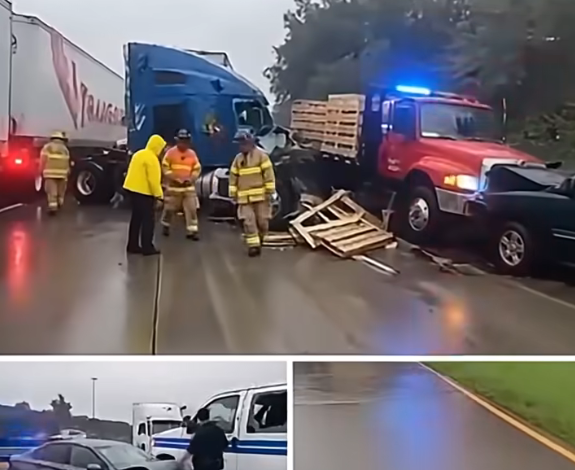
For thousands of commuters, it began like any other morning.
Cars filled the lanes of the Mexico–Querétaro Highway as drivers headed to work, families traveled between cities, and commercial vehicles moved steadily along one of the country’s busiest transportation routes. Traffic flowed normally, and few people gave much thought to the vehicles surrounding them.
Then, without warning, everything changed.
What had been an ordinary commute became a terrifying fight for survival.
Near Huehuetoca, witnesses suddenly noticed a large tractor-trailer racing down the highway at an alarming speed. At first, many assumed the driver would slow down or change lanes.
Instead, the truck kept coming.
Something was clearly wrong.
According to people at the scene, the trailer appeared unable to stop as it barreled toward a line of slower-moving vehicles. Drivers glanced into their mirrors and immediately realized the danger was closing in far too quickly.
Some desperately accelerated.
Others tried to change lanes.
Many had nowhere to go.
Within seconds, the massive truck slammed into traffic.
The first collision echoed across the highway like an explosion.
Then came another.
And another.
The enormous force of the impacts sent cars spinning across multiple lanes, crushing doors, shattering windshields, and scattering twisted pieces of metal across the pavement. Vehicles that had been traveling peacefully only moments earlier suddenly became part of a devastating chain reaction.
Horns blared continuously.
Tires screeched across the asphalt.
People screamed for help.
Those fortunate enough to avoid the initial impacts watched in horror as the trailer continued forward, pushing damaged vehicles ahead of it and creating an expanding trail of destruction.
Some motorists abandoned their cars immediately, running toward the roadside in search of safety.
Others remained trapped inside crushed vehicles, unable to open their doors as rescue seemed impossibly far away.
Several witnesses later described feeling completely helpless.
Everything happened so quickly that there was almost no time to react.
One moment they were driving.
The next, they were surrounded by wreckage.
As the trailer continued moving, the situation became even more dangerous.
Finally, after traveling through multiple collisions, the truck came to a stop.
But the destruction wasn’t over.
The trailer had turned sideways across the roadway, stretching almost completely across the highway and creating a massive steel barrier that blocked traffic in both directions.
Within minutes, one of Mexico’s busiest highways became completely paralyzed.
Cars stretched for kilometers in every direction.
Drivers trapped behind the wreckage stepped out of their vehicles, trying to understand what had happened ahead.
Many immediately called loved ones.
Some simply wanted to reassure family members they were safe.
Others struggled to explain why they weren’t coming home anytime soon.
For those closest to the crash, however, delays were the last thing on anyone’s mind.
The priority had become survival.
Emergency calls flooded dispatch centers as witnesses urgently reported the scale of the collision.
Soon, the sound of sirens replaced the noise of crashing metal.
Firefighters arrived first, followed closely by paramedics, police officers, and specialized rescue teams.
The scene confronting them was overwhelming.
Multiple damaged vehicles lay scattered across the highway.
Some had been pushed into one another with tremendous force.
Others were crushed so severely that occupants could not exit without assistance.
Rescue crews immediately began searching each vehicle.
Using hydraulic cutting tools and other specialized equipment, firefighters carefully worked through twisted metal to reach trapped motorists.
Paramedics established treatment areas along the roadside, providing emergency medical care while additional ambulances transported injured victims to nearby hospitals.
Every second mattered.
The complexity of the scene required extraordinary coordination between multiple emergency agencies.
Police officers secured the area, redirected traffic, and created access routes allowing ambulances and rescue vehicles to move as efficiently as possible despite the enormous traffic backup.
As operations continued, investigators also began documenting the crash scene.
Understanding exactly how such a catastrophic collision occurred would become essential.
Authorities launched a formal investigation examining every available piece of evidence.
Among the questions investigators sought to answer were whether mechanical failure contributed to the incident, whether the trailer’s braking system malfunctioned, whether excessive speed played a role, and whether road conditions influenced the driver’s ability to maintain control.
Commercial vehicle crashes often involve detailed technical inspections requiring specialists to examine braking components, tires, maintenance records, onboard systems, and driver information before reaching final conclusions.
Those investigations can take considerable time.
For the people directly involved, however, the emotional impact began long before any official report would be completed.
Many survivors later described struggling to process how quickly ordinary life had transformed into chaos.
Simple routines.
Morning commutes.
Conversations planned for later that day.
Everything changed within only a few terrifying seconds.
Road safety experts frequently remind drivers that heavy commercial vehicles require significantly longer stopping distances than passenger cars, particularly when carrying substantial loads. Proper maintenance, safe operating speeds, and strict adherence to transportation regulations remain essential to reducing the risk of catastrophic incidents involving large trucks.
Although commercial transportation safely moves enormous amounts of cargo every day, rare failures can produce devastating consequences because of the tremendous size and momentum involved.
As emergency crews gradually cleared the wreckage and investigators continued their work, traffic slowly began moving again.
The damaged vehicles would eventually be removed.
The highway would reopen.
Daily life would resume for thousands of commuters.
Yet for those who witnessed the disaster firsthand, the memory would remain.
Long after the shattered glass had been swept away and the skid marks faded from the pavement, many would still remember the sound of the approaching trailer, the desperate attempts to escape, and the overwhelming realization that an ordinary drive home had become one of the most frightening moments of their lives.
The crash serves as a sobering reminder of how quickly everything can change on the road.
One ordinary morning.
One unexpected mechanical problem—or whatever investigators ultimately determine caused the collision.
And within moments, countless lives were forever divided into two chapters:
The drive before the crash.
And everything that came after.