It was supposed to be just another drive home.
The Florida highway was busy but moving smoothly as commuters made their way toward work, home, and countless ordinary destinations. Some drivers listened to music. Others talked hands-free with family members or thought about the day ahead.
No one imagined that within seconds, a tiny creature crossing the road would bring everything to a sudden and violent stop.
Among the steady stream of vehicles, one driver noticed something unusual ahead.
A small turtle was slowly making its way across the highway.
It wasn’t moving quickly.
It wasn’t aware of the danger surrounding it.
It simply continued its slow journey across lanes filled with fast-moving traffic.
The driver reacted instinctively.
Without taking time to think, they slammed on the brakes, hoping to avoid hitting the tiny animal.
For a brief moment, it seemed like the compassionate choice.
Then reality caught up.
The vehicle behind had almost no time to react.
Its driver hit the brakes hard, tires screaming across the asphalt as the gap disappeared in an instant.
Another car followed.
Then another.
Within seconds, the peaceful flow of traffic transformed into chaos.
Metal slammed into metal.
Glass shattered across the roadway.
Airbags exploded from steering wheels and dashboards.
Vehicles spun into neighboring lanes as drivers desperately fought to regain control.
What had started with a single emergency stop quickly became a devastating chain-reaction collision.
Motorists who had been thinking about nothing more than getting to their destination suddenly found themselves trapped inside damaged vehicles, surrounded by confusion, fear, and the sound of car horns echoing across the highway.
Some people climbed out of their cars immediately, checking on nearby drivers.
Others remained inside, stunned by what had just happened.
Smoke drifted into the air from damaged engines.
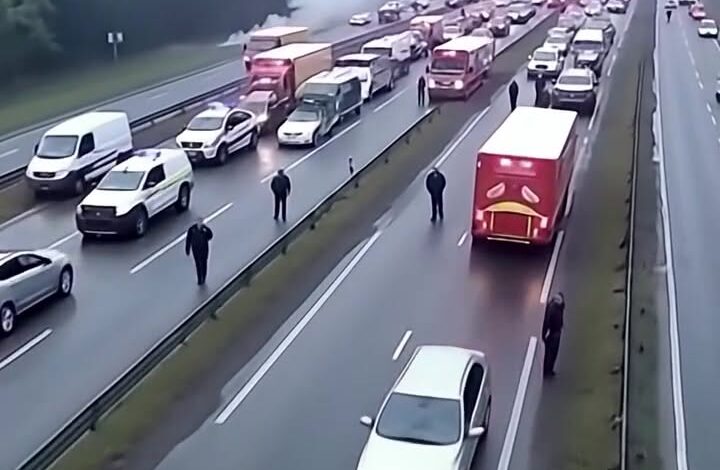
Traffic in both directions slowed almost to a standstill as frightened motorists looked toward the growing scene of destruction ahead.
Within minutes, emergency calls flooded dispatch centers.
Police officers, firefighters, and paramedics rushed toward the crash site as flashing lights illuminated the highway.
Rescue crews quickly moved from vehicle to vehicle, checking for injuries and helping occupants safely exit damaged cars.
Paramedics treated those hurt in the collision while officers redirected traffic around the growing backup that stretched for miles.
Fortunately, emergency responders were able to reach everyone quickly, but for many involved, the emotional shock proved almost as overwhelming as the crash itself.
People who had never met one another only moments earlier suddenly stood together along the roadside, trying to understand how an ordinary commute had unraveled so dramatically.
As news of the collision spread, the story ignited widespread discussion.
The cause seemed almost unbelievable.
A turtle.
One tiny animal had become the center of a debate that reached far beyond the highway itself.
Many people immediately sympathized with the driver who stopped.
After all, compassion toward animals is something most people admire.
Countless drivers have slowed for ducks crossing roads, stopped for wandering dogs, or carefully avoided wildlife whenever it could be done safely.
The instinct to protect a vulnerable creature often comes naturally.
Supporters argued that the driver’s decision came from kindness, not recklessness.
They believed the reaction reflected empathy—a split-second attempt to prevent unnecessary suffering.
Others viewed the situation very differently.
Highways operate under unforgiving physical realities.
Vehicles travel at high speeds.
Stopping distances are limited.
Drivers behind often have only fractions of a second to respond when traffic changes unexpectedly.
From that perspective, making a sudden stop for a small animal can place countless human lives at risk.
Road safety experts have long emphasized that drivers should avoid sudden, unpredictable maneuvers on high-speed roads whenever possible. While every situation is different, maintaining control of the vehicle and reducing the risk of major collisions is generally considered the highest priority when immediate braking or swerving could endanger other motorists.
The heartbreaking truth is that emergencies rarely provide enough time to carefully weigh every possible consequence.
Human instinct often acts first.
Reason follows later.
That is why so many people found themselves imagining the same impossible situation.
If they had seen the turtle, what would they have done?
Would compassion have guided their foot toward the brake pedal?
Or would concern for surrounding traffic have led them to continue forward?
It is an uncomfortable question because neither answer feels emotionally satisfying.
One choice risks the animal.
The other may risk everyone behind you.
Authorities later began investigating every aspect of the collision, including vehicle speeds, following distances, road conditions, and whether any traffic laws had been violated. Insurance companies also launched their own investigations to determine liability and assess the significant property damage caused by the chain reaction.
Those legal decisions would eventually establish responsibility.
They could not erase what had happened.
For the driver who stopped, the emotional burden may prove especially difficult.
An action motivated by compassion became forever connected to a frightening event involving damaged vehicles, frightened families, and injuries that might have been impossible to foresee in the moment.
It is the kind of decision many people replay endlessly afterward, wondering whether another choice might have changed everything.
Yet hindsight always enjoys something real life never offers.
Time.
On the highway, decisions are measured not in minutes but in fractions of a second.
There is rarely an opportunity to analyze every possible outcome before acting.
As the wrecked vehicles were eventually removed and traffic slowly returned to normal, those involved left with far more than repair estimates and insurance paperwork.
They carried a new understanding of how fragile ordinary moments truly are.
One second, life feels routine.
The next, everything changes.
The little turtle likely had no idea it had become part of a tragedy that would affect so many strangers.
Yet its unexpected appearance revealed something profound about human nature.
Compassion matters.
So does responsibility.
Sometimes those two values collide in ways no one expects.
And on that ordinary Florida highway, a tiny animal reminded everyone that life’s hardest decisions often arrive without warning—and without perfect answers.