The first time he knocked on my door, I almost said no.
He couldn’t have been older than seventeen.
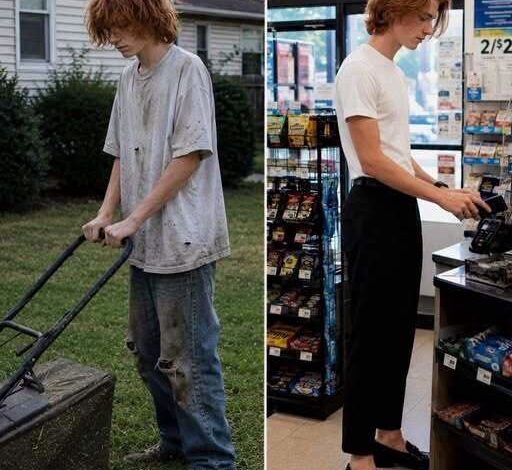
He stood on my porch wearing faded jeans, dusty sneakers, and a baseball cap that looked several years older than he was. Behind him sat a battered push mower.
“Ma’am,” he said, “would you like your lawn cut?”
I looked past him toward the yard.
“How much?”
“Twenty dollars.”
It was July, brutally hot, and the grass had grown embarrassingly high.
“Twenty for everything?”
He nodded.
“Front and back.”
I should have wondered why he was charging so little.
Instead, I felt sorry for him.
“What’s your name?”
“Evan.”
I hired him.
He worked for almost two hours.
When he finished, the lawn looked better than it had all summer.
I gave him thirty dollars.
His eyes widened.
“You gave me too much.”
“Keep it.”
He smiled.
“Thank you.”
That smile was probably what made me trust him.
Evan returned the following Saturday.
Then the Saturday after that.
Soon, we had an arrangement.
Every other weekend, he cut the grass.
Sometimes I brought him lemonade.
Once, when the temperature climbed above ninety-five, I made him a sandwich.
He always seemed grateful.
“You saving for something?” I asked one afternoon.
“A car.”
“What kind?”
“Anything that runs.”
I laughed.
He laughed too.
He seemed like a good kid.
Hardworking.
Polite.
Trying to earn money instead of getting into trouble.
That’s the story I told myself.
But looking back, there were details that didn’t fit.
I just didn’t recognize them as warnings yet.
The first was the windows.
One afternoon, I stepped outside and found Evan standing near the side of the house.
The mower wasn’t running.
He was looking through my dining-room window.
“What are you doing?”
He jumped slightly.
“Sorry. I thought I saw a wasp nest.”
I looked.
There wasn’t one.
I should have remembered that.
Instead, I forgot about it before dinner.
Another time, I noticed him near the back door.
The grass there barely needed cutting.
Yet he moved slowly around the steps, looking at the frame.
Then the lock.
Then the small kitchen window beside it.
“Everything okay?” I called.
He immediately started the mower.
“Yeah!”
Another clue.
Ignored.
Then came the garage.
Evan always finished there.
He would mow around it, trim the edges, circle back, then somehow find another reason to return.
At first, I thought he was simply thorough.
Later, I realized he had been studying it.
The side door.
The windows.
The security light.
The keypad.
Everything.
One Saturday, he casually asked, “You keep your car in there?”
“Sometimes.”
“What else?”
I laughed.
“What are you, my insurance company?”
His face changed for half a second.
Then he smiled.
“Just wondering.”
I told him anyway.
Tools.
Bicycles.
My late husband’s fishing equipment.
A few boxes.
Nothing particularly valuable.
Or so I thought.
Two weeks later, someone tried to break into the garage.
I woke shortly after 2:00 a.m. to the security alarm screaming.
By the time police arrived, whoever had been there was gone.
The side-door frame had fresh marks near the lock.
Nothing had been taken.
The officer called it an attempted burglary.
“Probably someone checking houses,” he said.
I didn’t sleep properly for days.
When Evan came the following weekend, I told him what happened.
He looked shocked.
“That’s terrible.”
“I know.”
“Did they get inside?”
“No.”
His next question should have stopped me.
“Did your cameras catch anything?”
I stared at him.
“I don’t have cameras.”
He nodded.
“Maybe you should get some.”
At the time, it sounded like concern.
Three days later, I bought cameras.
And that’s when everything changed.
The following Saturday, Evan arrived as usual.
I watched from the kitchen while he worked.
Then my phone buzzed.
Motion detected: Garage.
I opened the camera feed.
Evan was standing beside the garage.
Not mowing.
He walked toward the side door and looked directly at the new camera.
Then he stepped backward.
He pulled out his phone.
Took a photograph.
And walked around the side of the house.
My stomach tightened.
I switched cameras.
He photographed another one.
Then the back door.
Then the kitchen window.
This wasn’t curiosity.
He was documenting my security.
I called the police.
They told me not to confront him.
So I stood inside my own house pretending everything was normal while the boy I’d been feeding sandwiches photographed the places someone could enter.
When he finished, I watched him push the mower down the street.
Then something made me grab my car keys.
I followed him.
I know now that I probably shouldn’t have.
But fear doesn’t always make people cautious.
Sometimes it makes them desperate for an explanation.
Evan walked several blocks before reaching an old pickup.
He loaded the mower into the back.
Then drove away.
I followed at a distance.
We left my neighborhood.
Then my side of town.
Twenty minutes later, he turned into a gated community filled with enormous houses.
I nearly stopped following.
Maybe he worked there too.
That would have made sense.
Then the gate opened.
Evan drove through.
I waited until another vehicle entered and followed behind.
His truck eventually stopped outside a sprawling stone estate.
Not a modest home.
An estate.
Three-car garage.
Perfect landscaping.
Circular driveway.
A fountain near the entrance.
Evan climbed out.
Then a man walked from the garage.
They spoke briefly.
The man handed him something.
Cash.
Evan counted it.
My stomach dropped.
Then the garage door opened.
Inside were lawn mowers.
Trimmers.
Toolboxes.
Computers.
And shelves covered with what looked like surveillance equipment.
I called the officer who had taken my burglary report.
Within hours, the story became stranger than anything I’d imagined.
Evan wasn’t struggling.
He wasn’t saving for his first car.
The truck belonged to his family.
So did the estate.
And the man who had handed him money wasn’t his father.
He was his employer.
The company called itself a residential security consultancy.
Officially, it tested vulnerabilities for homeowners who had signed contracts.
Unofficially, according to investigators, some employees had apparently developed a far more questionable business model.
Young workers were sent into neighborhoods offering cheap services.
Lawn mowing.
Pressure washing.
Gutter cleaning.
Anything that gave them a legitimate reason to spend time around a property.
While working, they observed.
Windows.
Locks.
Alarm systems.
Vehicles.
Schedules.
Pets.
Cameras.
Then homeowners would sometimes receive advertisements warning them about burglary risks and offering expensive security assessments.
Fear created the customer.
The company sold the solution.
Investigators were still determining whether anyone connected to the operation had been responsible for actual break-ins.
That question terrified me most.
I kept thinking about the marks on my garage door.
Had someone merely tried the lock?
Had the attempted burglary been part of the sales strategy?
Nobody could tell me immediately.
Evan eventually admitted that he’d been paid to document houses.
He insisted he never broke into mine.
He said he’d been told it was “market research.”
I wanted to believe him.
Maybe because believing him would mean I hadn’t been completely wrong about the boy on my porch.
Then investigators showed me photographs recovered from his phone.
My house.
My windows.
My garage.
My car.
My backyard.
One photograph showed me carrying groceries inside.
Another showed my driveway empty.
Beneath it was a note:
Usually gone Tues 4–6.
That one frightened me more than everything else.
He hadn’t simply been looking at my property.
He had been learning me.
My routine.
My absences.
My habits.
The company eventually sent an attorney.
He spoke in polished sentences about unauthorized conduct, internal investigations, and regrettable violations of procedure.
He apologized.
He assured me the company would cooperate.
Everything he said sounded professionally empty.
I listened until he finished.
Then I asked one question.
“Why did you use kids?”
He hesitated.
I already knew.
Because people trusted them.
A teenager asking for twenty dollars to mow the lawn didn’t look threatening.
He looked ambitious.
Responsible.
Maybe even vulnerable.
Exactly the kind of person someone like me wanted to help.
My sympathy hadn’t merely failed to protect me.
It had been part of the strategy.
That realization stayed with me long after the police reports and phone calls ended.
Nothing was stolen from my house.
My husband’s fishing rods remained in the garage.
My jewelry stayed upstairs.
My television was still mounted on the wall.
But saying nothing was stolen wouldn’t be completely true.
For months afterward, every knock at the door made me tense.
I installed better locks.
More cameras.
Motion lights.
I stopped mentioning my schedule to strangers.
And when someone offered a service at the door, I found myself studying their face, wondering what they were really seeing when they looked past me.
That was what Evan had taken.
Certainty.
Before him, home had felt like the place where the outside world stopped.
Afterward, I understood that vulnerability doesn’t always announce itself with shattered glass.
Sometimes it arrives politely.
It smiles.
It works hard.
It remembers your name.
It accepts the lemonade you bring outside.
And while you’re congratulating yourself for helping someone who seems to need it, that person may be learning exactly when you aren’t home.
I don’t regret kindness.
I refuse to let what happened turn every stranger into an enemy.
But kindness and trust aren’t the same thing.
That’s the lesson I wish I’d understood sooner.
You can help someone without giving them information they don’t need.
You can be generous without ignoring questions that make you uncomfortable.
You can trust your instincts when something feels slightly wrong, even if you can’t yet explain why.
Because the clues had been there all summer.
The windows.
The doors.
The questions.
The garage.
I saw every one of them.
I simply gave each one an innocent explanation because innocence was the story I preferred.
By autumn, someone else was mowing my lawn.
A company I’d checked carefully.
The first afternoon they came, I stood at the window watching longer than I care to admit.
Then I caught myself.
I walked away.
I wasn’t going to spend the rest of my life afraid.
But I wasn’t going back to being careless either.
Evan had taught me the difference.
Danger doesn’t always wear a mask.
It doesn’t always break a window or kick down a door.
Sometimes it stands politely on the porch, looks you directly in the eye, and asks:
“Would you like me to mow your lawn?”