What made the ripped T-shirt puzzle spread so quickly across the internet was never really the shirt itself.
It was the unsettling realization that thousands of people could look at the exact same image and walk away completely convinced of entirely different answers.
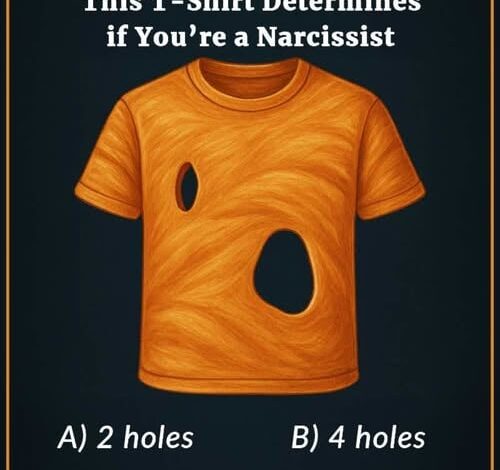
At first glance, the puzzle seemed almost insultingly simple:
“How many holes are in this shirt?”
Most people answered immediately.
Two.
They saw the obvious tears ripped through the fabric and moved on confidently, barely considering the question further. After all, the damage stood out visually. The jagged openings demanded attention. The brain registered them instantly as “holes” because they disrupted the shirt’s normal shape.
But then the arguments started.
Someone pointed out the neck opening.
Then the sleeves.
Then the bottom of the shirt itself.
Suddenly the internet fractured into camps.
Two.
Four.
Six.
Even eight, depending on how people interpreted the tears extending through both front and back layers of fabric.
And what began as a playful little brain teaser quietly transformed into something much more revealing about human thinking.
Because the real puzzle was never mathematical.
It was psychological.
The disagreement exposed how people carry invisible definitions inside their minds without realizing those definitions exist at all. Most of us move through daily life assuming words mean the same thing to everyone because language feels stable and automatic. But puzzles like this reveal how fragile that assumption actually is.
Take the word “hole.”
For some people, a hole means damage:
an unwanted rupture,
a defect,
something torn accidentally into an otherwise complete object.
Under that definition, the answer feels obviously “two.”
But for others, a hole means any opening passing through material intentionally or not:
a sleeve opening,
a collar,
the bottom of the shirt.
Under that framework, the answer changes immediately.
Neither side initially understands why the other seems so wrong because both are operating from different hidden assumptions while believing those assumptions are universal.
That’s what makes the puzzle fascinating.
Not the answer itself.
The certainty.
People defended their interpretations with surprising intensity online, posting diagrams, arguments, and sarcastic rebuttals as though the fate of civilization depended on proper shirt-hole accounting. Some mocked the “two-hole people” for ignoring basic clothing structure. Others argued the puzzle intentionally focused on tears rather than functional openings.
The emotional energy behind the debate became almost absurd.
And yet strangely recognizable.
Because humans do this constantly far beyond riddles.
We argue politically while quietly using different definitions for words like freedom, fairness, or responsibility.
We argue in relationships while attaching different meanings to loyalty, honesty, or support.
We argue culturally while assuming everyone shares identical assumptions about success, respect, or morality.
Often people are not truly disagreeing about facts first.
They are disagreeing about frameworks.
The shirt puzzle simply stripped that phenomenon down into harmless miniature form where everyone could observe it safely.
Once you step back and analyze the shirt more carefully, six becomes the most logically consistent answer under the broadest definition of “hole.” The shirt contains:
one neck opening,
two sleeves,
one bottom opening,
plus the two tears ripped through the fabric.
Six total openings.
Some people push the count higher by arguing each rip penetrates both front and back layers separately, creating additional holes. But most interpretations settle on six because the tears function as two complete openings through the garment itself.
Still, even after hearing that explanation, many people remain emotionally attached to “two.”
Why?
Because the human brain prioritizes salience over completeness.
We notice what disrupts expectation first.
The tears appear visually dramatic compared to the standard structural openings of the shirt, which the brain quickly categorizes as background information. The collar and sleeves become invisible through familiarity because they belong to the object’s intended design.
The ripped sections stand out because they represent change.
That tendency shapes human perception constantly.
People notice crisis more than stability.
Conflict more than routine kindness.
Failure more than quiet consistency.
The mind is drawn toward disruption instinctively because survival historically depended on detecting abnormalities quickly.
The puzzle also demonstrates another important psychological truth:
people hate ambiguity more than they realize.
Most viewers rush toward immediate answers because uncertainty feels uncomfortable. The moment we believe we understand something, the brain relaxes. But slowing down enough to question our assumptions requires effort and humility many people instinctively resist.
That’s why simple riddles become surprisingly effective mirrors for human behavior.
They reveal how quickly we commit to conclusions.
How emotionally attached we become to being right.
How difficult it can feel to reconsider something once certainty settles in.
And perhaps most importantly:
they expose how often obviousness depends entirely on perspective.
To the “two-hole” group, counting sleeves and collars felt ridiculous.
To the “six-hole” group, ignoring them felt equally absurd.
Both sides experienced genuine disbelief toward the other because each interpretation filtered reality through different unnoticed assumptions.
The internet amplified this perfectly.
People posted:
“It’s obviously two.”
“No, it’s clearly six.”
“How are people this bad at basic reasoning?”
“Are you seriously counting the neck hole?”
The confidence fascinated me most.
Not because confidence itself is unusual online — the internet practically runs on exaggerated certainty — but because the puzzle itself was so low-stakes and yet still triggered the same emotional patterns visible in much larger societal disagreements.
People mocked instead of questioned.
Defended instead of explored.
Assumed stupidity instead of difference in interpretation.
All over a shirt.
There’s something oddly comforting about that too.
It reminds us that confusion and disagreement are deeply human, not necessarily signs of moral failure or intelligence gaps. Sometimes people genuinely see the world differently because language itself contains hidden flexibility.
The puzzle works precisely because both answers feel reasonable initially depending on which definition arrives first in your mind.
That moment of realization —
“Oh… I didn’t think about the sleeves” —
is where the puzzle becomes valuable.
Not because you “lost.”
Because your brain briefly expands.
You recognize your first interpretation was not the only possible one.
That recognition matters far beyond riddles.
Modern life encourages snap judgments constantly:
headlines,
tweets,
clips,
arguments reduced into seconds.
People form conclusions rapidly and then defend them aggressively because slowing down feels inefficient in an attention economy built around speed.
But the shirt puzzle quietly rewards the opposite instinct:
pause,
reconsider,
define terms,
look again.
And once you do, the entire image changes.
The shirt itself never changes physically.
Only your framework changes.
That’s the deeper lesson hidden beneath the playful debate.
Reality often remains the same while interpretation shifts around it dramatically.
Two people can examine identical information and walk away carrying completely different truths because they are unconsciously answering slightly different questions.
In the end, the most meaningful part of the riddle is not arriving at “six.”
It’s realizing how easily certainty forms before understanding fully arrives.
A ripped shirt becomes a tiny laboratory for human perception:
showing how assumptions hide inside language,
how quickly people defend incomplete conclusions,
and how often clarity appears only after someone asks us to step back and examine what we thought was already obvious.
Which is another way of saying:
sometimes the most revealing thing about a puzzle is not the answer people choose,
but how confidently they stop looking once they think they’ve found it.