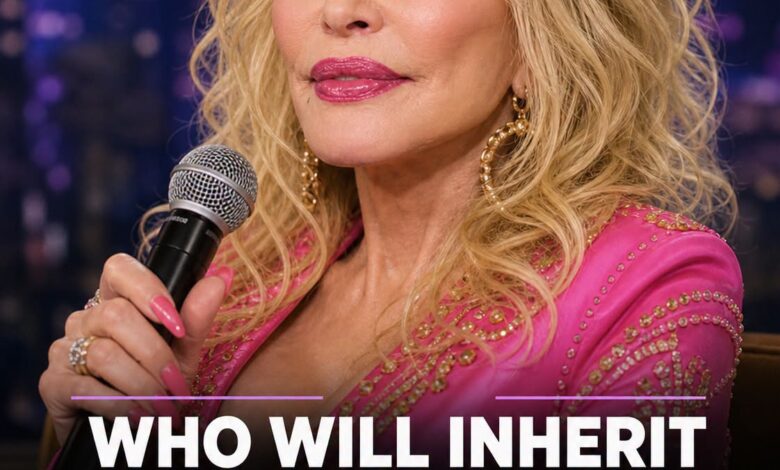
In the end, Dolly Parton’s most revealing act may not have been a song, a performance, or even one of the dazzling entrances that made her instantly recognizable around the world.
It may have been what she chose to leave behind.
For decades, people watched Dolly build an extraordinary life from beginnings she never tried to disguise. She came from a crowded cabin in the Tennessee mountains and eventually created a fortune tied to songs, publishing rights, businesses, Dollywood, licensing, real estate, and an image almost as recognizable as her voice.
But wealth was never the most interesting part of the Dolly Parton story.
What mattered was what she believed wealth was for.
With no children of her own and her beloved husband Carl Dean gone before her, the inevitable question surrounding her estate became irresistible:
Who gets everything?
It is the question celebrity culture always asks.
Who inherits the houses?
Who controls the songs?
Who receives the business interests?
Who becomes the keeper of the name?
Who “wins” the fortune?
Yet reports and speculation surrounding Dolly’s planning suggest that may be the wrong way to understand what she intended.
Rather than treating her estate like a dynasty waiting for an heir, she reportedly structured significant parts of her legacy through trusts and long-term protections designed to keep the things she built working.
That distinction changes everything.
Because an inheritance can be spent.
A system can keep giving.
Dollywood is more than a valuable entertainment property. It is tied to jobs, tourism, families, and the economy of the East Tennessee region Dolly spent her life celebrating.
Her song catalog is more than a collection of intellectual property. It represents decades of writing, ownership, creative independence, and the stories through which generations came to know her.
And her philanthropic work was never merely a side project attached to celebrity.
It became one of the clearest expressions of what she believed success should accomplish.
The Imagination Library may be the most famous example.
The idea itself was wonderfully simple: put books into children’s hands.
Not only the children of celebrities.
Not only children whose parents could afford shelves full of books.
Children Dolly would never meet.
Children who might never visit Dollywood, buy an album, or understand why the woman whose name appeared on the program mattered.
That was precisely the point.
The giving did not require recognition from the recipient.
Over time, that philosophy expanded into a much larger pattern.
Literacy.
Education.
Healthcare.
Disaster relief.
Support for communities that were too often remembered only after something went wrong.
Dolly repeatedly demonstrated that generosity did not have to be spectacular to be transformative.
Sometimes it looked like a major donation.
Sometimes it looked like rebuilding.
Sometimes it arrived in the mail as a children’s book.
So the possibility that her estate would continue directing money toward literacy, rural healthcare, music education, and other charitable purposes feels less like an unexpected final decision than the continuation of a habit.
Dolly spent her life turning success outward.
Why would death suddenly make her turn it inward?
There is something especially meaningful about that because Dolly and Carl never had children.
Celebrity estates without direct descendants often invite strange language.
People talk about the absence of heirs as though it creates a vacuum.
Who gets it all?
Where does it go?
As though every fortune naturally requires a biological dynasty at the end.
But perhaps Dolly saw another possibility.
Maybe an heir does not have to be one person.
Maybe it can be a child opening a first book.
A rural clinic keeping a service available.
A young musician receiving an opportunity that once seemed unreachable.
A Tennessee worker whose job remains secure because an institution was protected for the future.
A songwriter decades from now benefiting from decisions made by another songwriter who understood how important ownership could be.
If that was the design, then Dolly did not leave behind an empty space where children should have been.
She left a wider circle.
That does not mean family was unimportant to her.
Quite the opposite.
Dolly’s enormous family, her roots, and especially her long marriage to Carl were central to the private architecture of her life.
Carl, in particular, represented something rare in the world of extreme fame.
He was largely outside the spectacle.
While millions believed they knew Dolly, Carl knew the woman who came home.
Their marriage existed for decades without becoming a permanent public performance.
And after his death, that distinction between public Dolly and private Dolly seemed even more poignant.
The world possessed the songs.
It possessed the photographs.
It possessed countless interviews, jokes, costumes, performances, and stories.
But it never possessed all of her.
That boundary may also explain why the complete details of her estate could remain private.
There is a temptation to interpret secrecy as evidence that some enormous revelation must be hidden inside.
A surprise beneficiary.
A family conflict.
An unexpected transfer.
But privacy does not always conceal scandal.
Sometimes privacy is simply privacy.
Dolly understood that better than most.
She built one of the most recognizable public personas in entertainment while maintaining firm control over what remained hers alone.
The wigs were public.
The rhinestones were public.
The songs were public.
Carl largely was not.
Her most personal struggles often were not.
The details of her finances did not need to be either.
That separation was not hypocrisy.
It was architecture.
Give people generously from what you choose to share.
Keep a room inside yourself where the audience does not get a key.
If her final estate planning followed that same philosophy, then sealed documents may represent one last boundary rather than one last mystery.
The public does not necessarily need to know every percentage, beneficiary, trust provision, or private instruction to understand the larger pattern.
Look at what she built.
Look at what she funded.
Look at what she repeatedly chose when she had opportunities to help.
The answer may already be there.
That is what makes the usual question—Who inherited Dolly Parton’s fortune?—feel strangely inadequate.
Perhaps nobody inherited it in the way people imagine.
Perhaps thousands or millions of people will inherit pieces of what the fortune can do.
Not ownership.
Opportunity.
A book.
A lesson.
A job.
Healthcare closer to home.
A community program that survives another year.
A song protected instead of casually sold.
An institution given enough stability to continue after its founder is no longer standing beside it.
That kind of inheritance rarely produces a glamorous headline because no single person wakes up suddenly unimaginably wealthy.
The benefit disperses.
Quietly.
Sometimes anonymously.
Often to people who never know exactly which decision made their help possible.
And there is something deeply Dolly about that.
Her appearance was famously extravagant, but many of her most meaningful acts were practical.
She understood the usefulness of money.
Money could preserve creative control.
It could build businesses.
It could create jobs.
It could send books.
It could help communities recover.
It could turn affection into infrastructure.
That last transformation may be the most important.
Kindness is powerful when it happens once.
But kindness becomes legacy when someone builds a system that can repeat it.
Again.
And again.
And again.
A fortune structured that way does not simply sit waiting to be divided.
It moves.
Profits become programs.
Assets support institutions.
Songs continue earning money that can finance work the songwriter cared about.
A business remains tied to the community that helped give it meaning.
The person disappears, but the mechanism continues.
Perhaps that is the real measure of Dolly Parton’s estate.
Not its estimated value.
Not which relative received which possession.
Not which private document eventually becomes public.
But whether the things she built continue behaving like she did.
Creating.
Employing.
Teaching.
Helping.
Giving.
Dolly spent decades making herself impossible to overlook.
The hair.
The heels.
The rhinestones.
The unmistakable laugh.
Yet beneath all that glitter was a woman who seemed to understand that the highest purpose of success was not merely to accumulate more of it.
It was to circulate it.
So perhaps there is no missing heir at the center of her final chapter.
Perhaps we have simply been trained to look for one person when Dolly was looking toward thousands.
The child opening a book.
The patient receiving care.
The musician finding a beginning.
The family earning a living in the mountains she never stopped calling home.
Strangers.
Almost all of them.
People she would never meet.
People who might never have anything to give her in return.
If her fortune continues reaching them after her voice has gone quiet, then the mystery of who “won” Dolly Parton’s estate becomes almost beside the point.
Nobody had to win it.
She had already decided what winning looked like.
Keep the songs alive.
Keep the work alive.
Keep the doors open.
Keep the books arriving.
And when the spotlight finally moves away from the woman in rhinestones, let it fall on somebody who needs a little light.
That would not merely be an inheritance.
It would be Dolly Parton’s final act of giving.