For most of my life, I invented dramatic explanations for why Laura disappeared.
Kidnapping.
An accident.
A secret illness.
Some emergency so terrible that she had no choice but to vanish.
Those stories hurt, but they were easier to live with.
Because every one of them meant the same thing:
She had not chosen to leave me.
I could still believe that somewhere beneath all the unanswered questions, love remained intact.
Then my father told me the truth.
Laura had walked away.
Not because she stopped loving us.
Because she was frightened.
Because the marriage had become unbearable in ways I had been too young to understand.
Because two adults who once loved each other had become so consumed by anger, fear, and pride that leaving seemed easier than staying.
That alone would have been painful enough.
But my father had more to say.
Years after she left, Laura tried to come back.
He refused her.
I remember staring at him when he said it.
For a second, I thought I had misunderstood.
“She came here?”
He nodded.
“When?”
His eyes dropped toward the floor.
“About two years after she left.”
My chest tightened.
“How?”
“She called first.”
I waited.
“She said she wanted to see you.”
The room felt smaller.
“And you told her no?”
He rubbed one hand over his face.
“I was angry.”
“That wasn’t my question.”
He looked at me.
“Yes.”
One word.
Decades of absence packed inside it.
I had spent childhood imagining Laura trapped somewhere, searching for us.
Meanwhile, she had been close enough to call.
Close enough to ask.
Close enough to come back.
And my father had decided she no longer deserved access to me.
“Why?”
His answer came slowly.
“Because I thought if I let her back in, she would leave again.”
I stared at him.
“So you made sure she couldn’t.”
He closed his eyes.
“I thought I was protecting you.”
That sentence hurt more than I expected.
Protection.
Adults use that word for so many things children never asked them to do.
Hide the truth.
Make decisions in secret.
Choose which parent a child is allowed to miss.
Control information until the version that remains becomes the only one anyone is permitted to believe.
“You let me think she abandoned me.”
My father swallowed.
“She did leave.”
“And then she came back.”
He said nothing.
That silence was answer enough.
For years, I had asked him questions.
Where is she?
Why doesn’t she call?
Does she know where we live?
Did she ever ask about me?
Each time, his answers had been careful.
She made her choice.
Some people aren’t meant to stay.
You’re better off not thinking about it.
He never technically told me she was dead.
Never claimed she had been kidnapped.
He simply left enough empty space for me to fill with whatever explanation hurt least.
And I did.
Children are talented that way.
We build stories around the holes adults leave behind.
Sometimes those stories survive long after we are old enough to know better.
My father’s confession did not magically return my mother.
It did not hand me thirty lost birthdays.
It did not give me back school concerts where I searched the audience for a face I barely remembered.
It did not explain every decision Laura made.
She still left.
That truth mattered too.
I was not interested in replacing one comforting lie with another.
Maybe she had been overwhelmed.
Maybe she believed leaving was the only thing she could do.
Maybe she made terrible choices.
Maybe my father did too.
Both things could be true.
That was the hardest part.
There was no single villain large enough to carry all the blame.
Just two frightened adults making decisions that became a child’s lifetime.
For several days after my father told me, I barely slept.
I searched old boxes.
Photographs.
Letters.
Anything that might make Laura more real.
At the bottom of one drawer, I found a green sweater.
I recognized it immediately.
Not because I remembered seeing her wear it clearly.
Because I had spent years imagining that I did.
The fabric was softer than I expected.
One cuff had a loose thread.
I sat on the floor holding it against my knees and wondered how much of my memory belonged to reality and how much I had constructed because I needed something to miss.
That was when grief changed.
Before, I had mourned a mystery.
Now I mourned choices.
Those are harder.
Mysteries leave room for miracles.
Choices leave consequences.
I asked my father whether he knew where Laura was now.
He didn’t.
Or at least he said he didn’t.
For the first time in my life, I chose not to spend months interrogating him.
I had already given enough years to waiting for adults to hand me answers.
So I searched once.
Carefully.
I found an old address.
Then another.
A social-media account that might have been hers.
A photograph of a woman whose smile made something inside me ache.
I stared at the screen for almost an hour.
Then I closed it.
I could have sent a message.
I almost did.
Three words sat in the box:
Is this Laura?
I deleted them.
Not because I didn’t care.
Because I finally understood that finding her could not become another way of postponing my own life.
For decades, I had told myself everything would make sense when I knew the truth.
Then:
Everything will make sense if I find her.
Then:
Everything will make sense if she explains.
There was always another condition.
Another future event that supposedly held the key to my peace.
I was tired of renting my life to possibilities.
That did not mean I stopped hoping.
Hope and waiting are not the same thing.
I can hope Laura is alive.
Hope she is well.
Hope she thinks about me.
Hope that one day there will be a knock at my door and I will open it to find a woman whose face I have carried in fragments for most of my life.
But I no longer need that knock in order to get out of bed.
That difference took me years to learn.
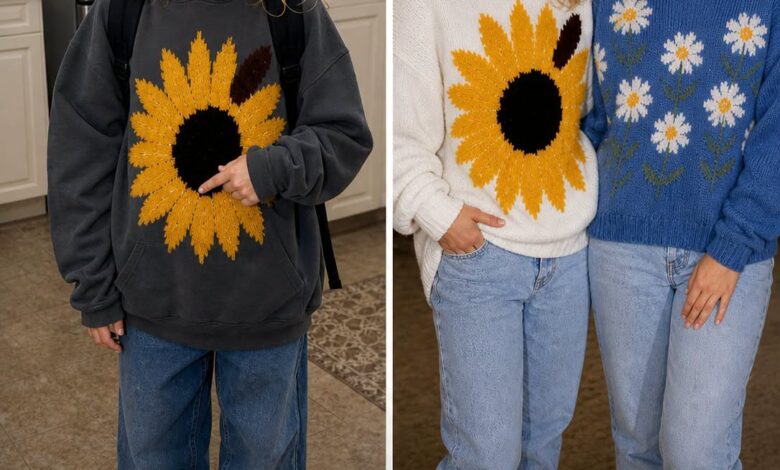
One afternoon, my granddaughter was sitting at the kitchen table drawing flowers.
She loves sunflowers.
Always has.
She made huge yellow circles surrounded by uneven petals, each one leaning in a different direction.
I sat beside her with Laura’s old sweater folded across my lap.
She pointed toward one flower.
“This one’s messed up.”
I looked.
One petal was brown.
The others were bright yellow.
“Why?”
“I colored the wrong one.”
She reached for the eraser.
I stopped her.
“Leave it.”
She frowned.
“But it doesn’t match.”
“I know.”
She studied the flower.
Then shrugged.
“Okay.”
A few minutes later, she added another brown petal to a different sunflower.
I smiled.
“What happened there?”
“That one wanted one too.”
Children can turn accidents into design much faster than adults.
I looked down at the sweater.
For so long, I had believed the past needed correcting before I could feel whole.
Laura needed to return.
My father needed to apologize perfectly.
Someone needed to give me back the years.
None of that was possible.
The brown petal would always be there.
The mistake.
The absence.
The unanswered question.
But it did not ruin the whole flower.
That sounds simple when you say it.
Living it is harder.
Some days, I still wake up wondering whether Laura remembers my birthday.
Sometimes I imagine her standing outside a house somewhere, wondering whether she has waited too long.
Sometimes I am angry with her.
Sometimes with my father.
Sometimes with myself for still caring.
Grief does not become neat just because you finally understand where it came from.
But now it has edges.
A shape.
Something I can hold without letting it swallow everything else.
My father and I never completely repaired what his confession broke.
Maybe confession is the wrong word.
It revealed a crack that had always been there.
But at least we stopped pretending.
He apologized.
Not once.
Many times.
Eventually, I stopped asking him to explain the same decision differently.
There was no version in which refusing Laura’s return became wise.
He was afraid.
He was angry.
He thought control would protect me.
It didn’t.
That became his burden to carry.
Mine was learning not to carry it for him.
Laura’s sweater remains folded in the drawer beside my bed.
I do not sleep holding it.
I do not take it out every week.
Sometimes months pass before I touch it.
But I keep it.
Not as a shrine.
As proof.
She existed.
We existed.
Something happened between us that was real, even if most of the story vanished before I was old enough to understand it.
And if she ever knocks on my door, I do not know what I will do.
Maybe I will open it immediately.
Maybe I will need a minute.
Maybe we will cry.
Maybe we will sit at the kitchen table and discover that love does not automatically bridge thirty years.
Maybe she will never come.
For the first time, I can live with not knowing.
Because my life is here too.
My granddaughter drawing crooked flowers.
Coffee cooling beside me.
A sweater folded in a drawer.
A father growing older with regret he cannot undo.
And me, finally understanding that the past does not need to disappear for the future to exist.
That afternoon, my granddaughter held up the drawing.
The sunflower with one brown petal was right in the middle.
“It’s my favorite now,” she said.
“Why?”
She smiled.
“Because it looks real.”
I stared at it for a moment.
Then I understood.
Maybe that was all I had been trying to learn.
A life does not become ruined because one part of it grew wrong.
A family does not become imaginary because people failed each other.
Love can exist beside abandonment.
Hope beside grief.
Anger beside compassion.
The brown petal stays.
So do the yellow ones.
I still hope Laura knocks someday.
But my hand is no longer frozen on the doorknob waiting for her.
I am already inside.
Living.
And that is enough.