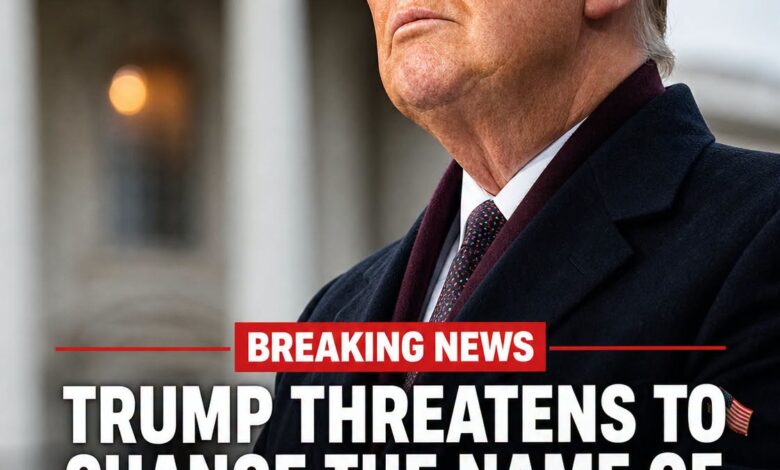
It sounds almost ridiculous at first.
A fight over the name of a lake.
Two neighboring countries with one of the world’s deepest economic relationships, millions of citizens crossing their shared border, generations of military cooperation, cultural exchange, family ties, and hundreds of billions of dollars moving between them—and suddenly people are arguing about what to call a body of water.
But that is precisely why the dispute matters.
Because the lake isn’t really the argument.
It’s the symbol.
Behind the rhetoric is something far more consequential: a relationship between the United States and Canada being tested by tariffs, retaliation, nationalism, political theater, and the increasingly uncomfortable question of whether two countries that spent decades describing themselves as friends still view each other that way.
President Donald Trump’s latest Truth Social intervention poured fuel onto an atmosphere already saturated with tension.
Coming amid a severe trade confrontation, his language transformed geography into another front in a political battle that had already moved far beyond spreadsheets and customs declarations.
Tariffs are supposed to be economic instruments.
A government taxes imported products.
Domestic prices shift.
Businesses adjust.
Negotiations follow.
At least that’s the sterile textbook version.
In reality, tariffs don’t land on charts.
They land on people.
They reach the Canadian producer wondering whether American customers will disappear.
They reach the U.S. retailer calculating whether prices need to rise.
They reach factories dependent on components that cross the border repeatedly before becoming finished products.
They reach truck drivers, farmers, restaurant owners, construction companies, manufacturers, families, and consumers who may never follow trade policy closely enough to understand why something suddenly costs more.
And once tariffs become wrapped in national pride, the economics become even harder to separate from emotion.
Products that once seemed politically meaningless can suddenly become symbols.
Wine.
Honey.
Hockey equipment.
Lumber.
Steel.
Automobile parts.
Food.
A bottle on a supermarket shelf stops being merely a bottle.
Now shoppers are encouraged to notice where it came from.
Retailers reconsider suppliers.
Politicians talk about buying domestic.
Consumers begin treating purchasing decisions as miniature acts of patriotism.
That is how a trade disagreement starts becoming something culturally deeper.
And Canada is not just another trading partner for the United States.
The two countries have spent generations building an unusually integrated relationship.
Their border stretches thousands of miles.
Communities on opposite sides depend on one another.
Supply chains don’t stop politely at customs checkpoints.
A product assembled in one country may contain materials, components, labor, and transportation services originating in the other.
The automotive sector illustrates the complexity particularly well.
Modern North American manufacturing wasn’t designed around the assumption that Canada and the United States would behave like distant economic rivals.
It developed around integration.
Parts move.
Materials move.
Workers and expertise move.
Businesses make long-term investments based partly on the expectation that the relationship will remain reasonably predictable.
That word—predictable—may be more important than it sounds.
Businesses can adapt to many unpleasant conditions if they know the rules.
What they struggle with is uncertainty.
Will another tariff arrive next month?
Will retaliation follow?
Will an exemption disappear?
Should a company expand a Canadian factory or relocate production?
Should an American importer sign a five-year contract with a Canadian supplier?
Should investors assume today’s rules will survive until next year?
Every escalation adds another layer of hesitation.
And hesitation has an economic cost of its own.
But something else is happening underneath the financial calculations.
Canadians are hearing the rhetoric.
That’s where Prime Minister Mark Carney’s language becomes important.
When a national leader describes the country as being attacked, the vocabulary has crossed an emotional threshold.
Trade disagreements between allies normally arrive wrapped in phrases such as “dispute,” “negotiation,” “market access,” or “commercial disagreement.”
The language of attack and war belongs somewhere else.
It suggests that the conflict is no longer being experienced merely as policy.
It is being experienced as disrespect.
That distinction matters enormously.
Countries, like people, remember humiliation differently from disagreement.
You can negotiate a tariff percentage.
You can revise an import quota.
You can sign another agreement.
Repairing damaged trust is much harder.
For decades, Canadians could disagree intensely with American governments while still assuming that the underlying partnership was secure.
Presidents changed.
Prime ministers changed.
Political parties rotated through power.
There were disputes over lumber, dairy, energy, defense spending, environmental policy, and countless other issues.
Yet beneath those disagreements sat a relatively durable assumption:
Whatever happens, we’re neighbors and allies.
The current confrontation puts pressure on that assumption.
And once people begin questioning the assumption itself, political consequences can last far longer than the original tariff.
Canada’s promise of retaliation therefore isn’t simply economic arithmetic.
“Dollar for dollar” sounds mathematical.
Politically, it means something much more emotional:
If you hit us, we will hit back.
That message is intended for Washington.
But it is also intended for Canadians.
A government facing pressure from a much larger neighbor cannot easily appear passive.
The economic imbalance between the countries makes this particularly important.
The United States has a population and economy vastly larger than Canada’s.
In a prolonged trade confrontation, that difference matters.
Washington possesses enormous leverage.
Ottawa knows it.
Canadian voters know it.
American negotiators know it.
That makes visible resistance politically necessary for any Canadian government that wants to demonstrate sovereignty.
Even when retaliation imposes costs at home.
That’s the cruel logic of trade wars.
Retaliatory tariffs can hurt the country imposing them too.
Governments know this.
They impose them anyway because refusing to respond can carry a different cost: appearing weak.
So each government searches for products that maximize political pressure while minimizing domestic pain.
The objective isn’t necessarily random punishment.
It is leverage.
Target products associated with politically important regions.
Make influential businesses uncomfortable.
Create pressure that travels from factories and farms toward elected officials.
Force the other government back to the negotiating table.
Except the other government understands exactly what you’re doing.
So it retaliates again.
Then comes another response.
Soon both sides are climbing a staircase neither originally intended to reach the top of.
This is where seemingly trivial symbolic disputes become dangerous.
A lake name.
A slogan.
A social media post.
A joke about sovereignty.
Individually, these things may appear unserious compared with billions of dollars in trade.
Collectively, they shape how citizens interpret the conflict.
And citizens don’t experience international relations through economic models.
They experience them through stories.
Who insulted us?
Who threatened us?
Who stood up for us?
Who backed down?
Who treated us like an equal?
Who treated us like a subordinate?
Once those stories harden, compromise becomes politically expensive.
Imagine two negotiators eventually reaching a perfectly reasonable agreement.
Tariffs decrease.
Market access improves.
Both governments claim victory.
Economically, the dispute may be finished.
Emotionally, it may not be.
Canadian businesses may begin asking whether dependence on the U.S. market is too dangerous.
Politicians may push harder for trade diversification.
Consumers who deliberately stopped buying American products may not immediately return to them.
Companies may redesign supply chains.
Investors may factor political volatility into decisions that once seemed routine.
None of that appears in the dramatic headline announcing that a tariff has been lifted.
But that’s how relationships change.
Slowly.
Then structurally.
The United States faces risks too.
Canada isn’t merely a customer.
It is a supplier of resources, energy, manufactured goods, agricultural products, and industrial inputs used throughout the American economy.
Making cross-border commerce more expensive doesn’t create a neat wall separating Canadian pain from American prosperity.
Integrated economies don’t work that way.
Costs travel.
A tariff imposed at the border may eventually appear in the price of a finished product hundreds of miles away.
Businesses absorb some costs.
Consumers absorb others.
Suppliers negotiate.
Production moves.
Investment decisions change.
The economic consequences spread outward like ripples.
Which brings us back to the lake.
Why should anyone care what politicians call it?
Because geography is unusually powerful political territory.
Borders, mountains, rivers, oceans, and lakes become embedded in national identity precisely because they appear permanent.
Governments come and go.
The landscape remains.
When political leaders begin using geographic names as tools of confrontation, they’re operating on a symbolic level deeper than normal policy disagreement.
They’re saying:
This is ours.
The other side hears:
You don’t matter.
And suddenly a word on a map carries the emotional weight of an insult.
That doesn’t mean every provocative statement creates a diplomatic catastrophe.
Political leaders exaggerate.
They troll opponents.
They perform for domestic audiences.
Social media rewards precisely the kind of language traditional diplomacy was designed to suppress.
The problem is that governments must still operate after the post goes viral.
Diplomats still have to meet.
Businesses still need rules.
Border officials still have to cooperate.
Military officers still share security responsibilities.
Provincial leaders still deal with governors.
Families still cross the border.
Tourists still travel.
The machinery of the relationship continues functioning beneath the spectacle.
The danger arises when spectacle begins damaging the machinery.
And that is the larger question hanging over the U.S.-Canada relationship.
Not whether one side can economically hurt the other.
Both can.
The United States can inflict far greater pressure because of its size.
Canada can retaliate strategically and impose meaningful political and economic costs.
Everybody can demonstrate toughness.
That’s easy.
The harder question is what happens afterward.
Suppose tariffs eventually disappear.
Suppose negotiators produce a new deal.
Suppose the social media posts stop.
What remains?
Does Canada still assume Washington is its most dependable economic partner?
Do American businesses still assume the northern border represents one of the world’s safest places to build integrated supply chains?
Do Canadians still instinctively think of Americans as cousins rather than competitors?
Does Washington still treat Ottawa as a partner whose dignity matters?
Those questions cannot be answered by customs officials.
They’re questions of trust.
And trust has a peculiar economic property:
It is enormously valuable while being almost impossible to price.
For decades, businesses on both sides benefited from the assumption that the relationship would remain fundamentally stable.
That assumption reduced risk.
It encouraged investment.
It made long-term planning easier.
It allowed integration to deepen.
If that confidence weakens, even temporarily, companies start purchasing insurance against political uncertainty.
They diversify suppliers.
Build redundancy.
Hold additional inventory.
Move production.
Delay investment.
Every precaution costs money.
In that sense, distrust itself becomes a tariff.
One that no president or prime minister can remove with a signature.
Perhaps that is why the rhetoric surrounding this confrontation feels more significant than another routine trade dispute.
The argument is no longer merely about what crosses the border.
It is about what the border means.
Canada is insisting that partnership cannot mean submission.
Trump’s political approach emphasizes leverage and the willingness to use America’s economic strength aggressively.
Those positions were always likely to collide.
Now they have.
And both countries are discovering that economic integration does not automatically guarantee political affection.
Sometimes it makes conflict more painful because there is so much to lose.
The irony is that geography ensures neither country can truly escape the other.
Presidents will change.
Prime ministers will change.
Tariffs will rise and fall.
Trade agreements will be rewritten.
Political movements will come and go.
Canada will still wake up beside the United States every morning.
The United States will still have Canada stretching across its northern frontier.
They don’t get to choose different neighbors.
That reality has historically encouraged cooperation.
It still might.
But cooperation requires more than mutual economic need.
It requires enough respect that disagreement doesn’t become humiliation.
Enough restraint that leverage doesn’t become permanent resentment.
Enough memory to understand that today’s political victory can become tomorrow’s diplomatic liability.
A lake can be renamed in an instant.
A tariff can be announced with a post.
A retaliatory measure can be approved by a government.
Those are easy acts of power.
The difficult work comes later.
Rebuilding confidence.
Convincing businesses the rules are stable again.
Convincing citizens the other country isn’t an enemy.
Restoring the casual assumption that cooperation is normal rather than temporary.
That may ultimately be the most important consequence of this confrontation.
Years from now, few people may remember the exact tariff percentage attached to wine, honey, steel, or hockey equipment.
They may not remember every threat.
They may even forget the argument over the lake.
But countries remember moments when relationships changed.
And if this becomes one of those moments, historians may conclude that the greatest damage was never measured at the border.
It was measured in something much harder to replace:
The moment two neighbors stopped automatically believing they were on the same side.