The wildfire had already consumed everything in its path.
Towering walls of flame raced across the dry hillsides of California’s San Gabriel foothills, turning forests into blackened landscapes of smoke, ash, and twisted metal. The sky glowed an unsettling orange as helicopters circled overhead, firefighters battled impossible conditions, and emergency crews searched desperately for anyone—or anything—that might still need help.
For first responders, scenes like this demanded complete focus.
Every minute mattered.
Every decision could mean the difference between life and death.
Officer Daniel Ruiz had spent hours helping evacuate neighborhoods threatened by the rapidly advancing fire. Thick smoke reduced visibility to only a few yards, while the constant roar of wind and crackling timber drowned out almost every other sound.
Then he heard something unexpected.
It wasn’t loud.
In fact, it was so faint he almost dismissed it as the wind shifting through burned trees.
But something about the sound didn’t fit.
He stopped walking.
The noise came again.
Soft.
Low.
Almost like a quiet cry buried beneath the chaos surrounding him.
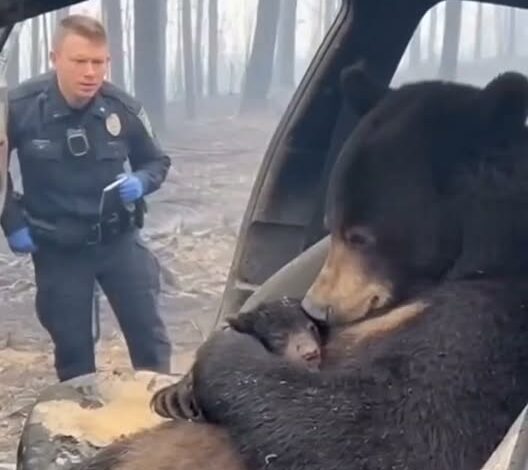
Following the sound through scorched brush and scattered debris, Ruiz eventually reached the remains of a burned-out vehicle sitting partially hidden near the edge of the road.
At first, he prepared himself for the possibility of finding another human victim.
Instead, he froze.
Curled beside the wreckage was a mother bear.
Her fur was badly singed.
Patches of burned skin showed where the fire had reached her.
She was exhausted, breathing heavily, yet she made no attempt to flee.
Carefully nestled between her front legs was a tiny cub.
The little bear wasn’t moving.
The mother wasn’t protecting food.
She wasn’t defending territory.
She wasn’t behaving aggressively.
She was simply holding her baby.
The sight left everyone speechless.
Despite her injuries, she had remained beside her cub through the fire, refusing to abandon him even after the danger had passed. She looked toward the approaching rescuers only briefly before lowering her head once again toward the small body she continued to cradle.
There was no growling.
No charge.
Only quiet grief.
Even experienced wildlife rescuers later admitted they had rarely witnessed anything so heartbreaking.
Animal behavior experts often explain that many mammals form powerful emotional bonds with their offspring. While each species responds differently to loss, observations over the years have shown that mothers may remain close to deceased young for extended periods, displaying behaviors that suggest confusion, protection, or mourning.
Watching the injured bear refuse to leave her cub, those scientific descriptions suddenly felt deeply personal.
The rescue quickly became incredibly delicate.
Everyone understood that forcing the mother away too quickly could increase her stress or provoke defensive behavior. Wildlife specialists approached slowly, speaking softly while preparing equipment that would allow them to help without causing additional fear.
For hours they waited patiently.
No one wanted to rush the moment.
The bear remained where she was, her eyes rarely leaving the tiny cub resting against her chest.
Eventually, after veterinarians carefully assessed the situation, rescuers were able to gently encourage the exhausted mother to move toward a transport enclosure where treatment could begin.
Even then, she hesitated.
Several times she looked back.
Her attention never drifted far from the cub she had refused to leave.
As rescuers carefully wrapped the tiny body, witnesses described an overwhelming silence settling across the burned landscape.
Nobody hurried.
Nobody spoke unnecessarily.
The moment carried a kind of respect that required no words.
Photographs taken during the rescue soon spread around the world.
Millions of people stopped scrolling when they saw the image.
An injured mother bear.
A lifeless cub.
A landscape reduced to ash.
The photograph quickly became more than documentation of a wildfire.
For many viewers, it symbolized something universal.
Love.
Loss.
The instinct to protect those we cherish, even when there is nothing left to protect.
Comments poured in from every corner of the world.
Some admitted the image brought them to tears.
Others reflected on the devastating impact wildfires have not only on people but also on countless animals whose stories are rarely seen.
Conservation groups used the rescue to highlight the enormous challenges wildlife faces during increasingly destructive fire seasons. While evacuation efforts often focus understandably on human communities, forests are home to countless creatures with no warning systems, no vehicles, and nowhere safe to escape as flames rapidly spread across their habitats.
Many survive.
Many do not.
Those that do often face weeks or months of recovery while searching for food, shelter, and familiar territory that may no longer exist.
The injured mother bear was transported to a wildlife rehabilitation facility where veterinarians treated burns, dehydration, and exhaustion. Recovery would require time, careful monitoring, and a quiet environment far removed from the devastation she had endured.
Staff members described her as remarkably calm despite everything she had experienced.
They knew emotional healing, if such a thing could be measured in animals, would remain impossible to fully understand.
The cub, meanwhile, was laid to rest beneath one of the few pine trees that had survived the fire.
Rescuers placed a simple marker nearby.
“Forever Safe.”
It wasn’t an official memorial.
Just a quiet gesture from people who had witnessed something they would never forget.
The wildfire eventually came under control.
News crews moved on to other stories.
The smoke gradually cleared from the mountains.
But the image of the mother bear remained.
Not because it showed destruction.
Because it revealed something stronger.
Even surrounded by devastation, she chose to stay beside the one life she loved most.
Her story reminds us that the cost of natural disasters extends far beyond burned homes and damaged landscapes. Every wildfire leaves behind countless untold stories involving animals struggling to survive in habitats transformed almost overnight.
Some endings cannot be changed.
Some losses cannot be undone.
Yet compassion still matters.
Patience still matters.
The willingness to stop, to notice, and to care still matters.
Long after the flames disappeared, one quiet image continued speaking without a single word.
An exhausted mother.
A tiny cub.
And a love powerful enough to endure even after the fire had taken everything else.