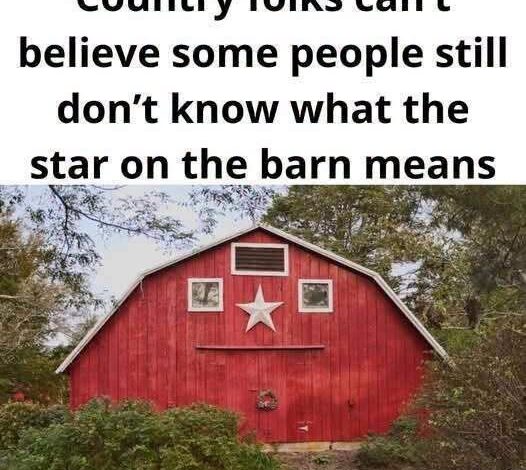
Long before barn stars became a familiar feature in country home décor or decorative accents in suburban neighborhoods, they carried a far deeper meaning. Mounted high on weathered barns throughout rural Pennsylvania and neighboring regions, these striking symbols reflected the hopes, fears, and traditions of families whose livelihoods depended almost entirely on the land.
For those early farmers, life offered very few guarantees.
A season of relentless rain could destroy an entire harvest. A harsh winter could claim livestock that represented years of hard work. Illness, drought, fire, or financial hardship could arrive without warning, threatening not only a family’s income but its survival. In a world shaped by uncertainty, people naturally searched for ways to express hope and find comfort.
The barn star became one of those enduring symbols.
Often associated with the Pennsylvania Dutch—a cultural group descended largely from German-speaking immigrants who settled in Pennsylvania during the eighteenth century—these stars gradually became part of the rural landscape. While many people today view them simply as decorative ornaments, generations of homeowners and farmers attached personal and cultural significance to the designs they displayed.
Some believed the stars represented protection.
Others saw them as expressions of faith, prosperity, or gratitude.
Whether rooted in family tradition, local folklore, or simple appreciation for their beauty, the stars became lasting reminders of the values that shaped rural communities.
Over time, different colors also came to carry symbolic meanings, although interpretations have varied from family to family and community to community.
A red star was often associated with strength, courage, or heartfelt devotion—qualities every farming family needed during difficult seasons.
Blue commonly represented peace, calm, or spiritual comfort, reflecting the hope that harmony would remain within the home despite the challenges beyond its walls.
Green frequently symbolized growth, fertile fields, and the promise of abundant harvests, making it an especially fitting choice for families whose futures depended on successful crops.
Other colors developed meanings as well, each reflecting values that mattered deeply to the people who displayed them.
Regardless of the exact interpretation, the message was rarely about decoration alone.
Each carefully painted star reflected optimism.
It acknowledged uncertainty while expressing confidence that better days would come.
Placed prominently against the side of a barn, the symbol quietly announced something about the people who lived there. It suggested that this was more than a building filled with tools, animals, or harvested grain. It was the center of a family’s life—a place where generations worked together, weathered hardships, and celebrated the rewards that followed perseverance.
The barn itself became a kind of family record.
Every repaired beam.
Every weathered board.
Every carefully hung star.
Together they told a story of endurance that often stretched across decades.
As rural life evolved and modern agriculture transformed the countryside, the practical concerns that once shaped daily existence gradually changed. Advances in farming, transportation, and technology reduced many of the uncertainties earlier generations had faced.
Yet the stars remained.
Their purpose slowly shifted.
Instead of serving primarily as symbols of hope during uncertain times, they became reminders of heritage, craftsmanship, and family history. Many people continued displaying them not because they expected protection from misfortune, but because the stars connected them to parents, grandparents, and communities whose values deserved remembering.
Today, barn stars appear in places far removed from their earliest homes.
They decorate front porches, garages, garden sheds, fences, and living rooms across the country. Some people choose them simply because they appreciate the timeless design. Others display them as a tribute to their ancestry or their love of rural traditions.
Whatever the reason, the symbol continues to resonate.
Perhaps its lasting appeal comes from the emotions it represents rather than any single historical interpretation.
Hope.
Resilience.
Belonging.
Pride in honest work.
A connection to the place one calls home.
Those values remain meaningful regardless of changing times.
When you notice a barn star today, you’re seeing more than a decorative accent attached to wood, brick, or siding. You’re looking at a tradition that has endured through generations, quietly preserving memories of people who built lives through determination, faith, and perseverance.
It stands as a reminder that homes are shaped by more than walls and roofs.
They are built through countless ordinary acts of care.
Early mornings in the fields.
Long evenings spent repairing what winter damaged.
Meals shared around crowded tables.
Children growing into adults beneath the same familiar roof.
The barn star has come to represent all of those stories.
Not because it possesses any magical power, but because symbols have always helped people express what words sometimes cannot.
In the end, the true meaning of the barn star lies not in superstition or legend, but in the enduring human desire to leave behind something that says, “This place mattered.”
It speaks of families who worked with their hands, endured seasons of hardship, celebrated seasons of abundance, and loved the land that sustained them.
And perhaps that is why these simple stars continue to capture our attention today.
They remind us that while homes may change, generations may pass, and traditions may evolve, the longing to belong somewhere—to build, to hope, and to leave a meaningful mark—remains as constant as the stars themselves.