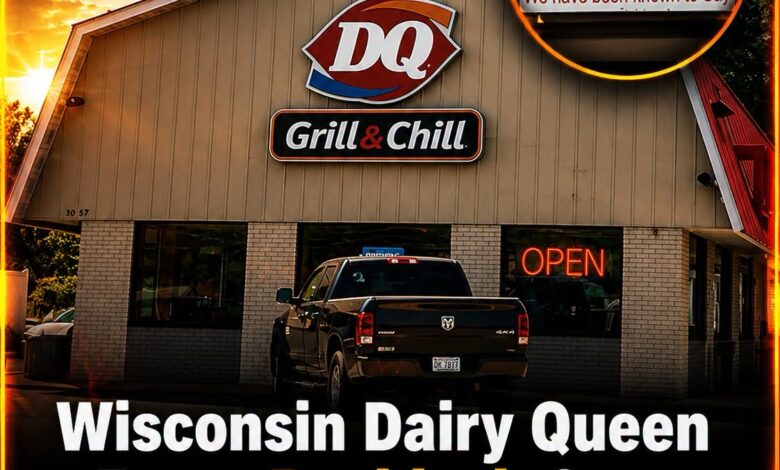
A simple handwritten sign taped inside the window of a Dairy Queen in Kewaskum, Wisconsin, became the center of a national debate—not because of its size, but because of what it openly declared. The message left little room for misunderstanding. It described the restaurant as “politically incorrect,” stating that employees would continue saying “Merry Christmas,” “Happy Easter,” “In God We Trust,” and “God Bless America.” It also expressed support for displaying the American flag and honoring military veterans, including offering free sundaes to veterans on Veterans Day.
For owner Kevin Scheunemann, the sign was not intended to provoke controversy. He said it was a straightforward explanation of the values his family-run business had embraced for years. According to Scheunemann, the decision to post it came after a customer complained about Christian music playing inside the restaurant. Rather than changing the atmosphere of the business, he chose to make his position clear from the outset so customers would know what to expect before walking through the door.
For quite some time, the sign attracted little attention beyond the local community.
Regular customers continued ordering ice cream, families gathered after Little League games, and residents treated the message as simply another reflection of a small-town business owner expressing his personal beliefs.
That changed when a visitor from outside the area photographed the sign and shared it on Facebook.
The post criticized the message as exclusionary and questioned whether it reflected values that welcomed every customer equally. What began as one person’s observation quickly spread across social media, where thousands of people who had never visited the restaurant formed opinions based solely on the image and its wording.
Within days, the discussion had grown into a national argument.
Critics viewed the sign as unnecessarily divisive, arguing that businesses should strive to make every customer feel included regardless of background or belief. Some believed the language suggested certain visitors might feel less welcome than others, while others questioned whether political or religious statements belonged in a restaurant at all.
Supporters reached the opposite conclusion.
Many defended Scheunemann’s right to express his personal values on his own property, arguing that transparency was preferable to hiding those beliefs. They emphasized that customers always retained the freedom to decide where to spend their money and that choosing another restaurant remained an available option for anyone uncomfortable with the message.
As emotions intensified online, the conversation moved well beyond the original sign.
Social media users on both sides exchanged increasingly harsh comments. Personal attacks soon replaced thoughtful discussion, and the individual who had first shared the photograph eventually removed the post after receiving significant backlash.
Meanwhile, the response inside Kewaskum looked very different from the one unfolding across the internet.
Many local residents rallied around the restaurant, viewing the controversy as outsiders criticizing a business they had supported for years. Customers continued visiting, some specifically choosing to stop by as a gesture of support. For many in the community, the issue was less about the wording on the sign than about defending a longtime local business against criticism from people unfamiliar with its history.
The situation also drew attention from Dairy Queen’s corporate office.
Because individual Dairy Queen locations operate under franchise agreements, local owners have considerable independence in managing their businesses. Even so, the company released a statement distancing itself from the sign, emphasizing that Dairy Queen strives to treat every customer with dignity and respect and that the views expressed by individual franchise owners do not necessarily represent those of the corporation.
That response highlighted a broader reality facing many national franchise systems.
While a company may operate under one recognizable brand, hundreds or even thousands of independently owned locations can reflect the personalities, traditions, and values of the communities they serve. At times, those local identities align comfortably with corporate messaging. At other times, differences become highly visible, especially when local decisions attract widespread public attention.
The controversy surrounding the Kewaskum Dairy Queen ultimately became about more than a handwritten notice taped to a window.
It reflected larger cultural conversations taking place across the United States about freedom of expression, religious identity, patriotism, inclusion, and the role businesses play in expressing personal values. Supporters and critics often viewed the same sign through entirely different lenses, each believing they were defending important principles.
For some, the sign represented honesty and the right of a small-business owner to be open about his beliefs.
For others, it illustrated how public messages displayed by businesses can influence whether potential customers feel welcomed or excluded.
Reasonable people reached different conclusions.
Years after it first appeared, the sign remains an example of how a local decision can become a national conversation almost overnight. In an era shaped by smartphones and social media, a photograph taken by a single visitor can spread far beyond the town where it was captured, inviting millions of people into a debate that once might have remained local.
Whether viewed as a statement of principle or a source of controversy, the sign demonstrates how quickly everyday moments can become symbols in broader cultural discussions. It also illustrates the growing tension between the distinct identities of small-town businesses and the broader expectations often associated with national brands—a conversation that continues well beyond the walls of one Wisconsin ice cream shop.