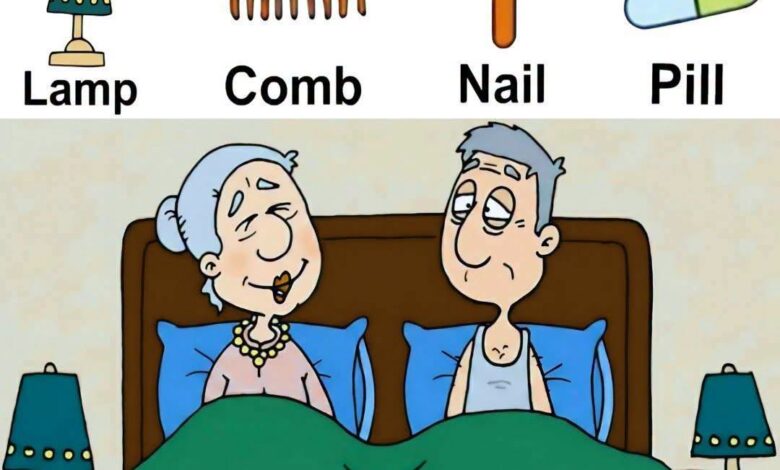
At first glance, the picture seems almost too simple to be challenging. An elderly woman rests in bed, the room feels familiar and peaceful, and your brain instantly recognizes the scene. Within a second, you’ve already labeled everything important: bed, pillows, bedside tables, lamps, people, bedroom. Satisfied that it understands the image, your mind begins filling in the rest without truly looking.
That’s exactly why the puzzle is so effective.
Hidden-object challenges don’t fool your eyes nearly as much as they fool your brain.
Once your mind believes it has identified the scene, it shifts into autopilot. Instead of carefully examining every corner, it starts making assumptions. Small details blend into larger objects, unusual shapes become part of the background, and cleverly hidden items disappear in plain sight.
The bedside lamps are usually the first objects people find.
They’re placed where you naturally expect them to be, making them easy to recognize. After another careful look, many people eventually notice the comb resting near the foot of the bed. A little more patience often reveals the nail, subtly worked into the furniture or another part of the room where it doesn’t immediately draw attention.
Then there’s the object that frustrates almost everyone.
The tiny pill.
Unlike the other hidden items, it isn’t tucked behind furniture or disguised by shadows. Instead, it’s hidden in a place your brain almost never thinks to inspect.
It’s inside the elderly woman’s mouth.
Because it’s so small and blends perfectly with the natural colors and shapes of her face, your brain automatically assumes it’s simply part of her tongue or mouth. Without realizing it, your mind accepts the illusion and immediately moves on, convinced there’s nothing unusual to see.
Only after someone points it out—or after an especially slow, careful search—does it suddenly become impossible to miss.
And that’s when the entire picture changes.
The cozy bedroom no longer feels quite so straightforward.
You begin wondering what other details escaped your attention.
How many times did your eyes pass directly over the pill without actually seeing it?
That moment of realization is what makes hidden-object puzzles so satisfying.
They aren’t simply exercises in eyesight.
They’re demonstrations of how human perception really works.
Our brains are incredibly efficient. Every day they process enormous amounts of visual information by focusing on what seems most important and filtering out everything else. That efficiency helps us navigate the world quickly, but it also means we sometimes overlook details hiding in plain sight.
The best puzzle solvers learn to work against that instinct.
Instead of scanning the entire picture at once, they divide it into smaller sections.
They examine one area before moving to the next.
They pay attention to shapes, colors, and outlines that seem slightly out of place.
Rather than asking, “What should be here?” they begin asking, “What doesn’t quite belong?”
That small shift in perspective often makes all the difference.
Interestingly, the same approach can be valuable outside of puzzles.
In everyday life, we frequently make quick judgments based on first impressions. We assume we understand situations before noticing important details, overlook small clues because we’re focused on the bigger picture, or miss opportunities simply because our attention has already moved elsewhere.
Hidden-object puzzles gently remind us to slow down.
To look again.
To question our assumptions.
To notice what everyone else walks past.
Every object you finally discover isn’t just another point scored in a game.
It’s proof that careful observation can reveal things that rushed thinking cannot.
So the next time a puzzle seems impossible, resist the urge to search faster.
Search differently.
Slow your eyes.
Study each section.
Let your brain stop guessing and start observing.
Because sometimes the most important detail isn’t hidden by darkness or distance.
It’s hidden by the simple belief that you’ve already seen everything there is to see.
And every time you uncover what was invisible just moments before, you’re doing more than solving a picture puzzle.
You’re strengthening one of the most valuable skills you can develop—the quiet habit of truly paying attention, both in the images you examine and in the world around you.