Hello, everyone!
Are you ready to put your eyes—and your brain—to the test?
Because the challenge you’re about to see looks ridiculously simple.
At first.
There’s no complicated math.
No trivia question.
No secret knowledge required.
All you need to do is look at a picture.
Sounds easy, right?
That’s exactly what makes this challenge so interesting.
In a moment, imagine a perfectly ordinary image appearing in front of you.
Nothing immediately seems unusual.
Your brain recognizes the objects almost instantly and begins telling you what you’re looking at before you’ve consciously examined every detail.
But somewhere inside that picture, something doesn’t belong.
One tiny detail is wrong.
And your challenge is to find it.
Here’s the catch:
Don’t trust your first glance.
Most people look at an image and believe they’re seeing everything in it.
They’re not.
The human brain is incredibly efficient. Instead of carefully analyzing every object, shadow, color, and shape, it often uses familiar patterns to predict what should be there.
Usually, that’s extremely useful.
Right now, you probably aren’t consciously examining every letter in every word you’re reading. Your brain recognizes familiar patterns and moves forward automatically.
Visual puzzles take advantage of that same shortcut.
They place something unusual exactly where your brain expects something ordinary.
And because your mind thinks it already understands the scene, the mistake can remain practically invisible.
So here’s your challenge.
Take a moment.
Relax your eyes.
Look at the entire picture first.
Don’t immediately start searching frantically.
What does the scene appear to show?
What objects are present?
What feels completely normal?
Now look again.
Slower this time.
Start in the upper-left corner and carefully move your eyes across the image.
Check the background.
Look at the objects people normally ignore.
Examine shapes.
Numbers.
Letters.
Reflections.
Shadows.
Patterns.
Edges.
Anything repeated deserves extra attention.
Still haven’t found it?
Good.
That’s when the puzzle becomes interesting.
Your brain may already have decided what the image contains, which means you’re no longer examining what’s actually there.
You’re examining what you expect to be there.
Try another strategy.
Instead of looking at the entire image, divide it mentally into four sections.
Inspect each section separately.
Top left.
Top right.
Bottom left.
Bottom right.
Ask yourself one simple question:
What doesn’t belong?
Don’t search only for something dramatic.
The mistake might be incredibly small.
A missing object.
A reversed letter.
An impossible shadow.
A number in the wrong sequence.
An object facing the wrong direction.
A tiny difference in a repeated pattern.
Sometimes the hardest visual puzzles hide their secrets in plain sight.
That’s why two people can stare at exactly the same picture and have completely different experiences.
One person notices the answer immediately.
Another searches for several minutes.
Neither person necessarily has better eyesight.
The difference is often attention.
Once your brain recognizes a familiar scene, it begins filtering information according to what seems important.
That’s useful in everyday life because consciously processing every tiny detail around us would be exhausting.
But it also means obvious things can occasionally become invisible.
Ready for another clue?
Look at the places you dismissed first.
That ordinary corner.
That familiar object.
That repeated sequence you assumed was correct.
Puzzle designers know that people naturally focus on unusual-looking areas.
So sometimes the smartest hiding place is the most boring part of the image.
Have you spotted it yet?
If you have, don’t reveal the answer.
Give everyone else a chance.
And if you haven’t, don’t worry.
Take another ten seconds.
Ten…
Nine…
Eight…
Seven…
Six…
Five…
Four…
Three…
Two…
One.
Now look again.
Did something suddenly jump out at you?
That’s the wonderful thing about these puzzles.
Once you finally notice the hidden mistake, it becomes almost impossible not to see it.
You may even wonder:
“How did I miss that?”
Seconds earlier, your brain was practically erasing it from the picture.
Now it feels painfully obvious.
That’s because visual challenges aren’t merely games about eyesight.
They’re games about expectation.
Your eyes collect information.
Your brain interprets it.
And those aren’t always the same thing.
We like to imagine that we experience the world exactly as it exists, but our minds are constantly filling gaps, recognizing patterns, ignoring distractions, and predicting what should come next.
Most of the time, those shortcuts help us navigate life efficiently.
Occasionally, however, they fool us completely.
And that’s what makes a simple picture surprisingly fascinating.
It isn’t only asking:
“Can you find what’s wrong?”
It’s quietly asking something much bigger:
“How carefully are you really looking?”
So if you found the hidden detail immediately, congratulations—your attention was sharp.
If it took longer, that’s completely normal.
And if you still haven’t spotted it?
Look one more time.
But this time, don’t look for what you think should be there.
Look at what’s actually there.
The answer may have been sitting directly in front of you the entire time.

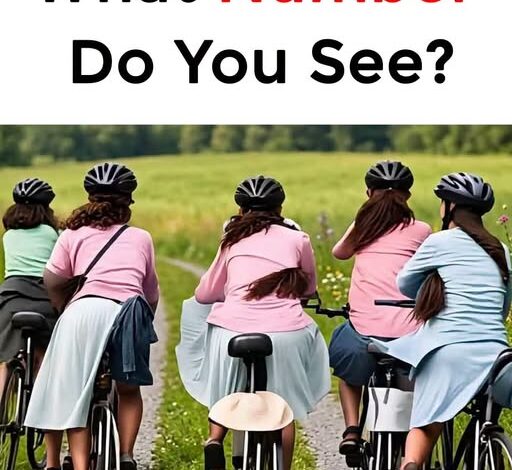
At first glance, there is nothing unusual about the picture.
It simply looks like a group of people enjoying a bike ride.
Cyclists.
Wheels.
Bodies leaning forward.
A busy outdoor scene filled with movement.
But hidden across the image is something completely different.
A number.
And once you see it, the entire picture changes.
The challenge is simple:
Can you find the hidden number without being told where to look?
Most people make the same mistake at first.
They study the cyclists individually.
They inspect the bikes.
They search for tiny shapes in the background.
They look between the wheels.
They scan faces, clothing, shadows, and road markings.
But that approach actually makes the puzzle harder.
The secret is not to look more closely.
It’s to look less clearly.
Try squinting your eyes.
Seriously.
Narrow them until the fine details begin to blur.
Don’t focus on the individual people anymore.
Let the shapes merge together.
As the image becomes softer, your brain stops concentrating on bicycles, arms, legs, and helmets.
Instead, it starts searching for larger patterns.
And that’s when the illusion begins to work.
The individual cyclists start blending into broad areas of light and dark.
Curves connect.
Empty spaces suddenly matter.
Separate objects begin behaving like pieces of one larger design.
Then, if you have the right amount of blur, a number starts appearing across the image.
Not hidden inside one tiny corner.
Across the whole group.
That’s what makes the illusion clever.
The number was visible the entire time.
Your brain simply refused to see it because it was too busy interpreting the picture as a scene full of cyclists.
Squinting changes the information your brain prioritizes.
Fine details disappear.
Large shapes remain.
And those larger shapes reveal the hidden message.
If it doesn’t work immediately, try adjusting your eyes slightly.
Squint a little more.
Then slightly less.
You can also move farther away from the image.
Sometimes increasing the viewing distance has a similar effect because the small details become harder to distinguish.
You may even find that briefly looking away and returning helps.
Then suddenly:
There it is.
Once your brain locks onto the number, it can be surprisingly difficult to understand how you missed it.
That’s one of the most fascinating things about optical illusions.
The picture itself never changes.
Only your perception does.
One moment, you see a group of cyclists.
The next, you see giant numbers stretching across them.
Both interpretations are created from exactly the same visual information.
Our brains do this constantly.
Vision isn’t simply a camera recording everything in front of us.
The brain organizes what the eyes detect.
It groups shapes together.
Separates foreground from background.
Recognizes familiar objects.
Fills gaps.
Makes predictions.
Most of the time, this allows us to understand complicated scenes almost instantly.
You don’t need to consciously analyze every wheel before realizing you’re looking at bicycles.
Your brain does the work automatically.
But optical illusions take advantage of those shortcuts.
They create images where one interpretation dominates until you change how you look.
That’s exactly what’s happening here.
When the image is sharp, the cyclists win.
When the image becomes blurry, the hidden number takes over.
It’s almost like having two pictures occupying the same space.
One appears when you focus.
The other appears when you stop focusing.
And the funny thing is that this challenge has very little to do with intelligence.
Someone can be incredibly clever and still stare at the picture for several minutes without seeing anything.
Another person might notice the number in three seconds.
The difference isn’t necessarily brainpower.
It’s visual strategy.
The moment someone says, “Squint,” the problem changes.
Instead of asking:
What tiny thing am I missing?
You begin asking:
What larger shape are all these pieces creating together?
That shift is everything.
There’s a broader lesson hidden inside these visual puzzles too.
Sometimes looking harder isn’t the solution.
Sometimes you need to change distance.
Change focus.
Change perspective.
Step back.
Let details disappear.
Only then does the larger pattern become visible.
We experience something similar outside optical illusions.
A problem can feel impossibly complicated when we’re trapped inside every tiny detail.
Then we step away.
Sleep on it.
Talk to somebody else.
Return later.
Suddenly, the structure becomes obvious.
Nothing necessarily changed.
We did.
That’s why little visual challenges like this are so satisfying.
They create a miniature version of that experience.
Confusion.
Frustration.
Experimentation.
Then recognition.
That tiny moment when your brain suddenly says:
Oh!
And once you’ve reached that point, you want everyone else to experience it too.
You show someone the image.
“What do you see?”
“People riding bikes.”
“Anything else?”
“No.”
“Squint.”
They narrow their eyes.
Wait.
Then their expression changes.
“I SEE IT!”
That’s half the fun.
So before reading the answer, give yourself one final attempt.
Look at the picture.
Don’t inspect individual cyclists.
Relax your focus.
Squint until the details blur together.
Watch the dark and light shapes merge.
Can you see three large digits?
Take a few seconds.
Don’t guess.
Let the image reveal itself.
Ready?
The hidden number is:
769
Once you see 769, the picture becomes almost impossible to view the same way again.
The seven emerges first.
Then the six.
Then the nine.
What originally looked like random positions and shapes suddenly feels carefully arranged.
And that’s the real trick.
The number wasn’t hidden because it was too small.
It was hidden because your brain was looking at the wrong level of detail.
Sometimes the secret isn’t seeing more.
It’s learning how to see differently.