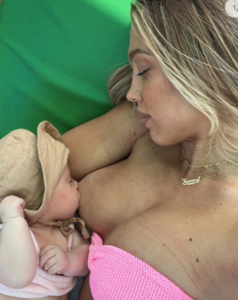
For something so fundamental to human life, breastfeeding can generate an astonishing amount of conversation—especially when a mother decides to show the experience exactly as it is.
A collection of breastfeeding photographs shared online has attracted widespread attention, with viewers responding to the intimacy and honesty of the images. For many parents, the pictures capture something immediately recognizable: those quiet moments when the rest of the world seems to disappear and feeding a hungry baby becomes the only thing that matters.
But behind the beautiful photographs is a much larger story.
Breastfeeding is one of the ways parents can provide nutrition to their babies during the earliest months of life. Breast milk contains a combination of nutrients needed for infant growth and development, along with antibodies and other components that help support a developing immune system.
For that reason, health professionals commonly recommend breastfeeding when it is possible, appropriate, and desired.
The first months of a baby’s life involve extraordinary development. The infant is growing rapidly while its immune and digestive systems continue maturing, making adequate nutrition especially important.
Breast milk naturally changes as a baby grows.
The milk produced immediately after birth, known as colostrum, is different from the milk produced weeks or months later. Although only small amounts may initially be produced, colostrum is particularly concentrated and contains important nutritional and immune-supporting components.
As feeding continues, milk production adapts to meet the baby’s changing needs.
But nutrition tells only part of the story.
For many parents, breastfeeding becomes an intensely emotional experience.
During feeding, a baby is held close to the parent’s body, creating repeated opportunities for skin-to-skin contact, eye contact, touch, and comfort.
Those ordinary interactions can become some of the memories parents treasure most.
A tiny hand resting against the chest.
A sleepy baby drifting off after feeding.
Quiet nighttime nursing sessions when the entire house is asleep.
Moments that may feel exhausting while they are happening can later become memories associated with an incredibly short chapter of childhood.
That emotional intimacy is part of what makes breastfeeding photography so powerful.
A camera can capture details that disappear almost before parents realize they should remember them.
The photographs that attract attention online often aren’t remarkable because something dramatic is happening.
Quite the opposite.
They are powerful because something completely ordinary is happening.
A baby is eating.
A parent is providing nourishment.
Yet placing that ordinary moment in a photograph can suddenly make people examine their own attitudes toward breastfeeding.
Some viewers see tenderness immediately.
Others become uncomfortable.
And that difference in reactions has fueled debates for years, particularly when breastfeeding occurs in public.
A mother nursing her hungry baby in a restaurant, park, airport, shopping center, or other public place may occasionally encounter stares or criticism.
For breastfeeding advocates, that reaction creates a frustrating contradiction.
Society generally agrees that babies need to be fed, yet some people remain uncomfortable when breastfeeding is visible.
Photographs depicting nursing openly can therefore become more than family keepsakes. Whether intended or not, they can contribute to conversations about how society views breastfeeding.
Still, the beautiful side of breastfeeding should never obscure its challenges.
“Natural” does not automatically mean easy.
Some babies struggle to latch effectively.
Some parents experience soreness or pain.
Others worry about milk supply or develop complications that require professional attention.
Frequent nighttime feeding can also be physically exhausting, particularly during the early weeks when parents are already recovering from childbirth and functioning on limited sleep.
Returning to work can introduce additional complications.
Parents who want to continue providing breast milk may need to pump throughout the day, safely store milk, coordinate feeding schedules, and find suitable time and privacy at work.
For some families, breastfeeding simply doesn’t work as planned.
That can be emotionally difficult, especially when parents have been surrounded by messages suggesting there is only one “correct” way to feed a baby.
There isn’t.
Some families exclusively breastfeed.
Others use formula.
Some combine both approaches.
Medical conditions, medications, milk production, adoption, work demands, personal comfort, and countless other circumstances can influence those decisions.
What matters is that babies receive appropriate nutrition and that parents have reliable information and support when making feeding choices.
For those who want to breastfeed but encounter difficulties, support can make an enormous difference.
Doctors, nurses, midwives, lactation consultants, breastfeeding groups, partners, relatives, and experienced parents can provide practical guidance and reassurance.
Sometimes a relatively small adjustment can improve feeding considerably.
Other situations require more extensive assistance.
And sometimes the healthiest decision is recognizing that another feeding method works better for the parent, the baby, or both.
There should be no shame attached to that.
Breastfeeding can also offer health benefits for the person doing it. Research has associated breastfeeding with a reduced risk of certain illnesses, including some cancers, while the hormonal processes involved after childbirth can play a role in postpartum recovery.
Yet every person’s experience is different.
That individuality is precisely why photographs of breastfeeding can resonate so deeply.
For one viewer, an image may bring back memories of peaceful early mornings with a newborn.
For another, it may recall months of pumping and sleepless nights.
Someone else may remember struggling desperately to breastfeed before eventually switching to formula.
The same photograph can represent joy, exhaustion, grief, pride, or relief depending on the person looking at it.
Perhaps that explains why these images generated such intense attention.
They show something deeply personal while simultaneously depicting an experience shared by families around the world.
There is vulnerability in allowing such a private moment to be photographed.
But there is also confidence.
The images don’t need to argue that every mother should breastfeed or that breastfeeding is effortless.
Their power comes from something simpler.
They show a parent feeding a child.
No spectacle.
No shame.
Just care.
And beneath all the online debate, that is what matters most.
Parenthood isn’t defined by producing a perfect photograph or following one universal feeding plan. It is built through thousands of ordinary decisions made with a child’s well-being in mind.
Breastfeeding may be one beautiful part of that journey for many families.
And when photographs capture those fleeting moments honestly, perhaps it isn’t surprising that people stop scrolling long enough to look twice.