A Single Insect Bite Nearly Ended It All The Nightmarish Reality of One Mans Forgotten Chores..

Julián had always believed danger came from outside.
From dark streets.
Unlocked doors.
Strangers standing too close at night.
That was why his apartment mattered so much to him.
After a bitter separation and years of emotional exhaustion, the small third-floor unit had become his refuge. It wasn’t beautiful, but it was his. Every evening, he locked the deadbolt, hung his keys on the same metal hook, reheated something simple for dinner, and let the silence settle around him.
For a while, the routine felt peaceful.
Then loneliness slowly turned peace into neglect.
Nothing dramatic.
A dish left overnight.
A few crumbs on the nightstand.
Laundry piled on a chair.
A bedroom window kept slightly open during humid summer nights because the air-conditioning barely worked.
Julián noticed all of it.
He simply stopped caring enough to deal with it immediately.
“Tomorrow,” he would tell himself.
Tomorrow became next week.
One Tuesday evening, he came home exhausted, ate crackers in bed while watching television, and fell asleep without closing the window.
At 2:13 in the morning, something stung him.
He slapped at his arm without opening his eyes.
Then came another sharp burst of pain.
This one on his shoulder.
Then his chest.
Julián woke fully.
“What the—”
Another sting.
He threw back the blanket.
Something small and furious moved across the sheet.
Then another.
His body went cold.
In the weak light from the streetlamp outside, he saw several insects crawling near the pillow.
He scrambled backward.
One flew toward his face.
Julián swung wildly, knocking over a glass of water.
The room exploded into movement.
A low buzzing rose near the curtain.
That was when he saw where they were coming from.
In the upper corner beside the partially open window, behind the curtain rod, a cluster of paper-thin material clung to the wall.
A nest.
Small enough to miss from the floor.
Large enough to matter.
Julián had apparently disturbed it while sleeping.
Several wasps were now trapped inside the room with him.
He ran toward the door.
Another sting struck the side of his neck.
Then one near his wrist.
Pain burned across his skin.
He reached the hallway and slammed the bedroom door behind him.
For several seconds, he simply stood there gasping.
Then he noticed something worse.
His hands were shaking violently.
His scalp began itching.
His chest felt tight.
Julián had been stung before as a child. It hurt, but nothing like this had happened.
He walked toward the kitchen sink.
Halfway there, dizziness hit him.
The hallway tilted.
He grabbed the wall.
“Come on.”
His lips felt strange.
Thick.
His throat tightened.
He tried swallowing.
It became difficult.
Panic surged through him.
This wasn’t just fear.
Something was happening inside his body.
His immune system was reacting violently.
Julián stumbled toward the living room, searching for his phone.
By the time he found it beneath a newspaper, breathing had become work.
He dialed emergency services.
“Emergency. What is your location?”
He tried answering.
The words came out broken.
“Apartment… third floor… I got stung…”
“How many times?”
“I don’t know.”
“Are you having trouble breathing?”
“Yes.”
The operator’s voice changed immediately.
“Stay on the line. Help is coming.”
Julián slid onto the floor.
His heart raced.
Then somehow it felt weak.
His vision narrowed until the room seemed to exist at the end of a tunnel.
The operator kept talking.
“Unlock the door if you can.”
Julián crawled.
He barely remembered reaching the lock.
The last thing he heard before losing consciousness was someone pounding on the apartment door.
When he woke again, bright lights were moving above him.
Paramedics.
One was speaking close to his face.
“Julián, can you hear me?”
He tried answering.
Another paramedic was working near his arm.
He heard fragments.
“Multiple stings.”
“Severe reaction.”
“Pressure’s low.”
“Move.”
Then darkness again.
Hours later, Julián woke in a hospital.
A monitor beeped beside him.
His throat hurt.
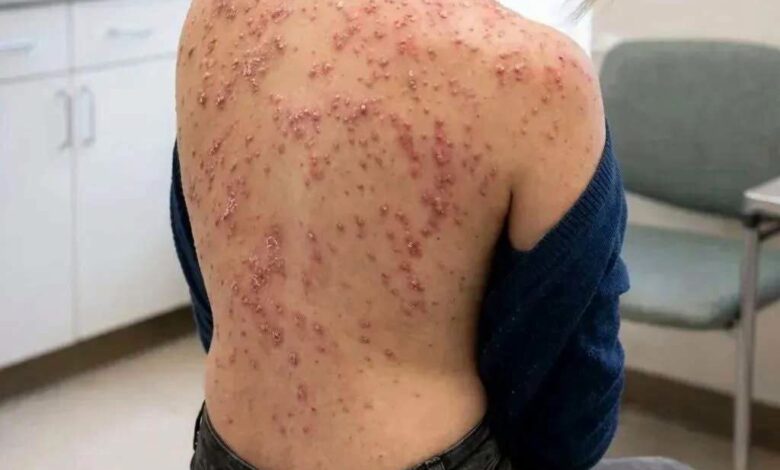
Several areas of his skin were swollen and angry.
A doctor stood near the bed.
“You had a severe allergic reaction,” she explained.
“Anaphylaxis.”
The word frightened him almost as much as the memory of the insects.
The doctor told him that multiple wasp stings can trigger a dangerous systemic allergic reaction in susceptible people. Difficulty breathing, swelling, dizziness, and a sudden fall in blood pressure can develop quickly.
Julián had been fortunate.
He had called for help before losing consciousness.
“If you’d waited much longer,” the doctor said carefully, “this could have ended very differently.”
For two days, Julián remained under observation.
But the physical recovery was easier than returning home.
When he finally stepped back into the apartment, he stopped just inside the door.
Everything looked normal.
That was the problem.
The kitchen table.
The couch.
The metal hook holding his keys.
The hallway leading toward the bedroom.
Nothing looked like the place where he had nearly died.
A pest-control professional had already removed the nest at his landlord’s request. They found a gap near the exterior window frame that had allowed the insects access.
The crumbs hadn’t “created” the wasps.
The unfolded laundry hadn’t summoned them.
Julián understood that now.
But his habit of ignoring small problems had mattered in another way.
He hadn’t inspected the damaged window frame.
He hadn’t noticed repeated insect activity near the curtain.
He remembered seeing one wasp in the bedroom days earlier and simply swatting it away.
Then another.
He never wondered why they kept appearing.
That realization changed him.
Not into the obsessive man he briefly feared he might become.
But into someone more attentive.
He repaired the window properly.
He began checking screens and seals.
Food stopped remaining beside the bed overnight.
He cleaned because he wanted his home comfortable, not because he believed dirt alone caused every pest problem.
Most importantly, he made a medical follow-up appointment.
The allergy specialist explained that future stings could potentially cause another severe reaction.
Julián was given an emergency plan and prescribed epinephrine auto-injectors, with instructions on how and when to use them.
He carried them thereafter.
At first, sleep was difficult.
Every tiny sound became buzzing.
A shadow near the window made him sit upright.
He checked the bedroom corners repeatedly.
One night, nearly a month later, he woke at 3 a.m. convinced something had landed on his arm.
Nothing was there.
He sat in bed breathing slowly until the panic passed.
That was when he understood the real damage the night had left behind.
His home hadn’t betrayed him.
His body hadn’t betrayed him either.
Something dangerous had happened, and now his mind was trying too hard to make sure it never happened again.
So he learned a second kind of vigilance.
The kind that includes knowing when fear has become bigger than the threat.
He didn’t seal every window permanently.
He didn’t spray chemicals into every corner.
He didn’t stop sleeping in his bedroom.
He learned.
He paid attention.
And he prepared.
Months later, Julián stood beside the repaired window one warm evening.
Outside, the city sounded exactly as it always had.
Cars.
Voices.
A distant siren.
He almost closed the window out of habit.
Then he noticed the intact screen.
The sealed frame.
Everything was secure.
He left it open.
That small decision felt strangely important.
For years, Julián had believed safety meant controlling everything.
Then, after his separation, he swung in the opposite direction and stopped noticing things that deserved attention.
The night of the wasps taught him something between those extremes.
A safe home is not a perfect home.
It doesn’t require paranoia.
It requires awareness.
Notice the insect that keeps appearing.
Fix the torn screen.
Repair the crack.
Understand your medical risks.
Know what to do if something goes wrong.
Small details matter—not because every neglected chore hides catastrophe, but because prevention often begins long before an emergency announces itself.
Julián still hangs his keys on the metal hook every evening.
He still lives alone.
He still enjoys the quiet.
But now, beside those keys, there is one additional item.
A small pouch containing his emergency medication.
Not a symbol of fear.
A reminder.
The night he nearly died began with something tiny.
A sting.
Then another.
But what saved him was also small.
A phone within reach.
A call made in time.
A door unlocked for paramedics.
A few decisions made before darkness closed in completely.
Julián no longer believes safety means nothing bad will ever happen inside your own home.
He knows better.
Safety means noticing.
Preparing.
Responding.
And respecting how quickly an ordinary night can become the moment everything changes.