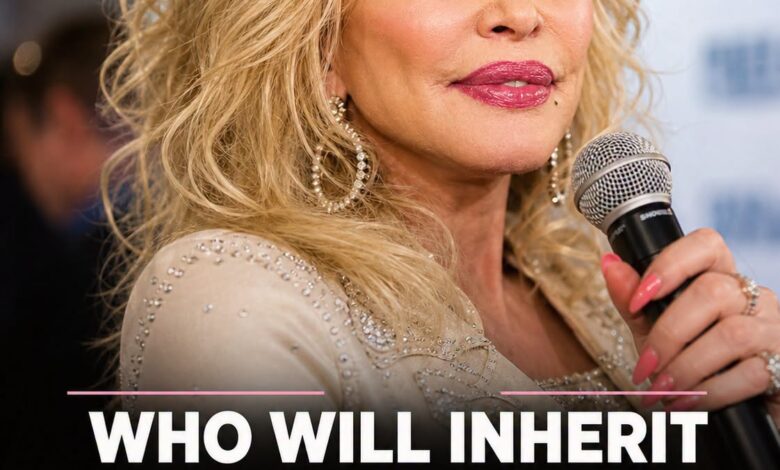
Dolly Parton spent her life making sure other people had more than she did growing up.
Books for children.
Jobs for families.
Opportunities for young musicians.
Money for causes she believed in.
Songs that became worth fortunes.
But after building an empire estimated in the hundreds of millions of dollars, Dolly faced a question that follows every great fortune eventually:
What happens when its creator is gone?
For Dolly, the answer may have been decided years before anyone else thought seriously about it.
She had no children.
Her longtime husband, Carl Dean, was no longer there to inherit everything automatically.
Her wealth stretched far beyond money sitting in bank accounts. It included intellectual property, business interests, royalties, real estate, licensing arrangements and a musical catalog capable of producing income long after her death.
And Dolly understood something many celebrities learn too late.
Leaving behind enormous wealth without a plan can turn grief into warfare.
So she planned.
Quietly.
Carefully.
And, characteristically, largely outside public view.
That is why the mystery surrounding Dolly Parton’s estate is so compelling. The question isn’t merely who receives a fortune estimated at roughly $450 million.
It is what happens to an empire built around one woman’s identity after that woman is no longer there to run it.
Dolly’s wealth was never straightforward.
Unlike entertainers who earn enormous salaries and simply invest the proceeds, she spent decades building an ecosystem around her work.
There was the music.
There was Dollywood.
There were publishing rights.
There were licensing deals.
There were film and television projects.
There were books, merchandise and countless uses of the Dolly Parton name and image.
And then there was perhaps her most emotionally significant creation outside music: the Imagination Library.
Each part carried a different kind of value.
Some generated money.
Some preserved intellectual property.
Some employed people.
Others existed primarily because Dolly believed wealth should accomplish something beyond making its owner wealthier.
Understanding her estate therefore requires understanding Dolly herself.
She was generous, but she was not careless.
The rhinestones and jokes sometimes obscured a remarkably disciplined business mind.
For decades, people underestimated her intelligence because she encouraged them to underestimate her appearance.
That mistake could be expensive.
Dolly knew the value of ownership.
One of the most important decisions of her career was holding onto control of songs she had written.
That philosophy became legendary through the story surrounding “I Will Always Love You.”
When Elvis Presley expressed interest in recording the song, the opportunity sounded like every songwriter’s dream.
Then came the publishing question.
Dolly refused to surrender the rights required for the deal.
Walking away was painful.
Years later, Whitney Houston’s recording became one of the most famous vocal performances in popular music history.
Dolly’s ownership became enormously valuable.
The lesson stayed with her.
A song isn’t merely something you sing tonight.
It can become an asset that continues generating value for decades.
That makes estimates placing her song catalog around the $120 million range particularly important.
Even after a songwriter dies, the songs do not stop working.
They are streamed.
Played on radio.
Licensed for films.
Used in television.
Covered by other artists.
Performed publicly.
Included in advertisements and theatrical productions.
Every one of those uses can involve rights and revenue.
In other words, Dolly didn’t simply leave behind money.
She left behind machinery capable of continuing to make money.
That distinction dramatically raises the stakes of estate planning.
Then there is Dollywood.
To the public, Dollywood is roller coasters, cinnamon bread, music and Smoky Mountain nostalgia.
To Dolly, it represented something deeper.
She repeatedly spoke about bringing economic opportunity to the region that raised her.
The attraction helped create jobs and draw tourism into East Tennessee while attaching her identity permanently to the place she came from.
Whatever the precise structure and valuation of her interests, Dolly’s association with the enterprise was one of the most valuable components of her business legacy.
But businesses create complications that cash does not.
You can divide money.
Dividing control is harder.
Who makes decisions?
Who approves the use of Dolly’s name?
Who protects the brand from becoming something she would have hated?
Who decides which licensing offers are appropriate?
Who ensures short-term profit doesn’t destroy long-term value?
Those questions may matter far more than who receives a particular bank account.
And Dolly appears to have understood that.
Years before her death, she had discussed the importance of getting her affairs organized.
She had watched what happened to other famous families.
The pattern is painfully familiar.
A celebrity dies.
A will surfaces.
Someone feels excluded.
Someone challenges the document.
Old resentments emerge.
Business partners disagree with relatives.
Previously private financial information enters court records.
Suddenly, the person’s artistic legacy becomes secondary to headlines about inheritance.
Dolly had spent too many years controlling her career to allow that kind of chaos willingly.
Estate planning offered another possibility.
Trusts.
Corporate structures.
Designated decision-makers.
Private instructions.
Separate arrangements for intellectual property and personal assets.
Potential charitable provisions.
Mechanisms designed to preserve control long after the person who created the fortune is gone.
Such arrangements can also provide something Dolly valued enormously:
Privacy.
A traditional will that passes through probate may become accessible through public court proceedings, depending on the circumstances and jurisdiction.
Trust arrangements can keep far more information outside that process.
That means the public may never receive the dramatic list it expects.
There may be no definitive document revealing that one relative received this amount, another received that property and a charity received the rest.
The real architecture of Dolly’s estate could remain largely invisible.
And perhaps that is exactly how she wanted it.
Because Dolly’s family was far larger than the traditional picture of spouse and children.
She grew up one of twelve children.
She had siblings, nieces, nephews, godchildren and extended relatives whose relationships with her existed largely beyond the cameras.
She also had employees and longtime professional associates who helped maintain the businesses surrounding her.
Then there were the charitable causes she treated almost like family.
Most famously, children.
Dolly never became a mother herself, something she discussed publicly with remarkable openness.
Rather than allowing that absence to define her negatively, she eventually described her life as having given her the opportunity to care about children on a much broader scale.
That philosophy became tangible through the Imagination Library.
What began as a literacy effort in her home region grew into an enormous book-gifting program reaching children far beyond Tennessee.
The emotional origin was personal.
Dolly’s father, Lee Parton, had not learned to read and write.
She knew what limited literacy could cost a person.
So she built something designed to intervene early.
Books arrived in children’s homes.
Again and again.
Month after month.
Long before many recipients knew who Dolly Parton really was.
That project complicates the estate question in a beautiful way.
Because Dolly’s legacy cannot be measured only by who inherits her wealth.
Some of her fortune had already been converted into legacy while she was alive.
She didn’t wait until death to become philanthropic.
She gave while she could see what giving accomplished.
That philosophy may provide clues about how she structured whatever came afterward.
It would hardly be surprising if charitable causes played some role.
Nor would it be surprising if relatives benefited.
Those possibilities are not mutually exclusive.
A sophisticated estate can support family, preserve businesses, protect intellectual property and fund charitable work simultaneously.
The interesting question is how Dolly balanced them.
And that answer remains private.
Perhaps it should.
Celebrity wealth creates a strange sense of public entitlement.
Because fans bought the records, watched the movies and visited the attractions, they can begin feeling that the resulting fortune somehow belongs to the cultural conversation.
We want numbers.
Names.
Percentages.
Who got the house?
Who controls the songs?
Who received the biggest share?
Was anyone cut out?
Will someone challenge the arrangement?
But Dolly’s money was still Dolly’s.
She earned it.
She invested it.
She protected it.
She gave enormous portions of her resources and influence to causes she chose.
And she had every right to decide privately what happened to the remainder.
The absence of children makes the mystery more intriguing because it removes the inheritance path people instinctively expect.
Had Dolly and Carl had children, many observers would simply assume that the estate moved primarily to them.
Without direct descendants, the possibilities multiply.
Siblings.
Nieces and nephews.
Other relatives.
Trusted associates.
Foundations.
Charitable organizations.
Trusts benefiting multiple groups over time.
Or some combination of all of them.
But there is another inheritance that doesn’t fit neatly on an estate inventory.
Control of Dolly Parton herself.
Her name.
Her likeness.
Her recordings.
Her compositions.
Her unreleased material.
Her archives.
Her costumes.
Her handwritten lyrics.
Her correspondence.
The artifacts of a career spanning decades.
For an artist of Dolly’s stature, those things carry cultural value as well as financial value.
A handwritten draft of a famous song can belong in an archive or museum.
An unreleased recording can become commercially valuable.
A recognizable photograph can be licensed.
A name can be placed on products.
A voice can potentially be recreated through emerging technologies.
Managing those rights responsibly will become increasingly important.
Dolly spent her career controlling how the world saw Dolly Parton.
After death, someone else has to protect that boundary.
That may ultimately be the most important job her estate plan performs.
Money can be spent.
Royalties can be distributed.
Property can be sold.
But reputation is fragile.
A poorly managed legacy can be diluted by endless products, questionable endorsements and projects the artist would never have approved.
A carefully managed one can remain culturally powerful for generations.
Dolly understood branding before celebrities routinely used the word.
She created an instantly recognizable visual identity.
She knew exactly what belonged inside the Dolly universe.
Humor.
Faith.
Sex appeal without shame.
Southern roots.
Music.
Family.
Generosity.
Self-deprecation.
Ambition.
And a refusal to become bitter.
Protecting that combination after her death requires more than an accountant.
It requires people who understand what she built.
That may explain why planning mattered so much.
The goal of a well-designed estate isn’t simply to distribute assets.
It is to prevent confusion about purpose.
Dolly had spent decades establishing hers.
She wanted her music to survive.
She wanted the businesses connected to her name to remain meaningful.
She wanted children to keep receiving books.
She wanted the people she loved protected from unnecessary turmoil.
And she wanted to avoid becoming another celebrity whose death triggered years of courtroom warfare.
Whether that plan succeeds may not become clear for a long time.
Perhaps documents will eventually reveal more.
Perhaps certain beneficiaries will speak.
Perhaps business filings will provide clues about where control moved.
Or perhaps the most significant arrangements will remain exactly where Dolly placed them:
Behind closed doors.
There would be something fitting about that.
Carl Dean spent nearly six decades married to one of the world’s most recognizable women while remaining almost entirely outside celebrity culture.
Dolly managed to share seemingly everything while protecting enormous pieces of herself.
She could tell hilarious stories about her marriage without surrendering the marriage itself.
She could sing about intimate emotions while keeping private pain private.
Why should her estate be any different?
The public knows the broad outline.
A fortune estimated around $450 million.
A hugely valuable music catalog.
Business interests connected to one of America’s most recognizable entertainment brands.
No children.
A vast extended family.
Major philanthropic commitments.
And evidence of deliberate preparation.
Everything else may belong to the people Dolly chose.
And perhaps the biggest mistake would be measuring her final legacy by whichever beneficiary receives the largest number.
Dolly Parton spent her life demonstrating that wealth could move outward.
A poor girl from the Smoky Mountains became extraordinarily rich, then used that success to create jobs, send books to children, support communities and preserve the songs that made everything possible.
Her fortune therefore existed in two forms.
There was the money she accumulated.
And there was the value she released back into the world.
The first can be counted.
The second cannot.
Lawyers may eventually administer trusts.
Executives may oversee business interests.
Publishers may continue collecting royalties.
Family members may receive assets.
Charities may benefit for decades.
But none of those transactions fully explains what Dolly left behind.
Her most successful estate planning may have begun long before any legal document was signed.
She built things capable of surviving her.
Songs people will continue singing.
Businesses that can continue employing people.
A literacy program that can continue putting books into children’s hands.
A carefully constructed public identity strong enough to remain recognizable even without its creator standing beneath the wig.
That is an inheritance far larger than $450 million.
And perhaps that was Dolly’s plan all along.
Not simply to decide who received what after she was gone.
But to make certain that what mattered most never depended on her being here to protect it.