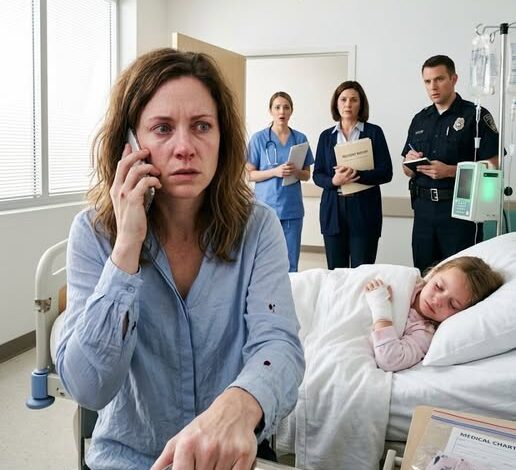
The hospital lights made a low buzzing sound that Clara Benson would remember long after she forgot the exact medical terminology the surgeons used that night.
The sound lived above her like static at 2:17 in the morning.
Cold.
Steady.
Unforgiving.
Her six-year-old daughter was somewhere behind pediatric surgery doors with her small hand wrapped in layers of gauze thick enough to hide what had happened but not thick enough to erase it.
Three fingers.
That was what the nurse said quietly before her professional calm tightened slightly around the edges.
Three fingers badly damaged.
Pins required.
Months of therapy possible.
Long-term complications uncertain.
Clara sat in a molded plastic hospital chair with dried blood stiffening the sleeve of her blouse and tried very hard not to fall apart in public.
The waiting room smelled like antiseptic, burnt coffee, damp winter jackets, and the metallic memory of blood.
Every time Clara closed her eyes, she felt Lily’s injured hand against her chest again.
Warm.
Shaking.
Bleeding.
Her name was Clara Benson.
Thirty-three years old.
Single mother.
Former daughter of the Benson household.
And until that night, she had spent most of her adult life believing survival meant leaving home only once.
She did not yet understand that some families continue living inside you long after you escape their walls.
Lily trusted her completely.
That was the part Clara could barely survive emotionally.
For six years she had built her entire life around one promise:
My daughter will not grow up afraid inside her own home.
She taught Lily to ask questions when confused.
To say no if uncomfortable.
To believe adults could be wrong sometimes.
She wanted her daughter to grow up loud where Clara had grown up quiet.
Then financial disaster arrived slowly enough to feel almost reasonable.
Reduced work hours.
Rent increases.
A failing car.
Childcare costs multiplying faster than paychecks.
And eventually came the offer.
Family help.
Richard Benson called first.
Her father’s voice still carried the same dangerous confidence Clara remembered from childhood.
“You and Lily can stay here temporarily,” he offered. “No point struggling alone.”
Elaine Benson offered kindness second.
Her mother specialized in that kind of kindness.
The kind folded carefully around hidden control.
“Family should help family,” Elaine said smoothly.
And because desperation makes old danger resemble shelter, Clara agreed.
Temporarily.
That word would later haunt her.
Richard Benson had ruled Clara’s childhood through fear disguised as discipline.
He yelled loudly enough that walls became nervous.
He treated obedience as morality.
Disagreement as disrespect.
And Elaine?
Elaine was quieter.
Sharper.
Richard exploded.
Elaine explained afterward why the explosion had been necessary.
Together, they created a household where reality changed depending on who needed protection most.
It was never Clara.
Her younger brother Aaron grew up differently.
Praised for mistakes Clara got punished for.
Protected from consequences Clara absorbed automatically.
When Clara cried during one of Richard’s screaming lectures at eight years old, he locked her inside a dark hallway closet “until she learned gratitude.”
At twelve, bruises shaped like fingerprints wrapped around her upper arm after she interrupted one of his arguments.
At sixteen, Elaine calmly informed her that “girls who embarrass their families should not expect dinner.”
Then the next morning everyone acted normal again.
That was the true Benson family tradition:
Not forgiveness.
Erasure.
By the time Lily was born, Clara promised herself she would never allow her child to mistake silence for safety.
But fear waits patiently.
It waits through financial emergencies.
Custody stress.
Loneliness.
Exhaustion.
It waits until the impossible suddenly sounds practical.
Three months, Clara told herself.
Just long enough to recover financially.
Instead, the Benson house swallowed her life quietly all over again.
Richard helped arrange work through one of his friends.
The car insurance moved under his account.
Elaine monitored groceries, laundry, schedules, and parenting decisions with suffocating sweetness.
Clara even hid emergency cash inside an old winter boot because somewhere deep down, instinct still warned her not to let her mother know exactly what resources she had available.
Lily adapted faster than Clara expected.
Children always do.
That’s what makes them vulnerable.
She loved her cousins.
Especially Aaron’s daughter Emma, who felt more like a built-in best friend than family.
That made what happened next infinitely worse.
Aaron’s birthday dinner looked beautiful.
Elaine specialized in beautiful presentations.
White linen napkins.
Candles glowing warmly in polished holders.
Steaks sizzling in garlic butter.
To outsiders, the Benson dining room looked elegant.
Healthy.
Normal.
Abusive families often care deeply about appearances because appearances confuse witnesses.
Clara moved automatically around the kitchen helping set the table while Elaine corrected tiny details behind her.
Not that fork.
Move the salt.
Wipe the plate edge.
Even after years away, Clara still obeyed instinctively.
Old training survives inside muscle memory.
Lily stood nearby wearing a yellow sweater and cotton leggings, trying very hard to behave properly.
Earlier that evening she asked quietly:
“Will Grandpa be nice tonight?”
Clara answered yes before she realized she was lying.
At exactly 7:06 p.m., everyone sat down.
That timestamp would later appear repeatedly in reports, interviews, and camera footage.
Aaron’s children received beautiful meals first.
Fresh steak.
Potatoes.
Green beans.
Then Elaine placed Lily’s plate down.
Clara saw it instantly.
Cold leftovers disguised beneath sauce.
Gray edges.
Sour smell.
Old food shoved deep in the refrigerator days earlier.
Lily stared at Emma’s dinner.
Then at her own.
Her face became confused.
Not spoiled.
Not rude.
Simply confused.
“Grandma,” she asked softly, “why does Emma get steak and I get old food?”
Silence hit the room immediately.
The kind of silence Clara recognized instantly from childhood.
Dangerous silence.
Elaine’s smile disappeared first.
Aaron stopped cutting his steak.
His wife stared at her napkin.
One candle flickered beside the gravy bowl.
Clara felt her body tense before her mind caught up.
The little girl still trapped somewhere inside her recognized the atmosphere instantly:
Punishment was coming.
Richard stood slowly.
The scrape of his chair against the hardwood floor sounded enormous.
Lily flinched immediately.
“Dad,” Clara whispered sharply. “Stop.”
But Richard wasn’t looking at Clara.
He stared directly at Lily.
“She needs a lesson,” he answered coldly.
Elaine folded her arms.
“There it is,” she muttered. “You raised a spoiled little beggar.”
Clara moved around the table quickly.
Richard moved faster.
He grabbed Lily by the wrist so violently that her chair tipped backward.
Lily cried out in fear.
Aaron said nothing.
That silence became one of Clara’s deepest wounds afterward.
Because violence isn’t only the person swinging the weapon.
Sometimes it’s every adult who stays seated while a child screams.
Richard dragged Lily toward the garage door.
Her sneakers scraped desperately against the floor.
Clara followed screaming for him to stop.
Elaine called her dramatic.
The garage smelled like motor oil, rust, cardboard dust, and lawn chemicals.
The concrete floor chilled Clara’s bare feet instantly.
Then she saw the workbench.
The pegboard.
The toolbox.
The hammer.
And suddenly time slowed horribly.
Richard shoved Lily’s small hand flat against the wooden surface.
For one impossible second, Clara saw everything perfectly clearly.
Then the hammer rose.
She lunged forward.
Too late.
The sound haunted her afterward more than the scream.
Because it wasn’t cinematic.
Not loud.
Not explosive.
Just one short horrifying crack.
Metal.
Bone.
Wood.
Then Lily screamed.
A scream so raw it seemed to tear through the entire house.
Even Richard froze afterward.
Lily collapsed sobbing violently while blood spread across the workbench surface.
And Richard smiled.
Actually smiled.
“Be thankful it was only your useless fingers,” he said calmly. “Next time it’ll be your mouth so you stop asking questions.”
Elaine still didn’t move.
Didn’t rush forward.
Didn’t scream.
She looked at Lily with exhausted disgust.
“Ungrateful girls should learn to swallow what they’re given,” she said quietly.
Something changed permanently inside Clara then.
Not dramatically.
Not heroically.
It changed like a lock turning.
For one terrible heartbeat, Clara wanted the hammer.
Wanted Richard terrified.
Wanted him broken.
Wanted him hurt.
Then Lily cried:
“Mommy…”
And Clara chose her daughter instead.
She wrapped Lily tightly against her chest, grabbed the nearest towel, pressed it desperately against the bleeding hand, and ran.
Richard shouted after them.
Elaine accused her of overreacting.
Aaron remained sitting beside his birthday dinner.
That image would follow Clara forever:
A fully grown man remaining seated while his niece bled.
The hospital moved fast once nurses saw the injury.
Doctors.
Forms.
Social workers.
The intake report listed:
Suspected crush trauma.
The surgeon later sat beside Clara gently explaining the damage.
Pins.
Surgery.
Months of healing.
Possible stiffness.
Long-term pain.
Then came the sentence that changed everything:
“This injury was not accidental.”
Clara stared at the floor afterward trying to survive the old instinct screaming inside her.
Protect the family.
Minimize.
Explain.
But then she pictured Lily asking one simple question before dinner.
Why does Emma get steak?
And suddenly Clara understood something devastating:
Her daughter had inherited the same punishment Clara once received.
The punishment for noticing unfairness out loud.
She looked at the doctor and whispered:
“My father did it.”
The world did not collapse.
That surprised her most.
The doctor remained calm.
The nurse remained kind.
Reality stayed standing.
Then Clara added quietly:
“My mother watched.”
That sentence freed something inside her.
By sunrise, police reports existed.
Photographs existed.
Medical evidence existed.
And for the first time in Benson family history, the truth existed somewhere official beyond manipulation.
Then came Aaron’s voicemail.
The garage had cameras.
Everything recorded.
Timestamped.
Documented.
Impossible to deny.
Richard dragging Lily.
The hammer rising.
Elaine insulting her afterward.
Even worse:
An earlier clip showed Elaine deliberately preparing Lily’s leftovers while discussing whether Clara’s daughter had “learned her place yet.”
The cruelty wasn’t spontaneous.
It was intentional.
That realization chilled Clara more deeply than the violence itself.
The Benson family didn’t lose control that night.
They revealed it.
Police moved quickly afterward.
Protective orders.
Evidence collection.
Formal charges.
Richard and Elaine immediately attempted their old strategies:
Clara was unstable.
Lily exaggerated.
Family matters should stay private.
But cameras don’t participate in family denial.
The footage spoke clearly.
And suddenly the Benson household faced something it had avoided for decades:
Accountability.
Lily’s recovery happened slowly.
Painfully.
At first she stopped asking for things entirely.
Food.
Toys.
Preferences.
Every request came wrapped in apology.
That broke Clara in ways surgery never could.
Because the hammer damaged fingers.
But fear damaged voice.
Healing meant teaching Lily something entirely new:
You are allowed to want things.
You are allowed to ask questions.
You are allowed to exist without punishment.
Their emergency housing apartment was tiny.
Cheap table.
Thin walls.
Wobbly kitchen chairs.
And yet it felt safer than the beautiful Benson dining room ever had.
Because safety is not polished silverware.
Safety is a child asking a question without fear.
Months later, Lily finally held crayons again.
Not perfectly.
Not painlessly.
But enough.
One afternoon while studying a restaurant menu, Lily looked up nervously and asked:
“Am I allowed to order chicken tenders instead?”
Clara nearly cried hearing how carefully her daughter asked permission simply to want something.
“You’re allowed to ask for what you want,” Clara answered softly.
Lily hesitated.
“Even if someone gets mad?”
Clara reached carefully for her daughter’s healing hand.
“Especially then.”
In the end, the hammer was not the first violence inside the Benson family.
It was simply the first violence with witnesses.
With footage.
With medical reports.
With a mother finally brave enough to stop translating abuse into discipline.
And every day afterward, Clara taught Lily the lesson nobody taught her as a child:
Love does not require fear.
Family does not require silence.
And no child should ever believe pain is the price of asking a fair question.