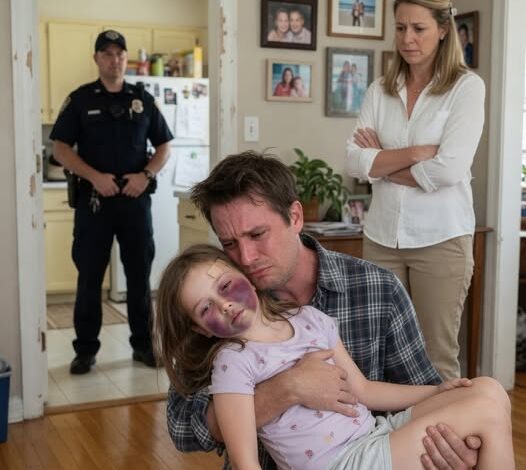
The first line of Emma’s note was written in purple marker so hard that the paper nearly tore beneath the pressure of her hand.
Daddy, please don’t leave me alone with Laura again.
The paramedic stopped moving.
Completely.
For one suspended second, the entire hallway seemed to hold its breath around that sentence.
The porch light outside flickered weakly through the open doorway, cutting pale yellow stripes across the walls and across the paramedic’s jaw while rain tapped softly against the front steps.
Emma lay strapped onto the stretcher wrapped tightly inside a gray emergency blanket.
She looked impossibly small.
Her tiny fingers rested limp against the black safety strap while the oxygen mask fogged faintly with each shallow breath. That tiny cloud of condensation became the only thing keeping me upright.
Proof she was still here.
Still breathing.
Still reachable.
Laura stood near the staircase.
Only moments earlier she had looked annoyed.
Controlled.
Almost offended by the inconvenience unfolding around her.
Now something else had entered her face.
Fear.
One hand gripped the railing tightly while the other hung at her side with fingers curled inward like she was still holding onto some invisible version of control.
“Daniel,” she said softly, “that’s just childish nonsense.”
The paramedic folded the note carefully once.
Then looked directly at her.
“No,” he answered quietly. “That’s evidence.”
Something changed in the room after that.
Not chaos.
Not screaming.
Colder.
Far colder.
The second paramedic wheeled Emma toward the ambulance while the first stepped between Laura and the front door.
His radio crackled sharply against his shoulder.
Outside, blue and red lights flashed across the windows, turning every family photograph inside the hallway strange and distorted.
Emma at the pumpkin patch.
Emma asleep on my chest at O’Hare Airport after a delayed flight.
Emma grinning proudly with missing front teeth.
All those memories suddenly looked like scenes from a life I had failed to protect properly.
Laura took one careful step toward the stretcher.
I moved before she could reach it.
No shouting.
No threats.
I simply planted myself between her and my daughter.
“She leaves with them,” I said.
Laura stared at me.
“You’re making a terrible mistake.”
Behind her, the refrigerator hummed steadily.
A drop of water tapped into the kitchen sink every few seconds.
The house smelled heavily of lemon disinfectant and Laura’s expensive perfume, but beneath both lingered another smell I suddenly recognized for the first time:
Fear that had lived inside this house much longer than I admitted.
A Naperville police cruiser arrived at exactly 8:04 p.m.
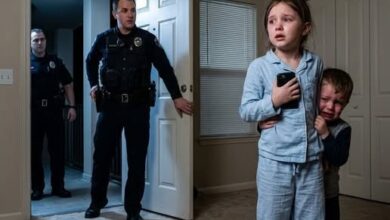
Two officers entered through the open doorway carrying rain across their jackets.
Officer Reynolds looked first at Emma.
Then at the note.
Then at Laura standing perfectly composed beside the stairs.
“Ma’am,” he said calmly, “please step into the kitchen.”
Laura smiled immediately.
Polite.
Controlled.
Practiced.
“Of course,” she replied softly. “I want this misunderstanding cleared up too.”
Misunderstanding.
That word nearly made me sick.
She stepped around Emma’s scattered homework pages on the floor like they belonged to somebody else’s child entirely.
At Edward Hospital, the pediatric emergency waiting room smelled like bleach, coffee, damp winter coats, and stale vending-machine snacks.
I stood beside the double emergency doors gripping Emma’s backpack against my chest so tightly the silver keychain inside kept clicking every time my hands shook.
A nurse had taken my jacket because Emma was still wrapped in it.
My shirt sleeves stuck damply against my wrists.
At 9:18 p.m., the doctor finally emerged.
“Mr. Cross?”
I stood too fast.
“Your daughter is stable,” she said carefully. “She’s responding well. We’re keeping her overnight for observation.”
Stable.
That word moved through my body like oxygen finally reaching somewhere starved.
But the doctor still wasn’t smiling.
“We also documented bruising in multiple stages of healing,” she continued quietly. “We’re legally required to notify Child Protective Services.”
“Do it,” I answered immediately.
Something flickered briefly across her face.
Relief, maybe.
“We already have.”
Inside the hospital room, Emma looked younger than eight years old.
Her hair spread softly across the pillow.
Her cheeks pale against white sheets.
The hospital bracelet around her wrist had been turned carefully upward so the words faced outward:
DAD’S BRAVE GIRL.
At 10:06 p.m., her eyes fluttered open.
I leaned closer immediately.
“Daddy?”
“I’m right here.”
Her eyes moved instantly toward the doorway.
“Is she here?”
“No,” I whispered. “She can’t come near you.”
Emma’s fingers tightened around the blanket.
“She said nobody would believe me because you loved her.”
My hand closed so tightly around the hospital bed rail that metal cut painfully into my palm.
“People believe you now,” I said.
Her mouth trembled once.
Then steadied.
“There’s more notes.”
I bent closer.
“In my room,” she whispered weakly. “Behind the blue star.”
At 11:32 p.m., Officer Reynolds drove me back to the house.
Laura was gone.
Not free.
Not released.
Taken to the station after hospital staff completed reports and the paramedic gave formal statements.
Yellow evidence tape crossed the front doorway now.
Inside, the house felt hollow.
Like the walls themselves had finally exhaled after months of holding secrets.
Emma’s room still smelled like crayons and strawberry shampoo.
Her purple comforter sat folded too neatly across the bed.
Her stuffed rabbit faced the wall strangely.
The blue cardboard star hung above her desk exactly where she’d taped it herself after second grade art class.
I lifted it carefully.
Behind it sat a sandwich bag taped flat against the wall.
Inside were seven folded notes.
Seven.
Officer Reynolds opened them one by one carefully.
The first contained dates.
The second showed childish drawings of locked doors with X marks across them.
The third listed rules in Emma’s uneven handwriting:
Don’t ask for Dad.
Don’t tell school.
Smile on FaceTime.
Say I fell.
Officer Reynolds stopped moving after that.
Not visibly emotional.
Just very still.
The fourth note carried a Denver area code phone number scribbled near the bottom.
Not Laura’s number.
A number Emma must have copied secretly from somewhere.
Reynolds photographed each page carefully before sliding them individually into evidence sleeves.
The soft plastic sounds filled the room quietly.
Seven little sounds.
Seven months of a child trying desperately to leave a trail behind while adults kept missing it.
At 12:11 a.m., my phone rang.
Unknown number.
Officer Reynolds nodded once.
Speakerphone.
“Daniel,” Laura said smoothly.
Her voice sounded calm enough to belong at brunch instead of inside a criminal investigation.
“You need to think carefully. This can still stay private.”
Reynolds held up one finger.
Keep talking.
“You mean Emma?” I asked.
“She’s emotional,” Laura replied softly. “Children exaggerate. Especially children with attachment issues.”
I stared at the evidence bags sitting on Emma’s desk.
“Why did the paramedic recognize you?”
Silence.
Brief.
Sharp.
Then:
“People make mistakes.”
“He called you Monica.”
Her breathing shifted slightly.
“Daniel, you just flew back from Seattle. You’re exhausted. Emotional. Let me handle the police tomorrow and we’ll clear this misunderstanding up.”
“No.”
That single word changed her voice instantly.
“You have no idea what you’re about to lose.”
Officer Reynolds looked up sharply.
“What did you say?” I asked quietly.
“I said custody battles become ugly,” she corrected smoothly. “Men who travel constantly don’t always appear like stable parents.”
There it was.
Prepared.
Organized.
Already rehearsed.
I suddenly realized Laura had been planning several exits simultaneously.
Then I asked the question that truly mattered.
“Where is Emma’s passport?”
The silence afterward answered before she spoke.
The next morning Detective Karen Holt arrived at the hospital carrying a sealed folder.
Beside her stood the paramedic from the house.
Aaron Miles.
He held his cap tightly between both hands.
“I worked as a rookie EMT in Denver six years ago,” he explained quietly. “We responded to a child welfare call involving a woman named Monica Vale.”
He swallowed hard.
“I never forgot her face.”
Detective Holt opened the folder.
Inside sat a grainy hospital surveillance photograph.
Different hair.
Different glasses.
Same eyes.
Laura.
Or Monica.
Or whatever identity she used before entering my life.
“There wasn’t enough evidence back then,” Holt explained. “The family refused cooperation. The case disappeared.”
Aaron looked devastated.
“But I remembered her.”
At 2:20 p.m., CPS issued emergency protective orders.
At 4:05 p.m., every lock on the house changed.
At 5:30 p.m., Laura’s financial access froze after investigators uncovered suspicious withdrawals totaling over eighteen thousand dollars during my Seattle trip.
Then officers found Emma’s passport.
Not inside the family safe.
Not inside filing cabinets.
Inside Laura’s overnight bag at the station beneath a cream-colored sweater.
Alongside:
A certified copy of Emma’s birth certificate.
Two one-way airline tickets to Phoenix.
One adult.
One child.
Departure scheduled for 6:15 a.m. the next morning.
Detective Holt showed me the evidence sleeve silently.
The paper looked terrifyingly ordinary.
Cheap.
White.
Normal.
That was the most horrifying part.
Kidnapping paperwork looks exactly like vacation paperwork until timing reveals intention.
“She wasn’t punishing Emma,” I whispered finally.
Detective Holt met my eyes.
“No,” she answered quietly. “We believe your daughter was trying to stop her from taking her.”
That night I reread every message Laura had ever sent me.
Emma’s clingy.
Emma exaggerates.
FaceTime upsets her routine.
She performs for attention when you travel.
Every sentence suddenly rearranged itself into something sinister.
At 6:03 a.m., Emma woke and asked for apple juice.
A nurse brought it with a bendy straw.
After three tiny sips, Emma whispered:
“I tried calling you from school.”
My chest tightened.
“When?”
“Tuesday. Mrs. Keller almost let me use the office phone, but Laura came early.”
By 9:40 a.m., school security footage confirmed everything.
Laura smiling at the office desk.
Emma standing beside her quietly.
Laura’s hand gripping Emma’s shoulder just tightly enough to control movement without creating visible struggle.
Timestamp:
Tuesday, 1:14 p.m.
The exact same afternoon I texted from Seattle:
Big meeting. Love you both.
Laura replied with a heart emoji.
The custody hearing happened two days later.
Laura arrived polished and composed in a charcoal coat, looking inconvenienced rather than frightened.
The judge reviewed:
Hospital reports.
Emma’s notes.
The passport.
Airline tickets.
Recorded calls.
Prior Denver investigations.
Laura’s attorney attempted using the word misunderstanding once.
The judge stopped him immediately.
“No.”
One clean word.
Emergency custody transferred fully to me.
Protective orders expanded immediately.
When the bailiff approached Laura afterward, her expression finally cracked.
Not guilt.
Calculation collapsing under pressure.
She turned toward me desperately.
“Daniel… don’t do this.”
I picked up Emma’s backpack from the courtroom bench.
The silver keychain clicked softly.
“You did this to her.”
That was the only sentence I gave her.
Three months later, Emma began sleeping through entire nights again.
Not every night.
But some.
She picked out a bright yellow backpack covered in planet patches.
The blue cardboard star now sits framed inside my office.
Not as decoration.
As proof.
Proof that my daughter tried saving herself long before adults finally understood what she was surviving.
Aaron Miles visited once carrying a stuffed ambulance teddy bear from his station.
After Emma left the room briefly, he looked at me quietly.
“I’m sorry,” he said.
“For what?”
“For not stopping her years ago.”
Across the room, Emma laughed softly at something a nurse said during a follow-up call.
The sound still carried fragility.
But it was real.
“You stopped her this time,” I answered.
The house in Naperville feels different now.
The lemon cleaner smell disappeared.
Laura’s sweater disappeared.
So did the fear living silently in corners.
Some nights Emma still checks the front door twice.
Sometimes I check it first so she doesn’t have to.
The last message Laura ever sent before her number was permanently blocked contained only five words:
You’ll regret choosing her.
I printed the message.
Handed it directly to Detective Holt.
Then I walked upstairs to Emma’s room, taped a brand-new blue star above her desk, and wrote one sentence behind it where only my daughter would know to look.
Daddy came home.