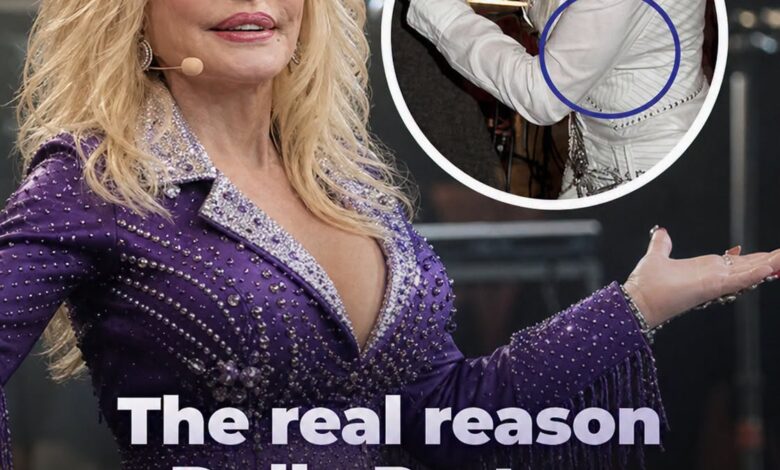
Dolly Parton spent decades making sure the world noticed her.
The towering blond hair.
The impossible heels.
The sequins.
The lace.
The rhinestones catching stage lights from every direction.
She understood spectacle better than almost anyone in entertainment, and she never apologized for enjoying it. If people were going to look, Dolly seemed determined to give them something worth looking at.
Yet one of the most revealing things about her was what she decided they did not get to see.
Beneath the glamorous costumes and carefully designed public image was a far more private story involving scars, tattoos, and a woman who understood that accepting yourself does not require displaying every vulnerability for public inspection.
For years, people speculated about Dolly’s habit of wearing long sleeves and gloves.
Why were her arms so often covered?
Was she hiding something?
Close-up photographs generated theories. Interviews produced questions. Rumors multiplied, as rumors inevitably do when a famous woman refuses to satisfy the public’s curiosity about her body.
Dolly eventually offered pieces of an explanation.
She had a tendency toward keloid scarring—raised scars that can develop when the body produces excess scar tissue after the skin is injured. Some people are simply more prone to them than others.
For Dolly, those marks became something she preferred not to emphasize.
But her response was characteristically imaginative.
Rather than treating the scars as defects requiring endless explanation, she reportedly incorporated some of them into delicate tattoos.
Butterflies.
Flowers.
An angel.
Soft images placed over or around places that had once made her self-conscious.
It is difficult to imagine a more Dolly Parton solution.
She did not erase the mark.
She decorated the story.
There is an important distinction there.
Modern celebrity culture often treats physical appearance as public property. A famous woman’s face, weight, skin, hair, hands, clothes, and aging process are photographed, enlarged, compared, analyzed, praised, mocked, and diagnosed by strangers.
A photograph appears online.
Someone zooms in.
Someone circles a detail.
Suddenly millions of people are debating something the person herself may have spent years learning to accept.
Dolly understood that machinery.
She also understood how to deny it complete access.
Her long sleeves became part fashion, part boundary.
The gloves became part of the mystery.
And the tattoos remained largely private.
That privacy mattered because Dolly’s public persona was often misunderstood as total openness.
She told outrageous jokes.
She discussed her appearance with remarkable humor.
She openly admitted that much of the Dolly Parton look was artificial.
The hair was exaggerated.
The makeup was exaggerated.
The clothes were exaggerated.
Even the jokes about herself were often exaggerated.
But openness and access are not the same thing.
Dolly could laugh about herself without surrendering herself.
She could tell the audience ninety things and keep the hundredth for herself.
The scars belonged to that quieter territory.
And rather than allowing them to become evidence that something was “wrong” with her, she transformed them into images she found beautiful.
A butterfly is especially fitting.
Dolly has long been associated with butterflies, creatures that appear delicate but are defined by transformation and movement.
A flower works too.
Something beautiful growing around an imperfect place.
And an angel carries its own obvious tenderness.
These were not tattoos designed primarily to shock an audience.
They appear to have been personal.
Almost secret.
That makes them more meaningful.
Because sometimes self-acceptance is loud.
Sometimes it means showing the world exactly what you were once taught to hide.
But sometimes self-acceptance is private.
It means looking at something on your own body and deciding that you no longer owe anyone an apology for it.
You may still cover it.
You may still decorate it.
You may still prefer that strangers not stare.
Acceptance does not require exhibition.
That distinction feels especially important in Dolly’s story.
She never built her identity around pretending to be naturally perfect.
Quite the opposite.
She joked openly about artifice.
She made glamour into a performance and then let everyone in on the joke.
The deeper confidence came from knowing that the performance did not define the woman underneath.
That same philosophy appeared throughout her life.
Dolly came from poverty without allowing poverty to become the only story people told about her.
She experienced heartbreak and turned it into music.
She encountered assumptions about her intelligence because of her appearance and answered them by becoming a formidable songwriter and businesswoman.
Again and again, she took something that could have reduced her and expanded beyond it.
The scars fit that pattern.
They were real.
They were part of her.
They simply did not get to become the headline.
And while strangers were busy wondering what Dolly might be hiding beneath her sleeves, she was building a legacy far larger than anything visible on her skin.
Books were arriving in children’s homes through the Imagination Library.
Songs were accompanying people through heartbreak, work, loneliness, and reinvention.
Jobs and tourism were being supported through businesses tied to her Tennessee roots.
Money and attention were repeatedly redirected toward causes she cared about.
That contrast is almost painfully revealing.
The public asks:
What’s under the glove?
Dolly asks:
Did the children get their books?
One question satisfies curiosity.
The other changes lives.
Perhaps that is why the tattoos matter less as a celebrity secret than as a glimpse into how Dolly handled vulnerability.
She did not deny it.
She did not necessarily display it either.
She transformed it on her own terms.
That is a kind of courage that receives less attention because it is not dramatic.
There is no grand announcement.
No demand that everyone admire her bravery.
Just a woman looking at scars and deciding they could become flowers.
Then putting her sleeves back on and going to work.
The world has always been fascinated by Dolly Parton’s exterior.
That was partly her own creation.
She knew exactly what rhinestones could do under a spotlight.
She understood the usefulness of being unforgettable.
But the spectacle was never the whole story.
Underneath it was discipline.
Humor.
Faith.
Business instinct.
Compassion.
Privacy.
And an extraordinary ability to turn vulnerability into something useful without pretending the original hurt never existed.
That may be the thread connecting the scars to the songs and even to her philanthropy.
Transformation.
Pain becomes music.
Poverty becomes empathy.
Success becomes opportunity for someone else.
A scar becomes a butterfly.
Nothing has to disappear before something beautiful can grow around it.
And perhaps that is why Dolly’s image will endure even after the details people once obsessed over become irrelevant.
The costumes will remain iconic.
The blond hair will still be instantly recognizable.
The rhinestones will continue sparkling in photographs long after fashions change.
But those were decorations.
The deeper beauty was always in what Dolly did with the imperfect things life handed her.
She covered some.
She laughed about others.
She turned many into songs.
She transformed a few into butterflies and flowers.
And then, rather than spending her life asking the world to reassure her that she was beautiful, she went out and tried to leave something beautiful behind.
The sequins made people look.
The woman underneath gave them a reason to remember.