My Mother-in-Law Had No Pension, No Savings, and Almost Nothing to Her Name. I Cared for Her for 12 Years. With Her Last Breath, She Pointed to a Torn Pillow and Whispered, “That’s for You.”

For twelve years, everyone in my husband’s family believed Fiona had nothing left to give.
No pension worth mentioning.
No retirement account.
No jewelry anyone considered valuable.
No property anyone knew about.
By the time she became too frail to live alone, her four adult children had already built lives elsewhere.
Some lived hours away.
Others were simply “too busy.”
And somehow, without anyone ever formally saying it, caring for Fiona became my job.
I was twenty-six when I married her youngest son, David.
Back then, Fiona still walked through her garden every morning and complained about grocery-store tomatoes as though buying one instead of growing it were a moral failure.
She had spent most of her life working farmland in rural Ohio.
Her husband died young.
Afterward, she raised four children with very little money and almost no help.
So when she eventually moved into our house, everyone assumed there was nothing left to inherit.
That never mattered to me.
Fiona was not an estate.
She was a person.
A stubborn, proud, sometimes exhausting person who cried the first time I buttoned her blouse because her fingers no longer could.
David worked long shifts in Chicago, leaving before sunrise and returning after dinner.
Most of Fiona’s care fell to me.
I made breakfast.
Sorted medications.
Helped her bathe.
Washed her hair.
Changed sheets.
Cut food smaller when swallowing became difficult.
Rubbed lotion into hands cracked by decades of soil, sun, and winter air.
Some nights I woke at two because I thought I heard her calling.
Sometimes she was.
Sometimes I simply needed to see her chest rise.
I did that for twelve years.
Some days gladly.
Other days so exhausted that hearing my own name made me want to cry.
One night, I finally did.
Fiona had spilled water across her bed while trying to reach her glass. After changing everything, I sat beside her and covered my face.
“I’m sorry.”
She looked at me.
“For what?”
“For being tired.”
She reached for my hand.
Her fingers were thin and cold.
“You know what’s strange about you, Mabel?”
I laughed through tears.
“I’m sure you’ll tell me.”
“You keep showing up after you think you’re empty.”
Her thumb moved slowly over my knuckles.
“That’s why, sweetheart. That’s why God will see you differently.”
I never forgot it.
The work did not get easier after that.
I simply stopped feeling ashamed for admitting it was hard.
Fiona’s other children visited occasionally.
One brought fruit.
Another stayed an hour and told me how patient I was.
Someone else called every few weeks.
They often said:
“I could never do what you do.”
Or:
“Mom has always been difficult.”
I smiled politely.
But what I heard was:
We could never do it, so you should.
That final winter, Fiona declined quickly.
She barely ate.
Walking to the bathroom exhausted her.
Some afternoons she stared toward the bedroom door.
Waiting.
I knew for whom.
Most days, nobody came.
One afternoon, she asked me to sit her upright.
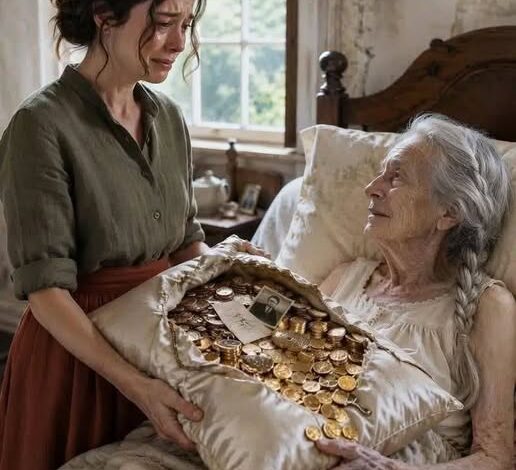
Behind her was the ugliest pillow in the house.
Faded flowers.
Split seam.
Stuffing poking through one corner.
I had offered to replace it dozens of times.
Fiona always refused.
“That one’s fine.”
That afternoon, she touched the torn seam.
“What is it?” I asked.
She glanced at me.
“Nothing yet.”
I assumed medication was confusing her.
That night, the wind rattled the bedroom window.
Around midnight, her breathing changed.
I called David.
Then hospice.
But before anyone arrived, I sat beside Fiona and held her hand.
Her eyes opened once.
They moved slowly around the room until they found me.
“I’m here.”
She tried to lift one arm.
Then pointed toward the old pillow.
“For you, Mabel.”
I leaned closer.
“What?”
“Only you.”
Her lips moved again.
No sound came.
Then her fingers relaxed.
She was gone.
By sunrise, the house was full.
Relatives.
Coffee.
Phone calls.
People discussing funeral arrangements who had rarely found time to sit beside Fiona while she was alive.
Later that morning, my oldest brother-in-law picked up the torn pillow and pushed it toward a garbage bag.
I grabbed it.
“Not that.”
My sister-in-law stared.
“Why?”
“Mom gave it to me.”
“That thing?”
“Yes.”
“Mabel, it’s disgusting.”
I hugged it to my chest.
“No.”
That evening, after everyone left, I placed it on the kitchen table.
The house was finally silent.
I kept hearing Fiona’s last words.
For you.
I reached into the torn corner to push the stuffing back.
My fingers touched something hard.
I froze.
Then I pulled out a dark velvet pouch tied with string.
Inside were two things.
A brass key.
And a folded yellowed letter.
My name was written at the top.
My dearest Mabel,
I sat down.
Fiona explained that before she married, her grandfather had transferred forty acres of land to her outside Columbus.
At the time, it was nearly worthless.
Then came highways.
Development.
Commercial expansion.
The land became extraordinarily valuable.
Her children never knew it existed.
The key opened a private safe-deposit box containing the deed and trust documents.
Then I reached the sentence that made me cover my mouth.
My children knew me when I had strength. You knew me when I no longer did.
I kept reading.
You never asked what I owned. You asked whether I was cold, whether I had eaten, whether I was frightened, whether I needed you to sit a little longer.
Tears fell onto the page.
I watched my children praise you for doing the work they had decided belonged to someone else. I do not hate them. But I will not reward indifference simply because we share blood.
Three years earlier, with independent legal counsel and medical certification, Fiona had transferred the property into a trust.
I was the sole beneficiary.
It belongs to you. Not because twelve years of care can be purchased. It belongs to you because when I became someone who had nothing obvious to offer, you still treated me as someone worth loving.
The next morning, her children gathered around our dining table studying her checking account.
“She only had eight hundred dollars,” one said.
Then my sister-in-law glanced toward the ugly pillow.
“At least Mabel got her inheritance.”
She laughed.
“The filthy pillow.”
I set down my tea.
“Actually, Fiona did leave something.”
I placed the brass key and trust papers on the table.
Forty acres.
Commercial land.
Worth close to two million dollars.
Silence.
Then chaos.
“You manipulated her.”
“She was sick.”
“She was our mother!”
I let them shout.
Finally, my oldest brother-in-law slammed his hand down.
“You have no right to take our inheritance.”
I looked at him.
“She wasn’t an inheritance while she was alive.”
Nobody spoke.
“She was your mother.”
The challenges lasted six months.
Fiona had anticipated them.
There were capacity evaluations.
Independent attorneys.
Witnesses.
Recorded statements.
On one recording, her lawyer asked:
“Mrs. Bennett, why are you leaving the property solely to Mabel?”
Fiona answered clearly:
“Because when everyone thought I was poor, she still came when I called.”
The challenges failed.
The land became mine.
But owning it never felt like winning.
Eventually, I leased part of it rather than selling everything.
We paid off our mortgage.
Created a college fund for our son.
And with part of the income, I started a nonprofit.
We called it Fiona’s Porch.
Transportation.
Meals.
Prescription pickups.
Respite care.
Home visits.
Nothing glamorous.
Just the ordinary things Fiona had needed.
Years later, we opened a small senior day center on part of the original land.
Near the entrance, I framed two objects.
The brass key.
And a square of faded floral fabric from Fiona’s pillow.
Underneath them was one line from her letter:
When I had nothing obvious to offer, you still treated me as someone worth loving.
People assumed the sentence was about me.
Eventually, it wasn’t.
It became the rule for everyone who walked through those doors.
Long after the lawsuits ended and the land became security, I still remembered Fiona’s final night more clearly than any bank statement.
Her cold hand inside mine.
The wind against the glass.
That torn pillow behind her back.
“For you, Mabel.”
People hear the story and think the surprise was the money.
It wasn’t.
The real surprise was discovering that Fiona had been watching too.
Every glass of water.
Every meal.
Every sleepless night.
Every time I sat beside her because she did not want to be alone.
I thought those moments disappeared as soon as they happened.
They didn’t.
Someone remembered.
Fiona left me forty acres.
Those acres eventually became money, stability, education, and a place where older people were treated with dignity.
But the most valuable thing hidden inside that pillow was not the key.
It was proof that love given quietly is not always love given unseen.
Everyone believed Fiona died with nothing.
They were wrong.
She left behind a fortune.
Only part of it was land.