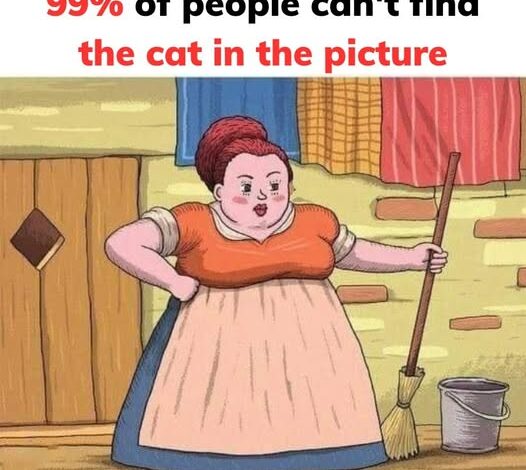
It was never really about the cat.
The image, the red circle, the comments insisting “it’s obvious once you see it” — all of that is only the surface layer of something much deeper and strangely familiar.
What unsettles people isn’t failing to spot the hidden animal.
It’s the feeling that arrives immediately afterward.
That small wave of panic.
That tightening in your chest when everyone else claims certainty while you remain staring at the same picture seeing absolutely nothing.
And almost instinctively, your mind begins turning against itself.
Maybe I’m missing something obvious.
Maybe I’m the problem.
Maybe everyone else sees reality more clearly than I do.
That moment is far larger than a visual puzzle.
It is social survival.
Most people experience versions of it constantly throughout life, often so subtly they barely recognize it happening in real time.
A group laughs at something you don’t understand, so you laugh too.
Someone confidently labels an idea “common sense,” and you nod even though uncertainty still lingers in your mind.
Friends insist a person is trustworthy, attractive, talented, guilty, embarrassing, dangerous, brilliant—and slowly their certainty begins replacing your own perception.
Not because you fully believe them.
Because being the outlier feels risky.
Human beings are wired for belonging long before they are wired for independent confidence. From childhood onward, we learn that fitting into the group often protects us emotionally, socially, even physically. Agreement creates safety. Certainty creates acceptance.
So when your reality collides with everyone else’s version of reality, many people instinctively choose the group over themselves.
Even in tiny harmless moments.
Especially in tiny harmless moments.
That’s why something as simple as a hidden-cat image can trigger disproportionate discomfort. It quietly mirrors a much older emotional pattern:
the fear of trusting your own perception when it conflicts with collective confidence.
And over time, those moments accumulate.
Not dramatically.
Quietly.
You start editing your reactions before expressing them.
You soften your opinions.
You stop asking follow-up questions because everyone else seems sure already.
You apologize for uncertainty instead of exploring it.
Little by little, self-trust erodes.
Not all at once.
Through repetition.
The most painful part is how invisible this process becomes while it’s happening. People often think self-betrayal requires huge compromises or life-altering decisions. But many forms of self-abandonment happen through tiny daily acts of social compliance.
Laughing when you don’t find something funny.
Pretending to understand.
Agreeing something is “obvious” when it isn’t.
Suppressing discomfort because everyone else appears comfortable.
Those moments seem insignificant individually.
But repeated over years, they begin teaching you something dangerous:
that your direct experience of reality matters less than maintaining harmony with the group around you.
Eventually, some people become so disconnected from their own instincts that they hesitate before every opinion, every interpretation, every emotional reaction.
Not because they lack intelligence.
Because they no longer fully trust themselves.
That’s what the cat image unexpectedly exposes.
Not visual failure.
Psychological conditioning.
The red circle becomes symbolic of every time authority, popularity, confidence, or collective agreement convinced you to doubt your own eyes.
And the irony is that sometimes there genuinely is no cat visible at all—or the image is ambiguous enough that many people naturally won’t see it immediately. Yet social pressure still pushes individuals toward performance instead of honesty.
People begin pretending.
“Ohhh, now I see it.”
Even when they don’t.
Because certainty is rewarded socially while confusion often feels embarrassing.
But there is something quietly powerful about resisting that impulse.
Something deeply human about saying:
“I don’t see it.”
Not defensively.
Not arrogantly.
Just honestly.
And perhaps the deeper transformation comes one step beyond that:
“I don’t see it, and I still trust myself.”
That sentence sounds simple, but emotionally it can feel revolutionary for people who spent years outsourcing perception to louder voices, stronger personalities, social consensus, or fear of exclusion.
Self-trust is not stubbornness.
It does not mean assuming you are always correct.
It means allowing your own experience to exist without immediate shame simply because it differs from someone else’s.
You can remain open, curious, and uncertain without surrendering your entire internal compass.
That distinction matters enormously.
Because healthy perception is not built through blind confidence or blind conformity.
It is built through the ability to observe honestly, question openly, and remain connected to yourself even when consensus pressures you to disconnect.
In many ways, adulthood becomes a long process of relearning that.
Relearning how to pause before automatically agreeing.
Relearning how to say “I don’t understand.”
Relearning how to trust discomfort as information instead of weakness.
And maybe that’s why the cat image lingers emotionally for some people long after the joke itself fades.
It accidentally touches a much older wound.
The memory of all the times you quietly abandoned your own perspective to remain acceptable, agreeable, safe, or included.
But hidden inside that discomfort is another possibility too.
The possibility that you no longer have to perform certainty simply to belong.
That you can remain connected to others without betraying your own perception in the process.
And maybe the real breakthrough is not finally spotting the hidden cat everyone else insists is there.
Maybe it’s recognizing that your worth was never dependent on seeing exactly what everyone else sees in the first place.