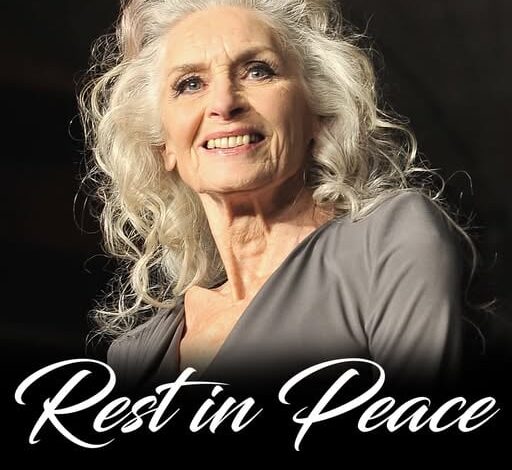
For most of the fashion industry’s history, aging women were treated almost like disappearing ink.
The moment silver appeared in their hair or lines settled around their eyes, they were quietly pushed aside — no dramatic announcement, no public rejection, just fewer calls, fewer campaigns, fewer runways. Fashion worshipped youth so aggressively that growing older became framed almost as professional failure, especially for women. Entire industries emerged promising to “fight” aging, “reverse” aging, “correct” aging, as though time itself were something shameful that needed defeating.
Daphne Selfe refused that war completely.
And in doing so, she became revolutionary almost accidentally.
Not because she demanded attention loudly.
Not because she chased reinvention desperately.
Not because she pretended to remain twenty-one forever.
She simply refused to apologize for becoming older.
That quiet refusal changed everything.
Long before fashion rediscovered her, Daphne Selfe had already lived several lives. She began modeling young, discovered at twenty-one during an era when glamour still carried old-Hollywood polish and postwar elegance. The industry noticed her immediately — tall, poised, unmistakably striking without trying too hard. She possessed the kind of face photographers love because it communicates intelligence before beauty fully registers.
But unlike many women consumed entirely by early success, Selfe stepped away.
Marriage mattered to her.
Family mattered.
Ordinary life mattered.
At a time when women were often forced to choose between ambition and domesticity entirely, she moved fluidly between both worlds without framing either as sacrifice. She modeled, yes, but she also built a life beyond cameras — raising children, maintaining friendships, existing outside the exhausting machinery of constant self-promotion.
That balance would later become part of what made her return feel so powerful.
Because when the industry finally welcomed her back decades later, she returned not as someone desperately trying to reclaim lost youth, but as a fully formed woman carrying an entire lifetime visibly with her.
And visibly matters here.
Daphne Selfe did not dye away her silver hair.
Did not surgically erase every line from her face.
Did not perform the exhausting illusion that aging only becomes acceptable if hidden successfully.
Instead, she walked into fashion exactly as time had shaped her.
Silver-haired.
Elegant.
Tall.
Wrinkled.
Radiantly alive.
And suddenly, the same industry that once treated aging women as invisible could not stop staring at her.
That reversal says as much about culture as it does about Selfe herself.
Because by the time she returned prominently in her seventies, public exhaustion with artificial perfection had started growing impossible to ignore. Audiences had spent decades flooded with chemically preserved beauty standards so narrow they barely resembled ordinary human existence anymore. Fashion became increasingly polished, filtered, corrected, and surgically maintained until many people stopped recognizing themselves inside it entirely.
Then came Daphne Selfe:
laughing easily,
wearing her years openly,
walking runways without pretending time had not touched her.
She felt real.
Not “real” in a manufactured marketing sense.
Actually real.
And authenticity carries enormous emotional power in industries built around illusion.
Her runway appearances at London Fashion Week and events like Royal Ascot became more than novelty. Audiences watched someone moving with the calm confidence of a woman no longer negotiating her worth through approval alone. Younger models often radiate ambition or anxiety beneath the surface because the industry conditions them to believe beauty is temporary currency disappearing daily.
Selfe walked differently.
Not because she no longer cared.
Because she no longer feared expiration.
That distinction transformed her presence entirely.
Photographers adored her not simply because she looked elegant, but because she carried emotional ease difficult to fake. There is something visually magnetic about people comfortable inside themselves after decades of surviving life fully. Selfe understood instinctively that beauty deepens when it stops begging for permission.
And she never framed aging as tragedy.
That may be the most radical part of her legacy.
Modern culture often discusses growing older using the language of loss:
lost youth,
lost relevance,
lost attractiveness,
lost possibility.
Daphne Selfe treated aging instead like continuation.
Life did not end at forty.
Or sixty.
Or seventy.
It simply kept unfolding differently.
She spoke often about ordinary pleasures with almost stubborn sincerity.
Coffee with friends.
Laughter.
Conversation.
Movement.
Curiosity.
Not as small consolations after youth disappeared, but as meaningful parts of a full life worth savoring intentionally. That perspective quietly challenged consumer culture itself, which profits enormously from convincing women their value declines naturally with age unless endlessly corrected through products, procedures, and reinvention.
Selfe rejected that desperation entirely.
And paradoxically, that rejection made her more captivating than people half her age striving frantically to appear flawless.
Because confidence rooted in self-acceptance always ages better than confidence rooted entirely in appearance.
Younger women responded to her strongly for precisely that reason.
Not because they necessarily wanted to look older.
Because she modeled a future where aging itself did not automatically equal disappearance.
That psychological shift matters enormously. Entire generations of women have grown up absorbing subtle panic about time from advertisements, media, entertainment, and social expectations teaching them that visibility belongs primarily to youth. Daphne Selfe interrupted that narrative simply by continuing to exist publicly with joy and dignity intact long after society expected her to retreat quietly.
She became proof that reinvention does not always require becoming someone new.
Sometimes it means becoming more fully yourself.
Her late-career success also revealed something uncomfortable about the fashion world itself.
The industry did not suddenly become enlightened overnight.
Culture changed first.
Audiences grew hungry for authenticity, texture, age, individuality — things polished perfection had stripped away increasingly. Fashion eventually followed because industries adapt when public emotional appetite shifts strongly enough.
In other words, the world finally caught up to what Daphne Selfe had quietly embodied all along:
that elegance has very little to do with pretending not to age.
True elegance comes from inhabiting life fully without shrinking from it.
Wrinkles included.
Loss included.
Joy included.
Time included.
And perhaps that is why her story resonates so deeply beyond fashion itself.
Because it speaks to a fear many people carry privately:
the fear of becoming irrelevant.
Of reaching a certain age and feeling invisible professionally, romantically, socially, culturally. Selfe dismantled that fear not through motivational slogans, but through example. She continued evolving. Continued working. Continued laughing. Continued appearing in rooms where younger people expected only youth to matter.
Not as a nostalgic relic.
As presence.
Fully alive presence.
That difference is important.
She was never trying to relive her twenties.
She was enjoying her seventies, eighties, and beyond with equal seriousness.
And maybe that is the real reason people found her so inspiring.
Not because she remained beautiful despite aging.
Because she remained open to life because of it.
Experience sharpened her instead of diminishing her.
Time expanded her rather than erasing her.
By the end of her life, Daphne Selfe represented something increasingly rare in modern culture: graceful visibility without desperation. She neither hid from aging nor built her entire identity around fighting it publicly. She simply continued forward carrying herself with warmth, humor, discipline, and extraordinary self-possession.
Her legacy feels simple on the surface.
But underneath it sits a deeply radical message:
human beings do not expire emotionally when youth ends.
Possibility does not belong exclusively to the young.
Relevance does not disappear automatically with wrinkles.
Beauty is not a countdown clock.
And perhaps most importantly of all:
you are never truly finished until you decide you are.