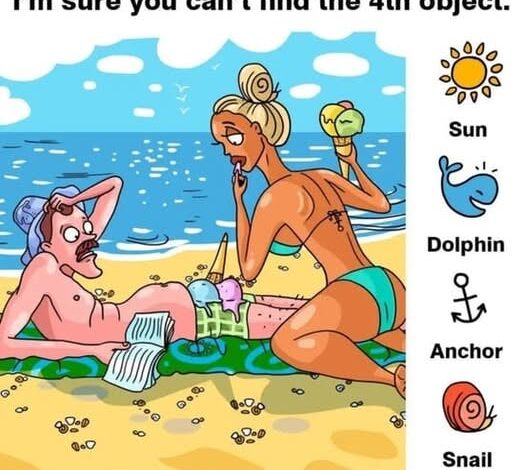
What makes this beach brain teaser so strangely irresistible isn’t simply the hidden objects or the colorful artwork — it’s the psychological trap unfolding inside your own mind while you search. At first, the image feels playful and easy. You casually scan the umbrellas, seashells, towels, and waves with the relaxed confidence of someone certain the answer will reveal itself immediately. Your eyes drift comfortably across the scene, almost lazily, because your brain assumes the challenge is simple.
Then the fourth object refuses to appear.
And suddenly, something changes.
Your attention tightens almost without you realizing it. The background noise around you fades slightly. You stop glancing and start studying. Your eyes move slower now, tracing edges carefully, checking corners twice, questioning shapes that seemed meaningless only moments earlier. A patch of sand becomes suspicious. A shadow near a beach chair suddenly looks intentional. The drawing stops feeling like a harmless cartoon and starts becoming a puzzle your brain urgently wants to solve.
That transformation is exactly why these visual riddles become so addictive.
They exploit one of the most fascinating traits of human perception: the brain’s desperate need for completion. Once you know something is hidden, your mind struggles to let go unfinished. The missing object lingers like an itch you can’t quite scratch, pulling your focus back again and again until either you solve it or surrender temporarily.
And during that process, your brain quietly shifts into a different mode entirely.
You stop seeing the image generally.
You begin seeing it selectively.
That’s where the real cognitive exercise begins.
Every repeated scan trains your mind to notice details most people overlook automatically in everyday life. Tiny inconsistencies suddenly matter: a curve that doesn’t quite match the surrounding shells, a spiral shape half-hidden beside someone’s sandal, a line that interrupts the natural flow of the sand. Your visual system starts separating patterns from distractions, teaching itself to distinguish what belongs from what merely blends in.
The hidden snail becomes more than an object.
It becomes a test of attention itself.
And attention is like a muscle: the more deliberately you use it, the stronger it becomes.
Modern life constantly fragments focus. Notifications interrupt conversations. Screens encourage rapid scrolling rather than deep observation. People skim more than they study. Brain teasers like this force the opposite behavior. They reward patience, concentration, and sustained visual effort in a world increasingly designed to destroy all three.
That’s part of why solving these puzzles feels oddly satisfying.
You experience a small neurological reward when your brain finally locks onto the hidden object after extended searching. The moment of recognition releases tension instantly. What seemed invisible seconds earlier suddenly becomes impossible not to see. Your brain flips from confusion to clarity in one satisfying burst.
And afterward, you almost laugh at yourself.
“How did I miss that?”
But that reaction is actually proof the puzzle worked perfectly.
Because the hidden object was never only testing eyesight.
It was testing perception.
Human beings rarely see everything in front of them objectively. Our brains constantly filter information, prioritizing what seems important while ignoring details considered irrelevant. That filtering helps us move efficiently through life, but it also means we overlook far more than we realize. Brain teasers expose those blind spots in harmless, entertaining ways.
The longer you search, the more your observation strategies evolve.
At first, you look randomly.
Then methodically.
Then obsessively.
Some people scan left to right like reading a book. Others divide the image into sections mentally. Some zoom in on colors while others track outlines and shapes. Without realizing it, your brain experiments with problem-solving techniques the entire time.
Even frustration plays a role.
That stubborn refusal to quit after failing repeatedly strengthens persistence and cognitive endurance. Each unsuccessful pass forces the brain to re-evaluate assumptions and search differently instead of relying on the same automatic patterns.
And strangely enough, that process mirrors larger challenges in life.
Often the answer exists in plain sight, but familiarity blinds us to it.
We stop observing carefully because we assume we already understand the picture.
That’s why these puzzles fascinate both children and adults alike. They trigger curiosity, competitiveness, and pattern recognition all at once. They turn a simple beach illustration into a miniature psychological experiment unfolding in real time inside your head.
Some people find the snail within seconds.
Others stare for ten minutes before spotting it suddenly.
A few give up entirely, only to return later and see it immediately.
That delayed recognition is fascinating too.
Sometimes stepping away resets the brain’s visual expectations, allowing hidden details to emerge more naturally afterward. Your mind stops forcing the image into old patterns and becomes more flexible when you return.
So whether you eventually find the hidden object or walk away determined to try again later, the puzzle has already done something valuable.
It sharpened your concentration.
Strengthened visual memory.
Encouraged patience.
Forced your brain to slow down and truly observe instead of merely glance.
All from one deceptively simple beach scene.
And perhaps that’s the real genius behind brain teasers like this:
they disguise mental exercise as play, quietly teaching your brain to look closer at the world one hidden detail at a time.