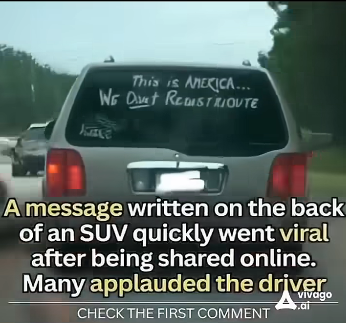
At first glance, it looked like nothing more than another angry message scrawled across the back of an SUV — the kind of political outburst people snap photos of, laugh at for five seconds, and forget before the next exit sign. But this one refused to disappear quietly. Maybe it was the bluntness of the wording. Maybe it was the timing. Or maybe Americans were already carrying too much frustration inside themselves, just waiting for something small enough to ignite it.
“This is America… we don’t redistribute wealth — we earn it.”
Eight words.
That was all it took to turn a random vehicle into a rolling cultural battleground.
Within hours, the image spread across Reddit, X, Facebook, and comment sections already primed for war. Some people treated the driver like a folk hero. Others saw cruelty disguised as patriotism. Entire arguments erupted beneath blurry highway photos, with strangers projecting entire political identities onto someone none of them had ever met.
To supporters, the message represented frustration that had been simmering for years.
Not just about taxes or government programs, but about recognition. About the feeling that millions of hardworking people wake up early, work long hours, sacrifice comfort, and still feel increasingly invisible while public conversations focus more on what society “owes” people than what people owe each other in return. For them, the SUV driver wasn’t simply making a political statement. He symbolized resistance against a culture they believe has begun confusing support with dependency and fairness with guaranteed outcomes.
Commenters praising the message used words like “discipline,” “personal responsibility,” and “earned success.” Many described growing resentment toward what they perceive as a modern mindset where struggle itself is treated as proof someone deserves reward, regardless of effort or contribution. Some shared stories of working multiple jobs, surviving without assistance, or climbing slowly out of poverty through years of sacrifice.
To them, the phrase “we earn it” carried emotional weight beyond economics.
It meant dignity.
Identity.
Proof that suffering can still lead somewhere if people push hard enough.
And underneath all that praise lived something deeper and more painful: fear.
Fear that hard work no longer guarantees stability.
Fear that personal sacrifice is becoming culturally irrelevant.
Fear that people who followed the rules are slowly losing faith those rules still matter.
But the backlash arrived just as fiercely.
Critics argued the message reduced complicated realities into a simplistic morality test where success automatically equals virtue and struggle automatically signals failure. They pointed out something America itself often struggles to admit honestly: not everyone begins life standing at the same starting line.
Some inherit wealth.
Others inherit trauma.
Some grow up surrounded by safety, stable schools, healthcare, family support, and opportunity. Others begin life navigating violence, addiction, underfunded communities, racism, disability, hunger, or instability long before adulthood even begins. Telling people to simply “earn it,” critics argued, ignores how dramatically circumstances shape outcomes before effort ever enters the picture.
And perhaps that’s why the image spread so explosively.
Because it touched a nerve larger than politics.
The SUV window became a mirror.
People didn’t just see a slogan — they saw themselves reflected inside it. Their anger. Their exhaustion. Their insecurities about fairness, success, failure, and whether the system still rewards effort the way they were taught it would.
For some Americans, the message sounded empowering.
For others, it sounded accusatory.
And for many, it sounded painfully incomplete.
Because reality rarely fits neatly into bumper-sticker philosophy.
There are people who work relentlessly and still remain trapped financially because illness, debt, caregiving responsibilities, or systemic barriers consume every opportunity before momentum can build. There are also people who exploit systems, manipulate benefits, or avoid responsibility entirely while others carry disproportionate burdens around them.
Both realities exist simultaneously.
That complexity is what makes conversations about wealth and fairness so emotionally volatile in America specifically. The country’s identity is deeply tied to the mythology of self-made success — the belief that determination and hard work can transform anyone’s life regardless of background. Millions still cling to that idea because it offers hope and purpose. But every year, more people question whether the promise still functions the way previous generations believed it did.
Housing costs rise.
Healthcare costs rise.
Education costs rise.
Wages stagnate.
Economic mobility shrinks.
Meanwhile, public trust erodes steadily as ordinary people watch billionaires accumulate unimaginable wealth while many working families remain one emergency away from collapse. In that environment, slogans about “earning it” become emotionally charged because Americans increasingly disagree not just about economics, but about what fairness itself should look like.
Should society reward effort above all else?
Should it protect vulnerable people even when they contribute less?
What counts as “earned” in a system where luck, privilege, geography, race, health, and opportunity shape outcomes so heavily?
There are no simple answers.
But social media rarely rewards complexity.
Instead, the internet transformed one angry sentence into tribal symbolism almost instantly. People weren’t debating the unknown SUV driver anymore. They were debating each other’s values, identities, and visions of America itself.
And perhaps the saddest part is how familiar this cycle has become.
A photo appears.
People divide instantly.
Nuance disappears.
Strangers become enemies before anyone fully understands what they’re even fighting about.
The SUV eventually kept driving.
The highway returned to normal.
The person behind the wheel probably went home without realizing their handwritten message would ignite thousands of arguments nationwide.
But the reaction revealed something important.
Americans are not merely divided politically anymore.
They are divided philosophically.
Over what success means.
Over what society owes people.
Over whether compassion weakens responsibility or strengthens community.
Over whether “earning it” describes freedom… or ignores invisible disadvantage.
And beneath all those debates lives a quieter truth neither side fully escapes:
Most people are exhausted.
Exhausted from working harder while feeling less secure.
Exhausted from watching others struggle.
Exhausted from feeling unseen, unheard, or blamed for problems too large for any one individual to solve alone.
That may be why eight angry words on the back of an SUV carried so much emotional force.
Not because they answered anything.
Because they exposed how many Americans are still desperately arguing over the same unresolved question:
What do we truly owe one another in a country built equally on ambition… and inequality?