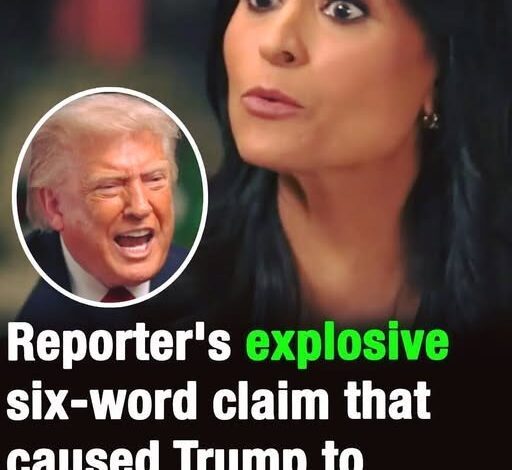
The interview was supposed to be tough.
Nobody expected it to unravel.
What began as a high-profile political conversation between former President Donald Trump and NBC journalist Kristen Welker quickly transformed into something far more dramatic—a tense, increasingly combative exchange that exposed the widening divide between political leaders, the media, and the audiences watching from home.
By the time it was over, the discussion had moved far beyond its original topic.
The questions remained unanswered.
The tension remained unresolved.
And millions of viewers were left debating not only what had been said, but what the confrontation revealed about the state of modern political discourse.
A Conversation That Quickly Turned Confrontational
From the moment the cameras began rolling, there was an unmistakable edge to the interview.
The studio lights were bright.
The setting was polished.
The format appeared familiar.
Yet beneath the professional atmosphere, a sense of friction lingered just beneath the surface.
As the discussion shifted toward election integrity and California’s voting procedures, the tone began to change.
What started as a policy-focused conversation gradually became a test of patience, credibility, and control.
Welker pressed for specifics.
Trump pushed back.
The exchanges became sharper.
The interruptions became more frequent.
And with each passing minute, the distance between interviewer and interviewee seemed to grow wider.
The Debate Over Evidence
One of the most contentious moments came when Welker sought clarification regarding Trump’s claims about election-related irregularities.
Like many journalists conducting high-profile political interviews, she repeatedly asked for evidence supporting the allegations being discussed.
Trump, however, appeared increasingly frustrated by both the questions and the direction of the conversation.
To him, the interview no longer felt like an opportunity to explain his position.
Instead, it appeared to feel like a challenge to defend it.
As the questioning intensified, so did his responses.
He accused the journalist of pursuing what he viewed as a biased line of questioning.
His language became increasingly direct.
At one point, he reportedly described aspects of the questioning as “crooked” and “stupid,” signaling that the interview had moved well beyond a typical policy discussion.
What viewers were witnessing was no longer merely a debate over election procedures.
It had become a struggle over trust, credibility, and competing perceptions of reality.
A Breaking Point
As both sides continued speaking over one another, the atmosphere inside the studio grew noticeably more strained.
Questions were interrupted.
Answers were challenged.
Attempts to redirect the conversation proved unsuccessful.
For viewers watching in real time, it became increasingly clear that neither side was willing to concede ground.
The interview had effectively become a contest of wills.
Then came the moment that changed everything.
Trump appeared to reach a breaking point.
After another contentious exchange, he signaled that he believed the conversation had run its course.
Rather than continuing the discussion, he stood up.
Staff members moved quickly.
Production personnel appeared caught off guard.
And before the interview could regain its footing, Trump walked off the set.
Just like that, the conversation was over.
The studio, moments earlier filled with rapid-fire exchanges and escalating tension, suddenly felt empty.
The abrupt departure left an unmistakable void—not only physically, but symbolically.
The interview that had been expected to generate headlines had now become the headline itself.
Immediate Reactions Across the Political Spectrum
Within minutes, clips from the confrontation began circulating online.
Social media platforms exploded with commentary.
Predictably, reactions divided sharply along political lines.
Supporters of the former president viewed the walk-off as a justified response to what they considered unfair treatment by the media.
To them, the interview represented another example of journalists approaching political figures with preconceived conclusions rather than genuine curiosity.
Many praised Trump’s decision to leave, arguing that he refused to participate in what they saw as a hostile environment.
Critics viewed the incident very differently.
They argued that public officials and political leaders should be prepared to answer difficult questions, particularly on matters of significant public interest.
For them, the walk-off raised concerns about accountability and transparency.
The same moment generated two completely different interpretations.
And that contrast itself became part of the story.
More Than a Disagreement About Voting
As coverage of the interview continued, the focus gradually expanded beyond the specific topic that had sparked the conflict.
What began as a discussion about election procedures evolved into a larger conversation about the increasingly strained relationship between politicians and journalists.
For decades, political interviews have served as a public forum where leaders are challenged, questioned, and asked to defend their positions.
Yet in today’s media environment, those encounters often carry additional layers of tension.
Many politicians accuse news organizations of bias.
Many journalists argue that rigorous questioning is necessary to hold powerful figures accountable.
The result is an atmosphere where interviews frequently become battles rather than conversations.
The confrontation between Trump and Welker seemed to capture that reality in real time.
Welker Responds
In the hours following the broadcast, Welker addressed the encounter and acknowledged the difficulties surrounding the interview.
She noted that the recording had included various challenges, including technical interruptions and other complications that contributed to an already tense atmosphere.
But by that point, the public conversation had moved beyond production details.
The images were already circulating.
The clips were already viral.
The walk-off had become the defining moment.
Whether viewers believed Trump was standing up to unfair treatment or avoiding difficult questions often depended on their existing perspectives.
The interview itself became a reflection of broader political divisions playing out across the country.
A Symbol of a Larger Divide
Perhaps the most significant aspect of the confrontation was not what it revealed about either individual.
It was what it revealed about the current state of public discourse.
Trust has become increasingly fragmented.
People often consume different sources of information.
They interpret the same events through different political lenses.
And they frequently arrive at entirely different conclusions while watching the exact same footage.
The Trump-Welker exchange illustrated that phenomenon perfectly.
Supporters and critics witnessed the same interview.
Yet many walked away believing completely different stories about what had happened.
In that sense, the confrontation became more than a disagreement between a politician and a journalist.
It became a snapshot of a larger national conversation.
One marked by skepticism, polarization, and competing definitions of fairness, truth, and accountability.
The Lasting Impact
As the political cycle continues, countless interviews, debates, and public appearances will come and go.
Most will be forgotten within days.
This one may not be.
Because it captured something larger than the questions being asked.
It captured the growing tension between institutions that increasingly distrust one another.
The press.
Political leaders.
And the audiences trying to make sense of both.
The interview began as a discussion about election procedures.
It ended as a viral moment that reignited debates about media bias, political accountability, and the fragile state of modern communication.
And perhaps that is why the confrontation continues to resonate.
Not because of any single answer.
Not because of any single accusation.
But because it exposed just how thin the line has become between a difficult interview and a complete breakdown of dialogue.
When the cameras first turned on, viewers expected a political conversation.
What they witnessed instead was a vivid illustration of a country still arguing over who should be asking the questions, who should be answering them, and whether either side still trusts the other enough to have the conversation at all.