My 12-Year-Old Son Carried His Wheelchair-Bound Friend on His Back During a Camping Trip So He Wouldn’t Feel Left Out – The Next Day, the Principal Called Me and Said, ‘You Need to Rush to School Now’

At first, it didn’t seem important.
Just one small sentence spoken over dinner while Leo pushed peas around his plate with a fork.
Most parents would’ve missed it completely.
But grief teaches you to notice tiny changes in your child, especially when you’ve already watched them survive too much too young.
Since his father died three years earlier, Leo had changed in ways both obvious and invisible. He still laughed sometimes. Still did his homework. Still remembered to feed the dog and take out the trash without being asked. From the outside, people probably thought he was adjusting well.
But I saw the quieter things.
The way he lingered longer in doorways before speaking.
The way excitement seemed to stop halfway before fully reaching his face.
The way sadness settled inside him like something permanent he simply learned to carry.
He was only twelve, but sometimes he looked unbearably older.
So when he walked through the front door after school that Thursday with an unfamiliar spark in his eyes, I noticed instantly.
Not loud excitement.
Not childish energy.
Something calmer.
Purpose.
He dropped his backpack near the kitchen table and said casually:
“Sam wanted to go too… but they told him he couldn’t.”
I looked up from the stove.
“The hiking trip?”
Leo nodded once.
Sam.
Of course.
The two of them had been inseparable since elementary school. Sleepovers. Science projects. Inside jokes no one else understood. Sam was bright, sarcastic, endlessly curious—and confined to a wheelchair after complications from a spinal condition he’d been born with.
Life had taught him exclusion early.
Field trips became logistical problems.
Sports became spectatorship.
Adventure became something other children described afterward.
And somehow, despite all of that, Sam remained one of the kindest kids I had ever met.
“What happened?” I asked carefully.
Leo shrugged, but I could already see anger hidden beneath the movement.
“They said the trail would be too difficult. Too dangerous.”
“And what did you say?”
“Nothing.”
But the way he said it told me everything.
Then quietly:
“It’s not fair though.”
I remember wiping my hands slowly on a dish towel while looking at him standing there in the kitchen. For a second he looked painfully like his father—not physically, but emotionally. The same inability to tolerate watching someone get left behind unfairly.
I thought it would pass.
Kids move on quickly sometimes.
I underestimated how deeply Leo had already made his decision.
Saturday arrived cold and gray.
Parents gathered outside the school parking lot waiting for the buses to return from the hiking retreat. People laughed while holding coffee cups and folding chairs. Kids usually came back filthy and overexcited from these trips, talking all at once about trails and bugs and campfire stories.
Then the buses arrived.
The doors folded open one by one while exhausted children stumbled down the steps.
And then I saw Leo.
My heart dropped instantly.
He looked utterly destroyed.
Not ordinary tiredness.
Not post-field-trip exhaustion.
His clothes were streaked with mud nearly to his knees. Sweat soaked through his shirt despite the cold weather. His face looked pale beneath dirt smudged across his cheeks, and his shoulders slumped with the kind of physical fatigue adults usually carry after twelve-hour work shifts.
I rushed toward him immediately.
“Leo, what happened?”
He looked up at me with eyes so exhausted they barely seemed open.
Then he smiled weakly.
“We didn’t leave him.”
I frowned, confused.
“What?”
Before Leo could answer, another parent approached us shaking her head in disbelief.
“Your son carried Sam,” she said softly.
Everything inside me stopped.
“What?”
“The entire hike,” she repeated. “Six miles.”
I stared at Leo.
Six miles?
The woman continued quietly:
“My daughter said whenever Sam apologized, Leo kept telling him, ‘I’ve got you. Just hold on.’”
I physically could not process it.
The trail had steep hills, narrow paths, slippery ground. I’d seen photos online from previous years. Grown adults complained about parts of it.
And somehow my twelve-year-old son carried another child across it because he refused to let his best friend stay behind.
I looked down at Leo’s trembling legs and suddenly understood why he looked barely able to stand.
“Why didn’t a teacher stop you?” I whispered.
His expression shifted slightly.
“They tried.”
Then his teacher approached.
And immediately the atmosphere changed.
He looked angry.
Flustered.
“Mrs. Carter,” he said sharply, “your son violated safety protocols today.”
Leo shrank slightly beside me.
“He separated from the designated group route and created a potentially dangerous situation.”
Dangerous.
The word echoed strangely in my head while staring at my exhausted child barely capable of holding himself upright.
“I understand,” I said automatically.
And I did understand.
Rules mattered.
Liability mattered.
Safety mattered.
But beneath all of that understanding sat another feeling swelling larger with every passing second.
Pride.
Immense, painful pride.
Because while adults argued about procedure, my son saw only one unbearable fact:
his friend was about to be left behind.
And he refused to accept it.
That night Leo fell asleep before dinner fully dressed on top of his blankets.
I stood in his doorway for a long time watching him breathe.
There were scrapes on his arms.
Blisters across his palms.
And despite all of it, he looked peaceful somehow.
Like carrying Sam had mattered more to him than the pain afterward.
The next morning, my phone rang just after 8 a.m.
The school principal.
Her voice sounded strained immediately.
“Sarah,” she said carefully, “I need you to come to the school.”
My stomach tightened instantly.
“Why? Is Leo okay?”
A pause.
Then:
“There are people here asking for him.”
“What kind of people?”
Another hesitation.
“Military.”
Every terrible possibility exploded through my mind at once.
Military?
I barely remember the drive.
Only my hands gripping the steering wheel too tightly while panic spiraled louder with every red light. By the time I reached the school parking lot, my pulse hammered so violently I could hear it in my ears.
Then I saw them.
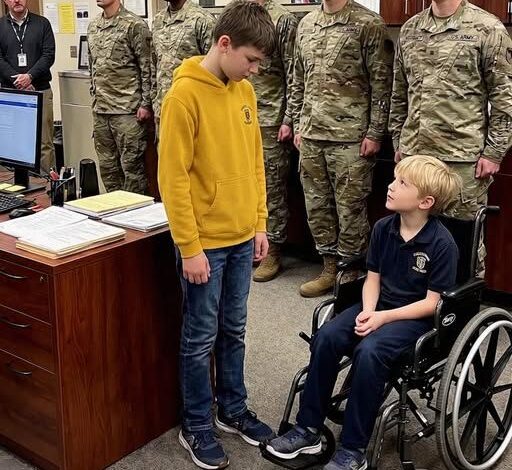
Five uniformed men standing outside the administration office.
Completely still.
Serious.
Watching.
Fear flooded me instantly.
Inside the office, Leo stood near the principal’s desk looking terrified.
The moment he saw me, relief crashed across his face.
“Mom.”
I crossed the room immediately and wrapped my arms around him.
“What happened?” I whispered urgently.
“I didn’t mean to get in trouble,” he said quickly. “I won’t do it again.”
That sentence nearly broke my heart.
Because even after doing something extraordinary, his first instinct was fear.
“No one’s taking you anywhere,” I promised firmly.
Then one of the soldiers stepped forward.
“We’re not here to punish him.”
The room fell silent.
The man’s expression softened slightly as he looked toward Leo.
“We’re here because of what he did for Sam.”
I blinked in confusion.
Before anyone else could speak, the office door opened again.
And Sam’s mother walked in crying.
She looked directly at Leo immediately.
“Sam told me everything,” she whispered.
Leo looked uncomfortable instantly, staring down at his shoes.
“He said everyone kept explaining why he couldn’t go,” she continued shakily. “And you just kept saying, ‘Then we’ll figure it out.’”
Tears filled her eyes.
“He told me every time he apologized, you said, ‘As long as we’re together, you’re not getting left behind.’”
Leo’s face turned bright red.
“I just carried him,” he muttered quietly.
One of the soldiers shook his head slowly.
“No,” he said gently. “You did something much bigger than that.”
Then the story unfolded.
They had all served with Sam’s father years earlier.
A Marine.
A man who spent his life making sure his son never felt excluded despite his disability. According to them, Sam’s father carried him everywhere when necessary—through parks, beaches, fishing trails, camping trips.
“He refused to let the wheelchair define his world,” one soldier explained softly.
After Sam’s father died overseas, something inside the boy changed permanently. He became quieter. More withdrawn. Less willing to ask for things because disappointment hurt too much.
Then came this hiking trip.
And according to his mother, something happened on that mountain neither therapy nor time had managed to accomplish.
“For the first time since his dad died,” she whispered through tears, “Sam came home feeling strong instead of different.”
The office went completely silent.
“He said Leo made him forget he was supposed to stay behind.”
I looked at my son.
Really looked at him.
Mud still stained beneath his fingernails. His body still ached visibly from exhaustion. Yet standing there surrounded by adults praising him, he looked confused more than proud.
As though kindness this obvious shouldn’t require recognition at all.
Then one of the soldiers stepped forward carrying a small wooden box.
“We spoke about your son last night,” he said carefully.
He opened the box.
Inside sat a military patch beside folded documents.
“We’ve established a scholarship fund in his name.”
I covered my mouth instantly.
Leo just stared blankly.
The soldier knelt slightly to meet his eyes.
“Courage isn’t always loud,” he said. “Sometimes it looks like refusing to leave someone behind when everyone else already accepted it.”
Then he placed the patch gently onto Leo’s jacket.
“You earned this.”
By then I was crying openly.
And when the soldier added quietly, “Sam’s father would’ve been proud of you,” something inside me completely shattered.
I pulled Leo against me tightly.
“Your dad would be proud too,” I whispered into his hair.
He nodded once against my shoulder, trying very hard not to cry.
Outside the office, Sam waited beside his wheelchair near the front steps.
The second Leo saw him, he smiled again for the first time all morning.
“I thought I was doomed,” Leo admitted while walking over.
Sam laughed.
“Worth it though.”
Leo looked at him for one second before answering:
“Yeah.”
Then more softly:
“Absolutely worth it.”
That night, after dinner and tears and endless retelling of the story to relatives calling nonstop, I stood quietly outside Leo’s bedroom.
He was already asleep.
The patch rested carefully on his desk beside unfinished homework and a half-empty water bottle.
Ordinary things.
But somehow the room felt different now.
Not because strangers honored him.
Not because of scholarships or recognition.
Because I finally understood something deeper about the child I was raising.
Kindness had not made him weak after losing his father.
Loss had sharpened his empathy instead.
He knew what abandonment felt like.
What loneliness felt like.
What exclusion felt like.
And instead of hardening him—
it taught him to carry other people.
Even when it hurt.
Even when adults said it was inconvenient.
Even when nobody expected him to try.
Standing there in the darkness outside his room, I realized something I’ll carry for the rest of my life:
you never fully know who your child is becoming until the world gives them a chance to choose between comfort and compassion.
And my son chose compassion.
Without hesitation.
Without applause.
As naturally as breathing.
And honestly?
I have never been prouder of anything in my life.
:::