What began as a late-night comedy joke quickly evolved into a national controversy, drawing in questions about political rhetoric, public safety, and the increasingly blurred line between entertainment and real-world consequences.
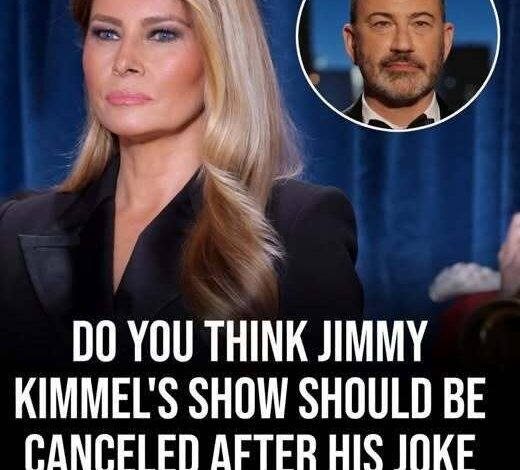
The dispute erupted after Jimmy Kimmel made a remark about Melania Trump during an episode of Jimmy Kimmel Live! that aired just days before the annual White House Correspondents’ Dinner. During the segment, Kimmel referred to the former first lady as an “expectant widow,” a comment he presented as political satire. Like many jokes made on late-night television, it was intended to provoke laughter through exaggeration and irony.
Instead, it ignited a firestorm.
Critics immediately condemned the remark, arguing that it went beyond ordinary political humor and ventured into territory they considered inappropriate and insensitive. Supporters of the joke countered that satire has long been a part of American political culture and that public figures have historically been targets of comedic criticism.
The debate was already gaining momentum when an unrelated but alarming event dramatically intensified public attention.
Just days later, panic erupted in Washington, D.C., during the highly anticipated White House Correspondents’ Dinner. Reports of gunfire near a security checkpoint triggered a rapid response from law enforcement and Secret Service agents. As confusion spread among attendees, security personnel moved quickly to protect Donald Trump and other high-profile guests.
For a brief period, uncertainty dominated the scene.
Attendees scrambled for information while authorities worked to secure the area and assess the threat. Although the situation was eventually brought under control, the incident heightened concerns about political violence and security in an already tense national environment.
In the aftermath, attention returned to Kimmel’s earlier comment.
Melania Trump responded forcefully, accusing the comedian of contributing to what she described as a dangerous political climate. She characterized the joke as hateful rhetoric and argued that remarks involving a spouse’s death—even when intended as comedy—help fuel hostility and deepen divisions within the country.
Her criticism resonated with many supporters who believed the joke crossed an ethical line.
For them, the issue was not simply about comedy but about timing and context. In an era marked by heightened political tensions and increasing security concerns, they argued that public figures should exercise greater caution when making comments that could be interpreted as references to harm.
Donald Trump echoed those concerns.
The former president criticized the segment and said the joke never should have been aired. He described it as another example of what he sees as persistent disrespect directed toward his family and supporters. Trump also suggested that the remark reflected a broader pattern in which political opponents and media personalities increasingly rely on personal attacks rather than substantive criticism.
His response further amplified the controversy.
Yet Kimmel remained unapologetic.
Addressing the backlash during a subsequent broadcast, the late-night host defended the joke and rejected suggestions that it encouraged violence or referenced physical harm. According to Kimmel, the comment was intended as a humorous observation about the age difference between Donald and Melania Trump, not as a prediction or wish for violence.
“It was a joke,” he insisted, arguing that critics were deliberately misinterpreting the intent behind the remark.
His defense immediately sparked another round of debate.
Supporters of Kimmel argued that satire is protected speech and that comedians should not be held responsible for every interpretation of a joke. They noted that political comedy has historically targeted presidents, first ladies, politicians, and public figures across the ideological spectrum. Restricting such commentary, they warned, could create a chilling effect on free expression and artistic freedom.
Others disagreed.
Critics argued that humor involving death, tragedy, or threats can take on a different meaning during periods of political instability. While acknowledging the importance of free speech, they maintained that comedians still bear responsibility for the messages their jokes send, particularly when directed at individuals facing heightened security concerns.
The disagreement reflects a broader cultural question that has become increasingly difficult to answer.
Where is the line between satire and irresponsibility?
For some, political comedy serves an essential democratic function, allowing public figures to be challenged, mocked, and scrutinized through humor. For others, certain topics should remain off-limits, especially when jokes touch on personal safety or family members.
The divide is unlikely to disappear anytime soon.
As reactions continue pouring in from both supporters and critics, the controversy has become about far more than a single joke. It now represents a larger debate over how Americans communicate during moments of heightened political tension and whether traditional standards of satire still apply in an age of constant outrage and instant reaction.
What makes the situation particularly revealing is how quickly multiple issues became intertwined.
A comedy segment evolved into a national argument about political discourse. A security scare intensified concerns about public rhetoric. Public figures, entertainers, and commentators found themselves debating not only the meaning of one joke but the broader responsibilities that come with having a powerful platform.
Meanwhile, the larger questions remain unresolved.
Can political satire remain sharp without becoming inflammatory? Should comedians be judged solely by their intent, or also by how their words are received? And in a deeply polarized society, is it still possible for humor to unite rather than divide?
Those questions now sit at the center of the controversy.
Whether one views Kimmel’s remark as harmless comedy or an example of rhetoric gone too far, the fierce reaction it generated reveals just how sensitive and fragmented the national conversation has become. Increasingly, entertainment, politics, media, and public safety are no longer separate arenas. They overlap, collide, and influence one another in ways that can be difficult to predict.
In the end, the dispute may be remembered less for the joke itself and more for what it exposed about the state of modern American discourse. A single line delivered during a late-night monologue became a flashpoint for debates about free expression, responsibility, and political hostility.
And as those debates continue, one thing is clear: the boundaries between comedy and controversy have never been more contested.