I Became a Mother at 17 – Years Later, My Son Took a DNA Test to Find His Father but Uncovered a Truth That Left Me Weak in the Knees

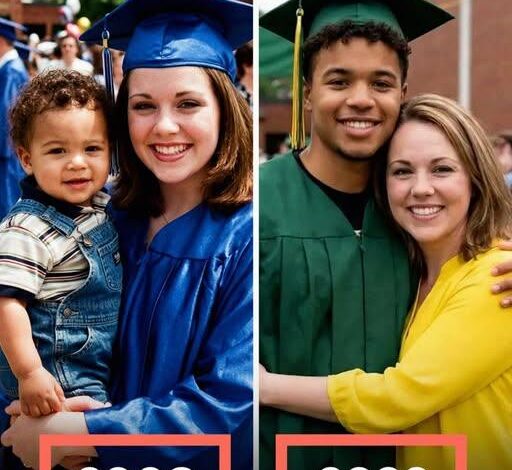
For most of my adult life, I believed I understood exactly how my first great love ended. I carried the story with me so long that it hardened into certainty: when things became difficult, he left. That belief shaped everything afterward — the way I raised my son, the walls I built around my heart, and the quiet ache I learned to live with whenever I thought about the boy I once imagined spending my entire life beside. Over time, I stopped searching for answers because unanswered questions eventually become part of survival.
Then, eighteen years later, the truth found me anyway.
It happened on what should have been one of the happiest days of my life. My son, Leo, had just graduated. I spent the afternoon in the kitchen frosting a cheap grocery store cake with shaky handwriting that read “CONGRATS, LEO!” while trying not to cry every few minutes. Watching your child reach adulthood does something strange to time. Suddenly you can see every version of them at once — the newborn you held against your chest, the toddler who followed you through grocery stores, the exhausted teenager studying late at night, and the young man standing on the edge of his own future.
I thought that day would only hold pride.
Then Leo walked into the kitchen looking like someone had knocked the air out of him.
The second he asked me to sit down, fear settled into my chest.
No parent hears those words casually.
At first, he struggled to explain. Finally he admitted he had taken a DNA test. Not because he was angry at me, not because he distrusted me, but because he wanted answers about the father he had never known. For years, all I could ever tell him was what I believed myself: that Andrew disappeared after I told him I was pregnant at seventeen.
One day he was there.
The next day he was gone.
No goodbye.
No explanation.
Just silence.
That silence shaped both our lives.
But according to the message Leo received after taking that test, silence was not the truth.
Through the results, he connected with a woman named Gwen — Andrew’s sister. Someone I barely remembered hearing about decades ago. When Leo showed me her message, my hands physically started shaking before I even finished reading it.
Andrew didn’t leave.
He was taken away.
According to Gwen, when Andrew learned I was pregnant, he panicked at first — but not because he wanted to run. He planned to stay. He told his family he loved me and intended to stand beside me no matter how hard things became.
But his mother made a different decision.
Without warning, she uprooted the entire family and moved them away almost immediately. Andrew was still a teenager himself, dependent on parents who controlled every part of his life. He wasn’t allowed to come back. Worse than that, he wasn’t even allowed to contact me properly.
And yet he tried anyway.
That was the part that shattered me completely.
For eighteen years, I believed I had been abandoned.
Meanwhile, he spent those same years trying to reach me.
He wrote letters.
Dozens of them.
Letters I never received because someone decided our story should end before we ever had the chance to write it ourselves.
That night, Leo and I drove to meet Gwen. My parents followed behind us in silence because by then this no longer felt like a private revelation. It felt like the reopening of an entire life.
When Gwen opened the door and saw us standing there, she burst into tears immediately.
Then she brought out the box.
An ordinary cardboard box.
Worn at the edges.
Far too small to contain eighteen years of grief.
Inside were letters stacked carefully in bundles. Some still sealed. Others folded soft with age. Birthday cards. Notes. Envelopes with my name written in Andrew’s unmistakable handwriting.
I sat on the floor and opened the first one with trembling hands.
“Heather, please don’t believe I left you. I’m trying to come back. I promise.”
I stopped breathing.
Every letter rewrote the past piece by piece.
Andrew wrote about me constantly. About the baby. About his fear of failing us. About working jobs, saving money, trying to figure out how to return once he became legally independent from his family. Some letters were hopeful. Others sounded desperate. All of them carried the same heartbreaking truth:
he never stopped loving us.
One letter said:
“If it’s a boy, I hope he laughs like you do when you’re really happy.”
Another read:
“If your mother ever tells you I loved her, believe it with your whole heart.”
I cried harder reading those words than I had in years because suddenly the story I built my identity around collapsed completely.
For so long, part of me quietly believed I wasn’t enough to stay for.
That belief lives deep inside people once it settles there. Even if life improves, even if you become stronger, some hidden part of you still carries the wound of feeling left behind.
And now I understood something devastating:
I had never been abandoned.
I had been separated.
There’s a difference between someone choosing to leave and someone being prevented from returning. That difference does not erase pain, but it changes the shape of it entirely.
Then Gwen told us the final truth.
Three years earlier, Andrew died in an accident.
He never got another chance.
Never found us.
Never met the son he spent eighteen years imagining.
That realization hollowed me out in a way I still struggle to describe. Grief arrived tangled with relief, anger, love, regret, and something almost unbearable to name:
vindication.
Because the man I mourned all these years wasn’t the man who truly existed.
The real Andrew fought for us quietly the only ways he knew how.
And my son — the boy who spent his life wondering whether his father wanted him — suddenly had proof that he was loved long before he was born.
That truth changed Leo visibly.
On the drive home, he sat silently holding the box of letters in his lap like something sacred. At one point he fell asleep clutching them against his chest, and I realized he looked peaceful in a way I had never seen before when conversations about his father came up.
For the first time in his life, he no longer carried a question mark where identity should have been.
Over the following weeks, we kept reading.
Slowly.
Carefully.
Some letters made us laugh unexpectedly. Andrew wrote terrible jokes. He complained constantly about his factory job. He worried about whether he’d be a good father. He described dreams where he taught Leo how to drive or embarrassed him at school events someday.
Ordinary dreams.
That’s what hurt most.
Not grand tragedy.
Not dramatic loss.
The ordinary life we never got to have.
Still, somewhere inside all that grief, healing began too.
Because truth — even painful truth — allows wounds to breathe differently. For years, silence forced us to invent our own explanations. And when people don’t know why they were left, they usually blame themselves.
Now we knew better.
Andrew’s absence was not proof of indifference.
It was proof of powerlessness.
That realization changed the way I saw my entire past.
I wasn’t the girl who got discarded when life became inconvenient.
I was loved by someone who never stopped trying to return.
And my son wasn’t forgotten.
He was imagined.
Written about.
Carried in someone’s heart across eighteen impossible years.
None of this gives us back what was lost.
It doesn’t restore birthdays, childhood memories, or the chance for father and son to meet face to face.
But it gave us something else instead:
peace.
Not perfect peace.
Not complete closure.
But enough truth to stop carrying the wrong story forever.
And maybe that’s the strangest thing about life: sometimes healing arrives not through forgetting the past, but through finally understanding it correctly.
Now, every few nights, Leo and I sit together opening another letter from the box.
Some make us cry.
Some make us smile.
But every single one reminds us of the same thing:
silence is not always abandonment.
Sometimes love exists even when circumstances bury it.
Sometimes people are kept apart by fear, control, and decisions made by others.
And sometimes the truth waits years — decades even — before finally finding its way home.
When it does, it doesn’t erase the pain.
But it can transform it into something gentler.
Something survivable.
Something that finally allows you to stop wondering whether you were ever truly loved at all.