The first time Daisy stopped wagging her tail, I knew something was wrong. Not because she looked sick at first — she still followed me from room to room, still rested her head against my knee every evening while I watched television, still waited patiently beside the front door every morning for our walks. But dogs speak through small changes long before words like “cancer” ever enter a room. And Daisy, who had spent eleven years greeting life with unstoppable joy, suddenly moved through the house more slowly, as if carrying something heavy nobody else could see.
At first I convinced myself it was age.
That’s what people do when they’re afraid.
We explain things gently because the truth feels unbearable.
“She’s just getting older,” I told my daughter Ellie one night after Daisy struggled climbing onto the couch.
Ellie frowned immediately.
“But she always jumps up there.”
“She’s tired, sweetheart.”
But I wasn’t convincing either of us.
A week later, Daisy stopped eating her favorite treats.
That terrified me more than anything.
This was a dog who once stole an entire birthday cake off the kitchen counter and somehow still looked innocent afterward. Food was Daisy’s religion. Seeing her turn away from peanut butter biscuits felt deeply unnatural, like watching sunlight suddenly refuse to rise.
The vet appointment was supposed to reassure us.
Instead, it split our lives into before and after.
I still remember the room vividly:
the sterile smell,
the soft hum of fluorescent lights,
Ellie sitting beside me clutching Daisy’s leash with both hands.
The veterinarian’s expression changed before he even spoke.
People think devastating news arrives dramatically, but often it enters quietly — through pauses, careful wording, and eyes that avoid yours for just a second too long.
“There’s a mass,” he said gently.
Everything after that blurred together.
Tests.
Scans.
Biopsies.
Specialists.
Then finally the word I had already begun fearing:
Cancer.
Ellie didn’t fully understand at first.
She was only eight.
“But dogs get better from sickness,” she whispered afterward in the parking lot.
I knelt beside her slowly.
“Sometimes,” I said carefully.
She looked at me with tears already filling her eyes.
“But Daisy always gets better.”
That sentence shattered something inside me.
Because children still believe love itself can protect the people they need most.
And maybe part of me still believed it too.
The months that followed became a strange combination of hope and heartbreak. Daisy started treatment almost immediately. Surgery removed part of the tumor, and chemotherapy followed afterward. Every week became structured around appointments, medications, side effects, and tiny victories people outside the situation would never understand.
A full bowl of food eaten.
A successful walk around the block.
One playful bark after days of silence.
Those moments became enormous.
Cancer changes entire households, even when the patient has four legs.
Ellie started sleeping beside Daisy every night on the living room floor because she worried the dog would feel lonely otherwise. She read books aloud to her after school. Wrapped blankets around her carefully. Told her stories about everything they would do together “when you’re better.”
Sometimes I’d stand in the hallway listening to Ellie whisper:
“You just have to stay, okay? Just stay.”
And honestly?
Daisy tried.
God, she tried.
Even during the worst treatment days, she still wagged her tail whenever Ellie entered the room. Still dragged herself toward the front door wanting walks she barely had strength for anymore. Still looked at us with complete trust despite everything hurting.
That’s the brutal thing about dogs.
They keep loving you through suffering without ever making you feel guilty for witnessing it.
One afternoon after chemo, Daisy collapsed briefly while trying to reach her water bowl. I rushed toward her in panic, but before I could even kneel down, Ellie got there first.
She wrapped both arms around Daisy’s neck and cried openly into her fur.
“You don’t have to be brave all the time,” she whispered.
I had to leave the room after that because I couldn’t breathe properly anymore.
Financially, things became difficult fast.
Cancer treatment for animals is brutally expensive, and I was already working two jobs after my divorce. There were nights I sat alone at the kitchen table staring at bills while trying to calculate how much time money could realistically buy us.
People said cruel things sometimes without meaning to.
“She’s just a dog.”
“You can’t bankrupt yourself.”
“Maybe it’s kinder to let go.”
But Daisy wasn’t “just a dog.”
She slept beside Ellie after nightmares.
Waited by windows when we came home late.
Licked tears off my face after the divorce when I thought nobody noticed me crying.
She had carried our family emotionally through some of the darkest years of our lives.
How do you place a price tag on that?
Then something unexpected happened.
Ellie’s teacher called me one afternoon asking if I could come to the school.
Immediately panic hit me.
Instead, when I arrived, I found the classroom covered in handmade drawings of Daisy.
Dozens of them.
Children holding signs saying:
“Stay Strong Daisy”
“We Love You”
“Dogs Beat Cancer Too”
Ellie stood near the front of the room holding a mason jar full of crumpled dollar bills.
“We raised money for Daisy’s treatments,” she said proudly.
I started crying immediately.
Not graceful tears.
Not polite ones.
The ugly kind that come from months of exhaustion finally breaking open.
Parents from school began helping after that.
Neighbors donated quietly.
A local pet bakery dropped off free meals.
Even the veterinary clinic reduced some treatment costs after hearing Daisy’s story.
And slowly, unbelievably, things began changing.
Daisy started eating normally again.
Her energy returned in small bursts at first.
The swelling decreased.
The scans improved.
Every appointment became slightly less terrifying.
Then came the morning everything changed completely.
The vet called while I was making breakfast.
For one horrible second, I assumed bad news automatically. My hands actually started shaking before I answered.
But the veterinarian sounded emotional immediately.
“The latest scans came back clear,” he said softly.
I stopped breathing.
“What?”
“No detectable cancer.”
The room blurred instantly.
Ellie looked up from the kitchen table confused while I covered my mouth trying not to collapse emotionally.
“She’s cancer free.”
Ellie screamed so loudly Daisy barked in surprise from the hallway.
Then we were all crying.
Laughing.
Holding each other on the kitchen floor while Daisy wagged her tail wildly like she understood every word somehow.
Maybe she did.
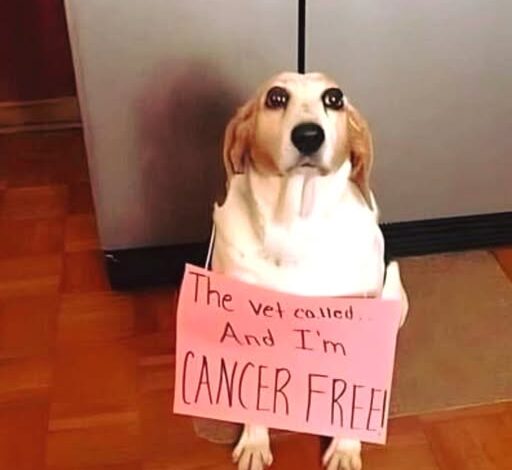
Later that afternoon, Ellie made the sign herself using pink construction paper and thick black marker:
“The vet called…
And I’m
CANCER FREE!”
We sat Daisy in front of the sign for a photo.
She looked slightly confused but proud anyway.
That picture spread online faster than we ever expected.
Thousands of strangers shared it.
Commented prayers.
Celebrated.
Told stories about their own pets surviving impossible odds.
But what people couldn’t see inside that photograph was everything hidden behind Daisy’s eyes:
the surgeries,
the fear,
the nights Ellie slept on hardwood floors beside her,
the bills,
the whispered prayers,
the moments we almost lost hope completely.
That image captured more than survival.
It captured endurance.
Years have passed since then.
Daisy moves slower now because age eventually catches even the strongest hearts. Her muzzle has turned white, and she sleeps more than she used to. But every morning she still waits outside Ellie’s bedroom door patiently until school starts.
Ellie is older too.
Teenagers are supposed to outgrow childhood attachments eventually.
She never outgrew Daisy.
Sometimes I catch her resting beside the old dog with homework spread across the floor while absentmindedly stroking her ears the same way she did during chemo treatments years earlier.
And every once in a while, when life feels especially overwhelming, I look back at that photo.
The sign.
The hopeful eyes.
The impossible relief captured in one frozen moment.
Because Daisy taught our family something profound during those terrible months:
hope is not pretending things aren’t painful.
Hope is loving something fully even when you’re terrified of losing it.
And sometimes, if you’re unbelievably lucky, love stays long enough for miracles to happen anyway.