I Constantly Used My Pocket Money to Buy Lunch for a Difficult Boy in My 3rd-Grade Class – The Package He Sent Me 30 Years Later Was Something I Never Expected in a Million Years

Three months ago, I thought I was about to become a widow.
Not eventually.
Not someday in the distant, abstract way people casually talk about mortality.
I mean truly lose him.
Suddenly.
Violently.
Without warning.
One ordinary Tuesday morning, my husband dropped a coffee mug in the kitchen, and our entire life split open.
The sound still lives inside me sometimes.
Ceramic exploding against tile.
Coffee spreading across the floor.
Mark gripping the edge of the counter so hard his knuckles turned white.
At first I thought maybe he was dizzy.
Then he tried to speak.
And the words came out wrong.
Not slurred exactly.
Broken.
His face drained of color so fast it terrified me more than anything else could have. Fear changes the atmosphere of a room instantly. One second you’re living normally, and the next your body understands danger before your mind fully catches up.
“Mark?”
He looked at me helplessly.
That look nearly destroyed me before the ambulance even arrived.
After that, life stopped moving normally.
Hospitals do that to time.
Days become fluorescent light and bad coffee and conversations spoken too quickly by exhausted people carrying clipboards. Everything important gets reduced to paperwork and percentages and phrases like “we caught it early” or “we’re monitoring the situation closely.”
The cardiologist explained that Mark had a structural defect in his heart. Rare. Serious. Dangerous.
They could stabilize him temporarily.
Fixing it was another matter entirely.
“We’ve referred his case to a specialist,” she explained carefully. “A cardiac reconstruction surgeon.”
For one brief moment, I felt hope.
Then came the financial meeting.
I still think hospitals should never schedule those conversations in rooms that cold.
The financial counselor sat across from me speaking gently while sliding papers across the table one by one. Procedure costs. ICU stays. Rehabilitation. Medication. Specialist fees.
Then finally she turned the estimate toward me.
$420,000.
I actually laughed.
Not because it was funny.
Because the human brain rejects certain numbers automatically when survival depends on disbelief.
“That can’t be right,” I whispered.
She looked at me with the exhausted sadness of someone who has watched this moment happen to too many families already.
“I’m sorry.”
Sorry.
As if apology could compete with half a million dollars.
I walked back to Mark’s hospital room afterward barely feeling my legs beneath me. Machines tracked his heartbeat steadily while he slept under thin blankets looking smaller somehow. Vulnerability changes people physically. It strips away the illusion that bodies are permanent things we fully control.
I sat beside him holding his hand trying not to fall apart.
“I’ll figure it out,” I whispered.
I had absolutely no idea how.
But love makes promises logic cannot support sometimes.
That night I drove home rehearsing impossible decisions in my head.
What could I sell?
What could I borrow?
How much of our life could I dismantle to buy him more time?
I barely noticed the package sitting on the porch initially.
Small.
Wrapped in brown paper.
No return address.
Ordinary.
Until I saw what it was wrapped inside.
An old paper lunch bag.
Not decorative.
Not vintage-style.
A real one.
Soft with age.
Folded carefully at the top.
The kind elementary schools used before everything became plastic and disposable.
I stared at it for several seconds before I noticed the name written across it.
Miles.
And beneath it—
my handwriting.
Not adult handwriting.
Child handwriting.
Uneven letters.
Too-large curves.
The exact way I used to write in third grade.
Suddenly my entire body went cold.
Because memory arrived all at once.
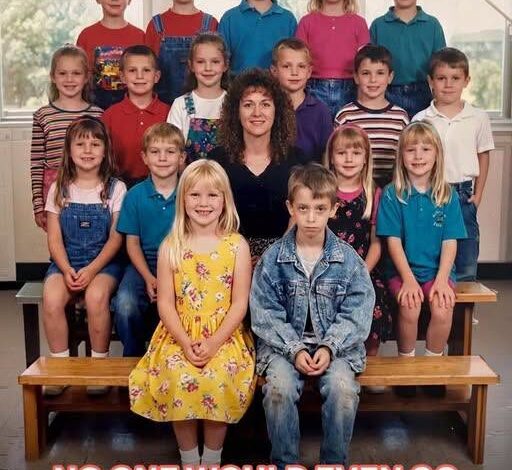
Miles sat near the back of Mrs. Donahue’s classroom in third grade. Quiet kid. Wore the same oversized jacket nearly every day. His shoes were too small, the front edges splitting slightly where his toes pushed against them.
He rarely spoke unless called on directly.
At lunch, he often had nothing.
One afternoon I saw him standing near the cafeteria trash cans staring at unfinished food kids had thrown away. Not touching it. Just looking.
That image stayed with me.
Children notice suffering differently than adults do sometimes. Adults rationalize discomfort away. Kids often see things plainly before they learn how to ignore them.
So I went home and lied to my mother.
I told her I’d been “extra hungry lately.”
She laughed and started giving me additional lunch money.
The next day, I bought two lunches.
I placed one on Miles’ desk before lunch period quietly.
“That’s yours,” he said immediately.
“Not today,” I answered.
It was a terrible lie.
But he accepted it.
After that, I kept doing it.
Not dramatically.
Not heroically.
I never told anyone.
Never thought of it as meaningful.
It was just something small I could do.
Sometimes he thanked me quietly.
Sometimes he looked too embarrassed to speak at all.
Then one day he disappeared.
No explanation.
No goodbye.
Just an empty desk where he used to sit.
And now, thirty years later, his name sat in my hands again.
My fingers shook carrying the package inside.
Inside was a hospital statement.
And a check.
At first I only stared at the statement because my brain refused to process what I was seeing.
PAID IN FULL.
I read it once.
Then again.
Then a third time.
The numbers never changed.
Then I unfolded the note beside it.
“You fed me when I was hungry. I hope you’ll forgive me for taking so long to return the favor.”
I sat down immediately because my knees physically stopped supporting me.
At the bottom:
Miles.
Cardiac Surgeon.
I genuinely thought I might faint.
The note explained everything slowly.
He had been one of the specialists reviewing Mark’s case. When he saw my name, something about it lingered in his memory. He didn’t act impulsively. He verified everything carefully first, professionally.
And once he knew for certain who I was—
he moved quietly.
He waived his own surgical fee.
Worked through the hospital foundation.
Contacted donors privately.
And when funding still fell short, he covered the remaining balance himself.
The check inside the package wasn’t even for the surgery.
It was for the invisible costs nobody warns families about:
gas,
food,
prescriptions,
lost wages,
parking,
survival.
In the memo line, he had written:
“Lunch money, with interest.”
That sentence shattered me completely.
Because suddenly I understood something devastating:
I had forgotten him.
But he had remembered me all these years.
I barely slept that night.
The next morning, I met him.
He looked nothing like the little boy from third grade anymore. Taller. Older. Sharper somehow. But the eyes were the same immediately.
Careful eyes.
Quiet eyes.
The kind belonging to people who learned early how quickly dignity can disappear.
“Hi,” he said softly.
And somehow that tiny word undid me faster than everything else already had.
We sat together for over an hour talking.
He told me his family moved constantly after his father left. Food insecurity became normal. School lunches sometimes represented the only guaranteed meal of the day.
“You made it feel normal,” he said quietly. “That mattered more than you probably realized.”
I asked him why he never mentioned any of this at the hospital.
His answer still stays with me.
“Because your husband needed a doctor,” he said. “Not someone trying to settle an emotional debt.”
That level of grace almost hurt to witness.
When I tried thanking him properly, he stopped me gently.
“There were days that lunch was the only real thing I ate,” he admitted quietly. “And you never made me feel ashamed for needing it.”
People talk constantly about life-changing moments as though they always arrive dramatically.
Sometimes they arrive in paper lunch bags.
Mark’s surgery happened the next morning.
Seven hours.
Seven endless, unbearable hours where every clock movement felt cruel. Families waiting in hospitals exist in a strange suspended reality where time stops belonging to the outside world entirely.
When Miles finally walked into the waiting room afterward, he looked exhausted.
But smiling.
“He’s okay,” he said simply.
I think part of me had prepared emotionally for loss already because relief felt almost impossible to process at first.
Like joy too large for my nervous system to hold.
But it was real.
Mark survived.
Recovery has been slow and messy and deeply human. He complains constantly now about dietary restrictions and medication schedules, which honestly feels miraculous after almost losing him.
A few weeks ago, Miles came over for dinner.
The three of us sat around our kitchen table eating pasta while somehow talking across thirty years of shared history that none of us fully understood yet.
At one point Mark grew quiet watching us.
After Miles left, he looked at me thoughtfully.
“You changed his life,” he said softly.
I thought about that for a long time.
About a little girl sliding an extra lunch tray across a desk without understanding what kindness might become once enough years passed around it.
About a boy who carried that small moment through hunger and hardship and eventually all the way into an operating room where he would one day save my husband’s life.
And finally I shook my head.
“No,” I whispered. “I think he gave mine back.”
I still don’t fully understand the scale of it emotionally.
How one small act survived decades.
How kindness traveled silently through time without either of us realizing it.
How the universe somehow carried that moment forward until the exact second we needed each other most.
But I know this now with absolute certainty:
kindness never disappears the way we think it does.
It settles somewhere deep inside people.
It becomes part of their survival.
Part of their memory.
Part of the way they move through the world afterward.
And sometimes—years later, after life has broken you open in ways you never expected—it returns quietly to your doorstep wrapped in an old paper lunch bag reminding you that even the smallest acts of compassion can echo farther than we will ever live to see.
:::