The call came in just after three o’clock on a stormy afternoon.
“Possible dog attack. Child in danger.”
Those words immediately grabbed Officer Daniel Harper’s attention.
After more than twenty years in law enforcement, he had responded to countless emergencies. He knew that situations involving children could escalate in seconds, and reports involving aggressive dogs demanded immediate action.
As rain tapped against the windshield of his patrol car, dispatch relayed additional information.
Several residents had called 911.
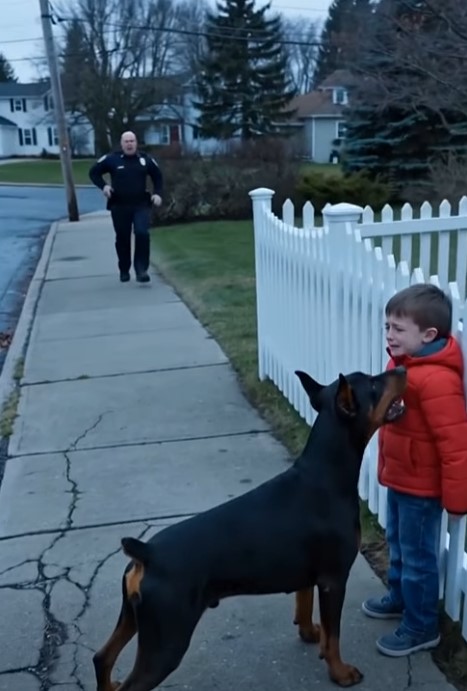
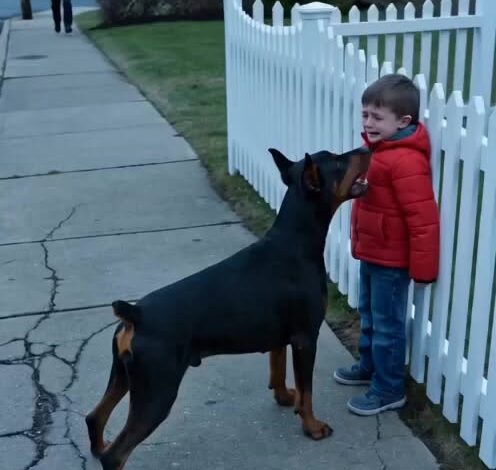
A large Doberman Pinscher had reportedly cornered a young child near a residential fence line. Witnesses described the dog as barking aggressively and refusing to leave the child alone.
To anyone listening, it sounded like a disaster waiting to happen.
Officer Harper activated his lights and headed toward the scene.
Every minute mattered.
As he turned onto the street, he could already see a small crowd gathered at a distance. Concerned neighbors stood beneath umbrellas, watching anxiously. Some pointed toward the far end of a yard.
That was where he saw them.
A young boy stood near a chain-link fence.
Only a few feet away was a large black-and-tan Doberman.
The dog barked loudly.
Again.
And again.
Its attention remained completely fixed on the child.
Officer Harper’s pulse quickened.
From where he stood, the situation looked exactly like the reports had described.
The child appeared frightened.
The Doberman seemed agitated.
And nobody was close enough to intervene safely.
Years of training immediately kicked in.
His first responsibility was clear: protect the child.
He stepped forward cautiously, preparing for whatever might happen next. Every movement was calculated. If the dog charged, he needed to react instantly.
The rain continued falling as tension filled the air.
Neighbors watched silently.
The child remained frozen.
The Doberman barked again.
Then something unexpected happened.
A loud metallic crash echoed nearby.
The sound was sudden and violent enough to make everyone turn.
Including Officer Harper.
For a split second, his attention shifted toward the source of the noise.
A pickup truck parked on a slight incline had begun rolling forward.
Slowly at first.
Then faster.
Its driver apparently hadn’t secured it properly before leaving.
The vehicle was now moving directly toward the area where the child stood.
Everything suddenly changed.
Officer Harper looked back toward the Doberman.
And what he saw completely overturned his understanding of the situation.
The dog wasn’t attacking.
It was trying desperately to move the child.
The Doberman lunged toward the boy—not with bared teeth or signs of aggression, but with urgency. It grabbed gently at the loose fabric of the child’s jacket and pulled backward.
The frightened child resisted.
Confused by the dog’s behavior, he fought against the tugging.
To an outside observer, it looked threatening.
But now the truth was impossible to ignore.
The dog had recognized the danger before anyone else.
While witnesses believed the animal was being aggressive, the Doberman had been trying to drag the child away from the path of the approaching vehicle.
“Move!” Harper shouted.
The officer sprinted forward.
At nearly the same moment, the Doberman made one final powerful pull.
The child stumbled backward several feet.
Just enough.
Seconds later, the unmanned pickup rolled through the exact spot where the boy had been standing.
Gasps erupted from the crowd.
The truck slammed into the fence with tremendous force, twisting metal and scattering debris across the wet ground.
For a moment, nobody spoke.
The realization spread through the crowd almost instantly.
What they had witnessed wasn’t aggression.
It was protection.
Officer Harper quickly reached the child, ensuring he was unharmed.
The boy was shaken but safe.
The Doberman stood nearby, breathing heavily but otherwise calm.
Its mission was complete.
As emergency personnel arrived to secure the scene, neighbors began discussing what had happened. Many admitted they had been convinced the dog was attacking.
Based on what they had seen, it seemed like the only logical explanation.
The barking.
The pulling.
The apparent refusal to leave the child alone.
Viewed from a distance, everything pointed toward danger.
Yet the reality had been entirely different.
The Doberman had seen the threat first.
Whether it noticed the vehicle moving, heard something unusual, or simply sensed danger through instinct, nobody could say with certainty.
What mattered was the result.
A child had been moved out of harm’s way.
And the dog had made that happen.
As details emerged, the community became fascinated by the story.
Animal behavior experts later explained that dogs are often far more aware of their surroundings than people realize. Their hearing can detect sounds humans miss entirely. Their senses are constantly gathering information about movement, changes in the environment, and potential threats.
Dogs also possess strong protective instincts, especially when they have developed bonds with children or family members.
Dobermans, in particular, are known for their intelligence and alertness.
Originally bred as working and protection dogs, they have long been respected for their courage, loyalty, and ability to react decisively under pressure.
While every dog is unique, many experts consider the breed exceptionally responsive in situations involving perceived danger.
For Officer Harper, the experience became one of the most memorable calls of his career.
He had arrived expecting to stop an attack.
Instead, he witnessed an act of heroism.
Later, he reflected on how easily the situation could have been misunderstood.
Had he relied solely on first impressions, the outcome might have been very different.
The experience reinforced a lesson every veteran officer understands: the first version of a story is not always the complete one.
Careful observation matters.
Patience matters.
Understanding the full situation matters.
The incident also sparked conversations throughout the community about how quickly assumptions can form.
Many witnesses admitted they would have reacted exactly the same way if they saw a barking Doberman pulling at a frightened child.
The scene looked alarming.
The conclusions seemed obvious.
Yet appearances had hidden the truth.
In reality, the dog had been doing everything possible to save the boy.
As weeks passed, the story spread beyond the neighborhood.
What began as reports of a dangerous animal transformed into a story of loyalty, courage, and instinct.
People praised the dog’s actions.
Children wanted to meet the heroic Doberman.
Neighbors who had once feared the animal now viewed it with admiration.
But perhaps the most important lesson remained simple.
Heroism does not always arrive in the form people expect.
Sometimes it wears a uniform.
Sometimes it comes from a quick-thinking stranger.
And sometimes it comes from a determined four-legged guardian barking desperately because nobody understands the danger it sees.
On that rainy afternoon, a veteran police officer responded to what seemed like a routine emergency call.
Instead, he witnessed something extraordinary.
A dog saw a threat before anyone else.
A child was saved.
And an entire community learned that courage can sometimes be mistaken for aggression—until the full story finally comes into view.