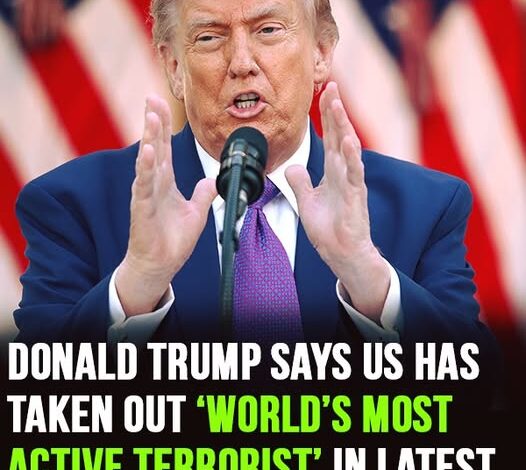
President Donald Trump’s announcement of a joint military operation between American and Nigerian forces immediately drew global attention, not only because of the target involved, but because of what the operation symbolized about the changing landscape of modern counterterrorism. According to official statements later echoed by major international news organizations, the mission targeted Abu-Bilal al-Minuki — also identified in some reports as Abu Bakr al-Mainuki — a senior ISIS-linked figure believed to have played a major operational role within extremist networks operating across West Africa and the Sahel region. Trump described the mission as a decisive success, praising the precision of the operation and the growing military coordination between the United States and Nigeria.
But beneath the headlines and political statements lies a far larger story — one involving decades of instability, the evolution of global terrorism, and a region increasingly becoming one of the world’s most dangerous battlegrounds.
The operation reportedly took place within the Lake Chad Basin region, an area stretching across parts of Nigeria, Niger, Chad, and Cameroon. To outsiders viewing maps from afar, it may appear like just another remote patch of territory. In reality, the region has become one of the most strategically important and difficult environments in modern counterterrorism operations.
The geography itself works against conventional military control.
Vast wetlands.
Remote villages.
Dense brush.
Porous borders.
Long stretches of territory with limited government presence.
These conditions have allowed extremist organizations to move across national boundaries with alarming speed, often disappearing into terrain where surveillance becomes difficult and local infrastructure remains weak. Military analysts have repeatedly warned that groups operating there thrive precisely because traditional state control is inconsistent.
For years, insurgent violence in the region has reshaped everyday life for millions of civilians.
Entire villages have been displaced.
Schools destroyed.
Roads abandoned after repeated attacks.
Communities forced into survival under constant fear of kidnappings, bombings, and armed raids.
The humanitarian consequences have been staggering. Families have spent years moving between temporary camps while aid organizations struggle to operate safely in areas where extremist violence remains unpredictable. In some regions, ordinary civilians have become trapped between insurgent groups, military campaigns, and collapsing local economies.
Against that backdrop, the rise of ISIS-affiliated organizations in Africa has become one of the most significant shifts in global terrorism over the past decade.
After ISIS lost much of its territorial control in Iraq and Syria, many analysts initially believed the organization had entered irreversible decline. Instead, the movement adapted. Rather than functioning primarily through centralized territory in the Middle East, ISIS increasingly expanded through affiliated regional branches across unstable areas of Africa and the Sahel.
Weak border enforcement, political instability, poverty, local conflicts, and limited state authority created opportunities extremist groups could exploit rapidly.
West Africa became one of the movement’s most active frontiers.
Groups linked to ISIS-West Africa Province and factions connected to Boko Haram intensified attacks across northeastern Nigeria and surrounding regions. These organizations targeted military outposts, villages, transportation routes, religious communities, and humanitarian operations. In many cases, they also sought to establish local influence through intimidation, forced recruitment, taxation systems, and propaganda campaigns aimed at vulnerable populations.
That broader context explains why the reported operation against Abu-Bilal al-Minuki carried such international significance.
According to official statements, the mission was not spontaneous. Reports indicated it followed months of intelligence gathering, surveillance, and tactical planning involving cooperation between U.S. intelligence assets and Nigerian military forces. Officials described the operation as “meticulously planned,” emphasizing the precision involved and the absence of injuries among participating American or Nigerian personnel.
Military experts note that operations targeting senior extremist leaders often serve multiple purposes simultaneously.
On the surface, they remove individuals directly involved in planning violence, coordinating attacks, managing logistics, or overseeing regional militant operations. But strategically, they also aim to disrupt communication networks, weaken morale within extremist organizations, interfere with recruitment systems, and fracture internal command structures.
High-ranking figures often function as more than symbolic leaders.
They coordinate financing.
Oversee weapons movement.
Manage alliances between factions.
Control propaganda narratives.
Direct cross-border operations.
Removing them can temporarily destabilize entire militant networks.
However, counterterrorism specialists consistently caution against oversimplifying such victories.
Eliminating one leader rarely ends an insurgency by itself.
Extremist organizations often adapt quickly after leadership losses, replacing commanders, shifting operational strategies, or increasing propaganda efforts in response to military pressure. In some cases, successful operations may even trigger retaliatory attacks designed to demonstrate continued strength.
That is why experts repeatedly emphasize that long-term counterterrorism success depends on more than military strikes alone.
Security operations can weaken immediate threats.
But sustainable stability requires broader structural solutions:
economic opportunity,
education,
local governance,
infrastructure,
community trust,
and regional cooperation.
Without those elements, extremist groups often continue finding fertile ground for recruitment.
The operation also highlights how Africa has become increasingly central to global security concerns.
In recent years, international intelligence agencies and military analysts have repeatedly warned that extremist violence in parts of Africa has expanded significantly while global attention often remained focused elsewhere. Reports from international organizations indicate that a substantial percentage of ISIS-related attacks worldwide now occur across African regions, particularly within the Sahel and West Africa.
This shift has forced countries like the United States to rethink counterterrorism priorities.
Rather than concentrating solely on the Middle East, intelligence cooperation, surveillance partnerships, military training programs, and regional security initiatives have expanded across multiple African nations. Nigeria, in particular, has become a critical partner because of both its regional influence and its long-standing struggle against extremist violence.
For more than a decade, Nigeria has faced ongoing insurgencies in its northeastern territories. Military campaigns against Boko Haram and ISIS-affiliated factions have achieved periodic successes, but the conflict remains deeply complex due to geography, governance challenges, economic instability, and the adaptability of militant groups.
The human cost has been enormous.
Thousands killed.
Millions displaced.
Entire communities destabilized for years.
In that context, joint operations like the one announced by Trump represent not only military action but also political messaging. They signal strengthened alliances, expanded intelligence-sharing, and growing international commitment to confronting extremist threats before they spread further.
Public reaction to the announcement reflected the complexity of modern counterterrorism itself.
Supporters viewed the mission as evidence that coordinated international pressure can successfully target dangerous extremist leaders. Others questioned the long-term effectiveness of military operations without broader regional reforms. Online discussions quickly became filled with speculation, political arguments, and competing interpretations — some grounded in verified reporting, others shaped more by ideology or misinformation.
That reaction reflects another reality of modern warfare:
military operations no longer unfold solely on battlefields.
They unfold simultaneously across media networks, political narratives, and digital platforms where information competes constantly with speculation.
Even successful operations become part of larger debates involving foreign policy, military intervention, sovereignty, and global security priorities.
Still, regardless of political interpretation, one reality remains difficult to ignore:
the expansion of extremist violence across parts of Africa represents one of the defining security challenges of the modern era.
And operations like this demonstrate how interconnected that challenge has become internationally.
What happens in remote stretches of the Lake Chad Basin no longer remains isolated from global politics, intelligence networks, or international security planning. Militancy, recruitment systems, arms trafficking, and ideological propaganda now move across borders with unprecedented speed, forcing nations into increasingly cooperative approaches toward security.
Yet perhaps the most important lesson hidden beneath headlines about military success is also the simplest:
counterterrorism is rarely about one operation, one leader, or one moment.
It is a long, difficult struggle shaped not only by military force, but by stability, governance, opportunity, and the ability of communities to resist fear and extremism over time.
The reported operation against Abu-Bilal al-Minuki may weaken one branch of an extremist network temporarily.
But the broader challenge facing the region — and the world — remains ongoing.
And that reality ensures the story does not end with one successful mission beneath the dark skies of the Lake Chad Basin, but continues as part of a much larger fight over security, stability, and the future of entire regions shaped by conflict for far too long.