Most traffic jams begin with frustration.
This one began with a man standing on the edge of a bridge.
Drivers on Interstate 696 near Huntington Woods, Michigan, had no idea why traffic suddenly slowed to a crawl that afternoon. Brake lights stretched across the highway like a red ribbon. Engines idled. People glanced at their phones, checked navigation apps, and wondered what accident or construction project had brought everything to a standstill.
Minutes passed.
Then more minutes.
Soon, traffic stopped completely.
What none of those motorists could see was the heartbreaking crisis unfolding above them.
On an overpass overlooking the interstate, a man stood dangerously close to the edge. He was in severe emotional distress and contemplating ending his life.
Far below, thousands of people sat trapped in traffic.
Above, a battle for a human life had begun.
Michigan State Police officers arrived quickly after receiving emergency reports. Among them was Trooper Michael Shaw, a veteran officer who immediately recognized the seriousness of the situation.
These calls are unlike most emergencies.
There is no visible fire to extinguish.
No suspect to chase.
No simple solution.
Instead, every decision must balance urgency with patience, because one wrong move can change everything.
Negotiators were called to the scene and began speaking with the man. Their goal was simple in theory but incredibly difficult in practice: build trust, establish connection, and give him a reason to step away from the ledge.
But time was passing.
And the danger remained.
The overpass stood high above the interstate. A fall from that height would likely be fatal.
As Shaw surveyed the scene, a troubling reality became clear. Negotiators might need hours to earn the man’s trust. There was no guarantee how long the conversation would take.
Then an idea came to him.
It was unconventional.
Complicated.
But it could save a life.
If officers couldn’t immediately bring the man down, perhaps they could reduce the consequences if the worst happened.
Shaw contacted traffic personnel and began organizing a detour to prevent more vehicles from entering the already congested area. Then he turned his attention to a resource already scattered throughout the traffic backup.
Truck drivers.
Massive semi-trucks filled portions of the interstate below the bridge.
What if those trucks could be used as a protective barrier?
Shaw began reaching out.
Would they help?
Would they be willing to reposition their vehicles beneath the overpass?
Would they stop their workday for a stranger they had never met?
The answer came quickly.
Yes.
One by one, truck drivers volunteered.
Some were hauling freight across state lines.
Some were making local deliveries.
Others were simply trying to finish a routine shift before heading home to their families.
None of them knew the man on the bridge.
Yet none of them hesitated.
Under police direction, the drivers carefully maneuvered their enormous vehicles into position. It wasn’t easy. Coordinating multiple tractor-trailers on a blocked interstate required precision and cooperation.
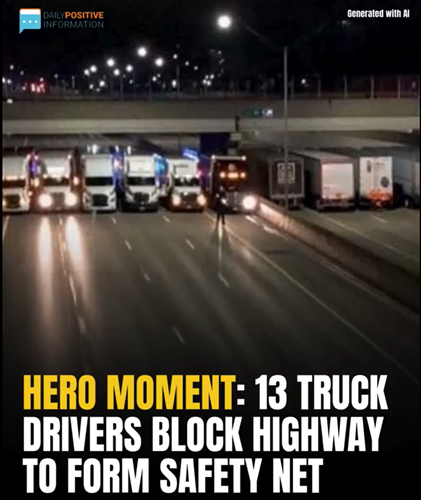
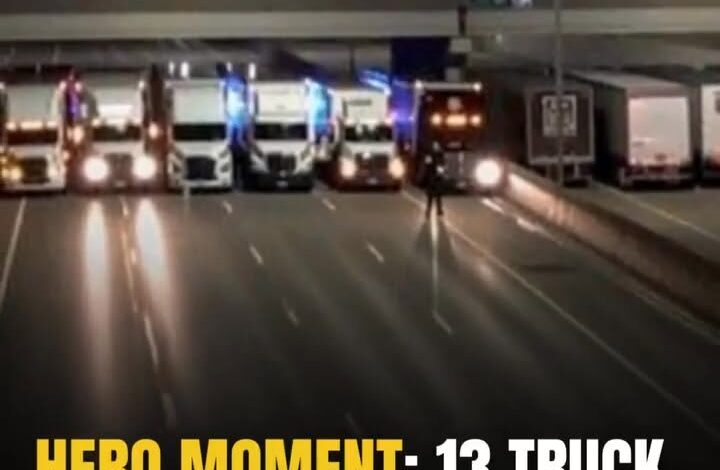
Slowly, the trucks formed a tight row directly beneath the overpass.
From above, the trailers looked almost like giant pieces of a puzzle fitting together.
Each driver understood what they were doing.
They were creating a safety net.
The engines were turned off.
Emergency lights flashed.
And then everyone waited.
Hours passed.
Above the highway, negotiators continued their conversation.
There were no dramatic speeches.
No magical words.
Just patient, steady communication.
They listened.
They reassured.
They encouraged.
Mental health crises rarely have simple solutions. The pain that brings someone to such a moment is often built over months or years, hidden beneath everyday appearances.
The negotiators understood that.
Their job wasn’t to argue.
It was to connect.
Meanwhile, below the bridge, thirteen truck drivers remained exactly where they were.
Deliveries were delayed.
Schedules were disrupted.
Phone calls had to be made.
Customers waited.
Yet not one of the drivers left.
The longer they stayed, the more powerful their presence became.
Each truck represented a choice.
A choice to help.
A choice to care.
A choice to sacrifice convenience for compassion.
As word spread through the traffic backup, many motorists began learning why the highway had been closed.
Frustration faded.
Concern replaced it.
People who had spent the first hour wondering about delays now found themselves silently hoping for a positive outcome.
The interstate had transformed into something unusual.
Instead of thousands of strangers rushing past one another, it had become a community united by a single purpose.
Save a life.
Four hours passed.
The sun slowly shifted across the sky.
The tension remained.
No one knew how the story would end.
Then, finally, something changed.
The man took a step backward.
Negotiators continued speaking calmly.
Another step.
Then another.
Slowly, carefully, he moved away from the edge.
Relief spread through the officers on scene.
The negotiators maintained their focus until responders could safely approach him.
Moments later, he was secured and escorted away from the bridge.
Alive.
The crisis was over.
The outcome everyone had hoped for had finally arrived.
Below, the thirteen truck drivers had succeeded in something remarkable.
They never had to use the safety barrier they created.
And that was the best possible result.
The trucks remained parked for a short time as officers completed their work.
Then traffic slowly resumed.
Engines restarted.
Drivers returned to their routes.
The interstate gradually returned to normal.
But the story was far from over.
News helicopters captured images of the trucks lined up beneath the bridge.
Photographs spread rapidly across television broadcasts and social media platforms.
Millions of people saw the striking image.
A row of massive trailers positioned side by side beneath a man in crisis.
The picture resonated far beyond Michigan.
It wasn’t simply a rescue story.
It was a reminder of what people are capable of when they choose compassion over indifference.
Trooper Michael Shaw received widespread recognition for his quick thinking and leadership.
Yet he repeatedly emphasized that the rescue belonged to everyone involved.
The negotiators who spent hours building trust.
The officers who secured the scene.
The traffic personnel who coordinated road closures.
And the truck drivers who immediately answered a call for help.
Without any one of those pieces, the outcome might have been very different.
The incident also sparked important conversations about mental health.
Many people struggle silently with depression, anxiety, trauma, and emotional pain. Often, those closest to them may never realize the depth of their suffering.
The rescue served as a reminder that reaching out for help matters.
Listening matters.
Compassion matters.
Most importantly, it showed that a single moment of crisis does not have to define an entire life.
For the man on the bridge, that day became the beginning of another chance.
A chance for treatment.
A chance for healing.
A chance for a future.
For the truck drivers, it became a day they would likely never forget.
They started their morning expecting an ordinary shift.
Instead, they became part of a life-saving effort that inspired millions.
And for everyone who heard the story, it offered something increasingly valuable in a world often dominated by bad news.
Hope.
Because sometimes humanity reveals itself in unexpected ways.
Sometimes it appears in the calm voice of a negotiator refusing to give up.
Sometimes it appears in an officer willing to think creatively under pressure.
And sometimes it appears in thirteen strangers parking their trucks side by side beneath a bridge because someone’s life depends on it.
That afternoon on Interstate 696, a busy highway became something far more important than a road.
It became proof that even in someone’s darkest moment, complete strangers can come together and create a path back toward the light.