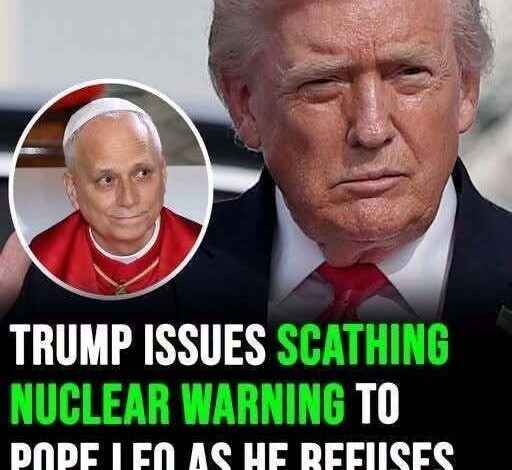
The disagreement was brief.
The implications were not.
When President Donald Trump publicly challenged Pope Leo’s calls for diplomacy regarding Iran, the exchange immediately captured international attention. It was more than a clash of opinions between two influential figures. It became a rare public collision between two fundamentally different visions of how the world should confront danger.
On one side stood a political leader arguing that strength and deterrence remain the most reliable safeguards against emerging threats.
On the other stood a spiritual leader warning that the pursuit of security through confrontation can sometimes create the very dangers it seeks to prevent.
The debate quickly expanded beyond Iran.
It became a conversation about power, peace, and the future of global stability itself.
The controversy began when Trump criticized remarks made by Pope Leo regarding escalating tensions in the Middle East. The Pope had urged restraint, dialogue, and renewed diplomatic efforts, warning that military escalation could carry devastating consequences not only for the region but for the wider world.
Trump viewed those comments differently.
He argued that excessive emphasis on diplomacy risks sending the wrong message to governments pursuing dangerous ambitions. In his view, maintaining a firm posture toward Iran remains essential to preventing future threats and preserving international security.
Supporters of the President saw his position as realistic.
They argued that history has repeatedly shown that adversaries are more likely to be restrained by strength than by goodwill alone. To them, deterrence is not an obstacle to peace—it is what makes peace possible.
Without credible consequences, they argue, diplomacy can become little more than wishful thinking.
But Pope Leo approached the issue from a very different perspective.
Speaking before worshippers during a visit to Africa, he returned to a message that has become a defining theme of his papacy.
Peace cannot be built solely through military power.
Nations, he argued, should invest more in people than in weapons. Resources devoted to conflict should instead be directed toward development, education, healthcare, and the reduction of human suffering.
His warning was not aimed at one nation alone.
It was aimed at a world increasingly shaped by military competition, geopolitical rivalry, and growing fears of wider conflict.
“No society becomes truly safer by moving closer to war,” he suggested through his remarks.
That message resonated with many who fear the consequences of continued escalation.
For decades, the Vatican has maintained a remarkably consistent position on these issues. Successive popes have spoken against the spread of nuclear weapons, urged diplomatic solutions to international disputes, and called on world leaders to prioritize human dignity over military confrontation.
The Church’s stance is rooted not in political ideology but in moral principle.
Its leaders have repeatedly argued that even justified military actions carry enormous human costs, particularly for civilians who often bear the greatest burden of war.
Pope Leo’s comments therefore fit within a long tradition of Vatican diplomacy.
Yet in today’s political climate, even calls for peace can become controversial.
Critics accused the Pope of underestimating the dangers posed by hostile governments and militant actors. Some argued that diplomacy without pressure can embolden adversaries rather than restrain them.
Others countered that dismissing diplomacy altogether risks creating a cycle of confrontation with no clear exit.
The result is a debate that extends far beyond the immediate dispute.
At its heart lies one of humanity’s oldest and most difficult questions:
How do nations create security without creating more insecurity?
The answer has never been simple.
History offers examples supporting both perspectives.
Military strength has sometimes prevented conflict by discouraging aggression.
At other times, escalating displays of force have helped push rival nations toward war.
Likewise, diplomacy has produced remarkable breakthroughs in some eras while failing disastrously in others.
The challenge is determining which approach best fits the dangers of the present moment.
That is what makes the disagreement between Trump and Pope Leo so significant.
It reflects a larger struggle taking place across the international community.
Governments increasingly face a world marked by uncertainty.
Regional conflicts continue to erupt.
Nuclear concerns remain unresolved.
Strategic rivalries are intensifying.
Technological advancements have created new forms of warfare and new sources of instability.
In such an environment, leaders often find themselves pulled between competing instincts.
One instinct favors caution through strength.
The other favors stability through dialogue.
Neither side views itself as opposing peace.
In fact, both claim the same ultimate goal.
That may be the most fascinating aspect of the debate.
Despite their disagreement, Trump and Pope Leo are not arguing about whether peace matters.
They are arguing about how peace is best protected.
For Trump and his supporters, peace is secured when potential adversaries understand that aggression carries serious consequences.
For Pope Leo and many of his supporters, peace is secured when nations invest in cooperation, communication, and the prevention of conflict before violence begins.
The destination is similar.
The path is dramatically different.
That distinction helps explain why the exchange generated so much attention around the world.
It touched on fears that millions of people already share.
Fear of war.
Fear of instability.
Fear of miscalculation between powerful nations.
At a time when international tensions remain elevated, every disagreement among influential leaders attracts scrutiny.
Every statement is examined.
Every message is interpreted.
Every difference in approach becomes part of a larger conversation about what comes next.
For ordinary citizens watching from afar, the debate feels intensely personal despite its geopolitical scale.
Because behind every discussion about deterrence, diplomacy, military readiness, or international strategy lies a human reality.
Wars are ultimately fought by people.
Conflicts reshape families, communities, and entire generations.
The consequences extend far beyond political speeches and diplomatic meetings.
That is why discussions like this matter.
They force societies to confront difficult questions before crises become catastrophes.
Questions with no easy answers.
Questions that have challenged leaders throughout history.
Can strength prevent conflict?
Can dialogue overcome hostility?
Can nations protect themselves without fueling greater tensions?
Can peace be preserved without preparing for war?
These questions remain unresolved.
And they likely will remain unresolved long after this particular disagreement fades from the headlines.
For now, both the White House and the Vatican continue to defend their positions.
Neither side appears likely to change course.
Yet beneath the political disagreement lies a shared aspiration.
Both claim to seek a safer world.
Both claim to want stability.
Both claim to hope for peace.
The challenge is that peace often looks different depending on where one stands.
And that reality may explain why the conversation continues to resonate so strongly.
Because the debate is not simply about Iran.
It is not simply about one president or one pope.
It is about the enduring struggle between power and persuasion, deterrence and diplomacy, force and dialogue.
A struggle that has shaped world affairs for centuries.
And one that remains as relevant today as ever.
As global tensions continue to evolve, the world will keep watching—not only to see who is right, but to see which vision of security proves capable of delivering the future both sides say they want.
A future where peace is more than an aspiration.
A future where it becomes reality.